

Philosopher · Classical antiquity · Classical Athens · Greece
Epicurus
341–270 BC
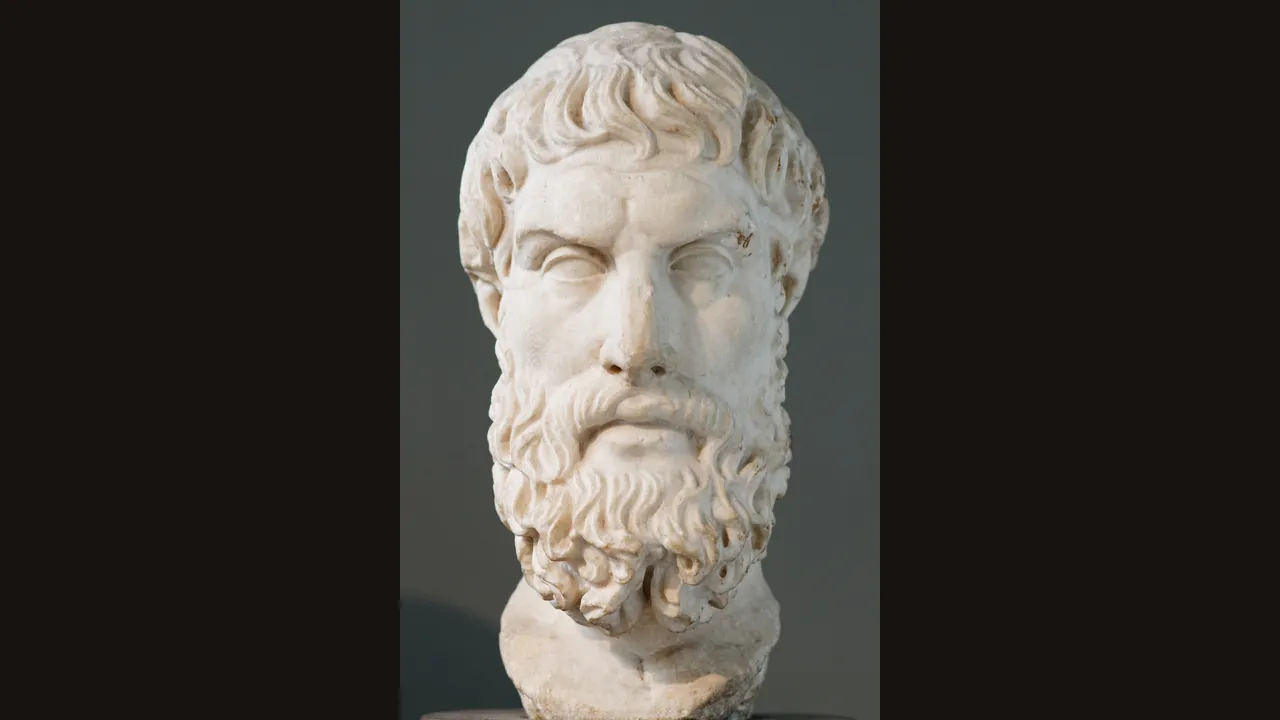
Greek philosopher born on Samos who founded the Garden school at Athens in 306 BC. He taught that pleasure, understood as the absence of pain and disturbance, is the goal of life. He lived 341 to 270 BC, and his school lasted centuries.
Epicurus was born on Samos in 341 BC to Athenian settler parents and died at Athens in 270 BC. He taught first at Mytilene and Lampsacus, then in 306 BC settled at Athens and founded his school, the Garden, named for the ground where it met. The community lived simply and admitted women and slaves as members. Epicurus wrote a great deal, including a work On Nature in thirty seven books. Nearly all of it is lost.
What survives is three letters and forty short statements, the Principal Doctrines, preserved by Diogenes Laertius. The physics takes atoms and void from Democritus, with one change: atoms sometimes swerve without cause, which breaks the chain of necessity and leaves room for free action. The gods exist, he taught, in the spaces between worlds, and they neither rule the world nor answer prayers. The soul is made of fine atoms and scatters at death, so death is nothing to us: where we are, death is not, and where death is, we are not. The goal of life is pleasure understood as absence of pain in the body and trouble in the mind, reached by limiting wants to what is natural and necessary and by living among friends.
His school held the Garden at Athens for centuries after his death, and Lucretius later put the system into Latin verse, which carried the teaching, and its debt to Democritus, to readers far beyond Greece.
Facts
- Born
- 341 BC, Samos, Greece.
- Source: Encyclopaedia Britannica, Epicurus
- Died
- 270 BC, Athens.
- Source: Encyclopaedia Britannica, Epicurus
- School
- Epicureanism, taught in the Garden at Athens.
- Source: Encyclopaedia Britannica, Epicurus
- Known for
- Atomist physics taken from Democritus, and an ethics of measured pleasure. Lucretius carried the doctrine to Rome in verse.
- Source: Encyclopaedia Britannica, Epicurus
Sources
- Encyclopaedia Britannica, Epicurus Source
Source links accessed 22 November 2026.
Images
Related
- GreeceConnected
- DemocritusConnected
- Zeno of CitiumSame civilization
- RepublicSame civilization
- AristotleSame civilization
- PlatoSame civilization
What happened elsewhere
Pairings are by recorded year, not exact simultaneity.
- Mauryan EmpireWhile Epicurus (around 322 BC)
- ZhuangziWhile Epicurus (around 369 BC)
- MenciusWhile Epicurus (around 372 BC)
- XunziWhile Epicurus (around 310 BC)
- Han FeiziWhile Epicurus (around 280 BC)
Meanwhile
Meanwhile, around the world — drag to spin, click a pulsing marker.
Keep reading
Test yourself
When was Epicurus born?
- 341 BC, Samos, Greece
- About 334 BC, Citium, Cyprus
- About 460 BC, Abdera, Greece
- 106 BC, Arpinum, Italy
Answer
341 BC, Samos, Greece — Born: 341 BC, Samos, Greece.
When did Epicurus die?
- 270 BC, Athens
- About 135, Nicopolis, Greece
- About 262 BC, Athens
- 270, in Campania, Italy
Answer
270 BC, Athens — Died: 270 BC, Athens.
What is Epicurus known for?
- Atomist physics taken from Democritus, and an ethics of measured pleasure. Lucretius carried the doctrine to Rome in verse
- The doctrine of the One, from which Intellect and Soul overflow, and the soul's return by contemplation
- The Meditations, twelve books of self examination, and the last of the Five Good Emperors
- Living in a tub, carrying a lantern in daylight looking for an honest man, and telling Alexander to stand out of his sunlight. The stories are later, not records
Answer
Atomist physics taken from Democritus, and an ethics of measured pleasure. Lucretius carried the doctrine to Rome in verse — Known for: Atomist physics taken from Democritus, and an ethics of measured pleasure. Lucretius carried the doctrine to Rome in verse.
Which school of thought was Epicurus part of?
- Epicureanism, taught in the Garden at Athens
- Pyrrhonist skepticism
- Academic skepticism, with Stoic leanings in ethics
- Stoicism, named for the Stoa Poikile where he taught
Answer
Epicureanism, taught in the Garden at Athens — School: Epicureanism, taught in the Garden at Athens.
True or false: Greek philosopher born on Samos who founded the Garden school at Athens in 306 BC.
- True
- False
Answer
True — True. Greek philosopher born on Samos who founded the Garden school at Athens in 306 BC.
My notes
Highlights on this page
None yet.
Spotted an error on this page? Email [email protected] and it will be checked against the sources.