

Philosopher · Classical Greece · Classical Athens · Greece
Plato
c. 428–c. 348 BC
Athenian philosopher, student of Socrates, teacher of Aristotle, author of the Republic and of the dialogues that carry most of what is known of Socrates.
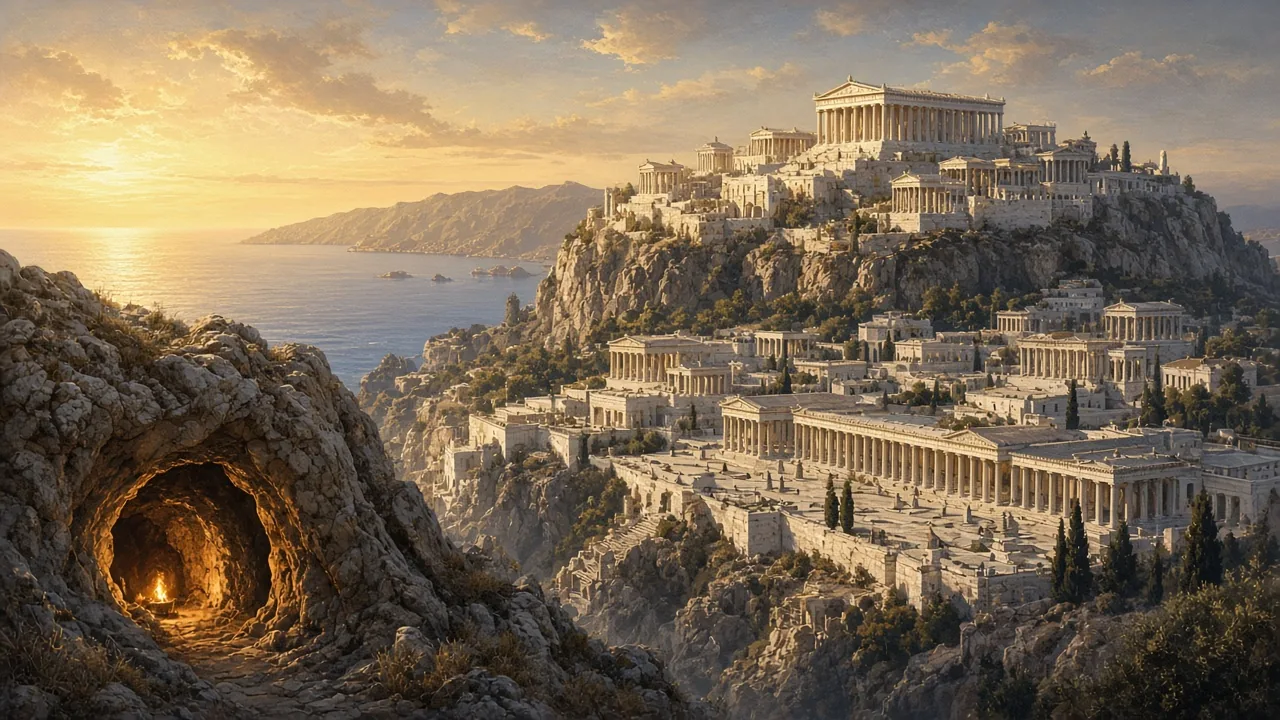
Plato's city is an earlier, hierarchical political model, not modern socialism. It is governed by an elite claiming supreme knowledge of the Good.
In the Republic, Plato constructs an ideal city (Kallipolis) governed by philosopher-kings. Their authority rests on claims of philosophical insight rather than democratic consent, with the text asserting that human suffering will not cease until philosophers hold sovereign power or sovereigns become genuine philosophers ([473c]). To maintain their integrity, the ruling guardian class lives under a system of communal ownership. They are barred from private property, individual land ownership, and personal wealth, eating in shared messes and living in conditions likened to a military camp ([416d–417a]). In its most radical form, this arrangement extends to communal arrangements regarding spouses and children ([457c–d]). Plato explicitly warns that if guardians acquire private lands, homes, or money, they will inevitably transform from protective allies into self-interested tyrants ([417a–b]). Aristotle later critiqued this communal structure in the Politics, observing that property shared among the greatest number of people receives the least overall care ([1261b]).
To stabilize this political order, Plato introduces the "noble lie" (gennaion pseudos), also known as the myth of the metals ([414c–415d]). According to this state-sanctioned myth, citizens are instructed that they share a common earthly origin, yet God has mixed gold into the souls of the rulers, silver into the military auxiliaries, and bronze or iron into the farmers and artisans. The myth includes a warning that the state faces destruction should a bronze or iron individual assume the role of guardian. In The Open Society and Its Enemies (1945), philosopher Karl Popper identified the noble lie as an early precursor to modern ideological statecraft, arguing that Plato's closed society relies on manufactured myth to enforce a rigid social hierarchy.
This governance structure is reinforced by the Allegory of the Cave ([514a–517a]). In this framework, humanity resembles prisoners chained inside a cave, interpreting shadows on a wall as ultimate reality. The philosopher who escapes to the surface beholds true knowledge and must subsequently be compelled to return to the cave to govern ([520a–e]). Plato notes the paradox that the most stable state is governed by rulers least eager to hold power, whereas states led by those who actively seek office suffer from instability.
Plato attempted to apply these theoretical principles directly to politics through his interactions with the rulers of Syracuse. Travelling to Sicily on three occasions (around 388, 367, and 361 BCE), he sought to mentor Dionysius I and Dionysius II alongside his associate Dion, attempting to mold them into philosopher-kings. These efforts ultimately dissolved into political instability, imprisonment, and internal conflict, forcing Plato to flee Syracuse.
This shows the risks built into any city planned from the top down. When political frameworks require mandatory communal structures for leaders, state-directed mythmaking, and compulsory rule by an enlightened elite, they establish a structural pattern that has recurred throughout political history under various names.
Sources
Primary sources
- Philosopher-kings (473d), the noble lie (414c–415d), the guardians' common property (416d–417a) and families (457c–d), the cave (514a–517a) and the compelled return (520a–e) Plato, Republic (c. 375 BC).
- Critique of the communal arrangements: what is common to the greatest number receives the least care (1261b) Aristotle, Politics, Book 2 (4th century BC).
Secondary sources
- The noble lie and Plato's closed society as a precursor of modern ideological statecraft Karl R. Popper, The Open Society and Its Enemies, Vol. 1: The Spell of Plato (1945).
Watch
Plato: The Allegory of the Cave
Stories & Myths · 2026-10-21
Plato's Allegory of the Cave, from Book VII of the Republic, told in full. Prisoners chained in a cave take the shadows on a wall for the whole of reality, until one of them is freed, is dragged up into the light, and learns to see things as they are.
The narration is the allegory itself, word for word, spoken by two voices, the storyteller and the listener. The film runs six minutes and thirty nine seconds. It belongs with the essay Plato's ideal city, printed on the Plato page, where the cave is the picture behind the city the Republic builds.
Facts
- Life
- About 428 to about 348 BC. Dates are traditional, not from a birth record.
- Source: Encyclopaedia Britannica, Plato
- School
- Founded the Academy at Athens, about 387 BC.
- Source: Encyclopaedia Britannica, Plato
- Major work
- Republic, on the just city and the just soul. A dialogue, not a constitution he enacted.
- Source: Plato, Republic
Sources
- Plato, Republic
- Encyclopaedia Britannica, Plato Source
Source links accessed 22 November 2026.
Images

Related
- SocratesConnected
- AristotleConnected
- RepublicConnected
- Classical AthensConnected
- Classical GreeceConnected
- HypatiaConnected
What happened elsewhere
Pairings are by recorded year, not exact simultaneity.
- Diogenes of SinopeWhile Plato (around 404 BC)
- MoziWhile Plato (around 470 BC)
- MenciusWhile Plato (around 372 BC)
- ZhuangziWhile Plato (around 369 BC)
Meanwhile
Meanwhile, around the world — drag to spin, click a pulsing marker.
Keep reading
Articles

My notes
Highlights on this page
None yet.
Spotted an error on this page? Email [email protected] and it will be checked against the sources.