

Era · Classical Greece · Greece
Classical Greece
5th–4th century BC
Classical Greece covers roughly the fifth and fourth centuries BC. The period opens with the Persian Wars. Xerxes invaded Greece in 480 BC, and Greek forces defeated his fleet at Salamis and his army at Plataea in 479. Athens led the Delian League, moved its treasury to Athens in 454 BC, and turned the league into an empire. Sparta led the opposing Peloponnesian League. Athens ran a direct democracy of male citizens, built the Parthenon between 447 and 432 BC, and supported the dramatists and historians whose works survive.
Athens and Sparta fought the Peloponnesian War from 431 to 404 BC. Athens lost its fleet at Aegospotami in 405, surrendered in 404, and had its walls pulled down and a government of thirty men imposed on it. In the fourth century the Greek states fought shifting wars among themselves, Sparta, then Thebes, then Athens holding the lead in turn. Greek colonisation ran from Spain and southern France to the Black Sea, and war and emigration moved Greeks across the eastern Mediterranean as soldiers, settlers, and exiles.
Macedon ended the independence of the city-states. Philip II defeated Athens and Thebes at Chaeronea in 338 BC, and his son Alexander conquered the Persian Empire between 334 and 323 BC. Alexander's death in 323 BC is the usual end point, and Greek rule after it took the form of kingdoms.
Watch
The Sack of Athens and the Themistoclean Wall, 480–478 BC
Events · 2026-10-10
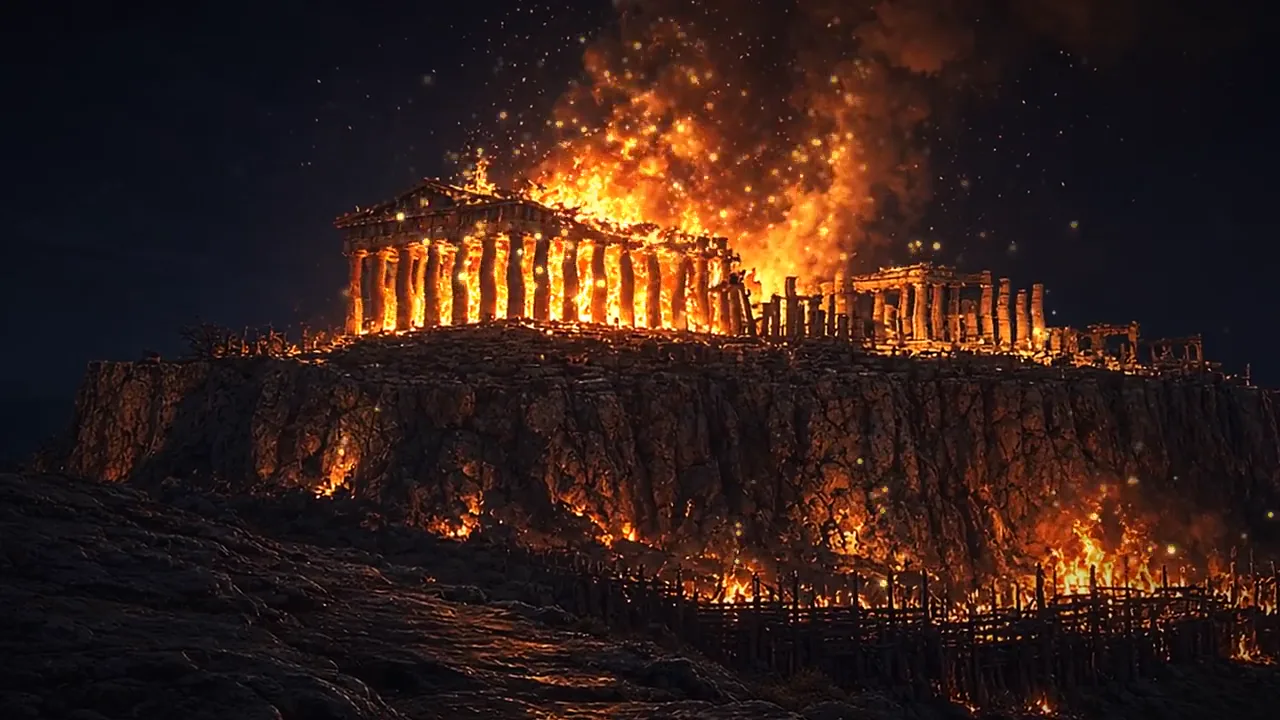
In 480 BC, Xerxes’ Persian forces invaded Athens, reducing the Acropolis and the sacred temples to ash.
Following Greece’s decisive victory at Salamis, the Athenians returned to find their homes in ruins, and their first task was to secure their future.
Under the direction of Themistocles, the citizens built a defensive perimeter known as the Themistoclean Wall. Fearing a fortified Athens would dominate Greece, rival Sparta urgently demanded they halt construction. Recognizing the threat to Athenian sovereignty, Themistocles used tactical deception.
He traveled to Sparta to negotiate, deliberately stalling discussions while every Athenian, man, woman, and child worked frantically around the clock using recycled rubble, tombstones, and shattered temple columns.
By the time Sparta realized the ploy, the fortifications were already high enough to withstand a siege. The wall gave the rebuilt city a defensible circuit, and its building told Sparta that Athens would answer to no one. The naval empire rested on other foundations: the two hundred triremes the Laurion silver had bought in 483 BC, and the Delian League founded in 478 BC, whose tribute paid for the fleet and, in time, for the building of the golden age. A generation later the Long Walls joined Athens to its port at Piraeus, and that corridor, not the city wall alone, let Athens live by sea through a siege.
Facts
- Span used here
- Roughly the 5th and 4th centuries BC. Historians place the start and end in different years; a common end point is the death of Alexander the Great in 323 BC.
- Source: Encyclopaedia Britannica, ancient Greek civilization
- Entries in this era
- Classical Athens, Socrates, Plato, Aristotle and Plato's Republic.
- Source: Keep the Tale index
Sources
- Keep the Tale index
- Encyclopaedia Britannica, ancient Greek civilization Source
Source links accessed 22 November 2026.
Related
What happened elsewhere
Pairings are by recorded year, not exact simultaneity.
- Roman RepublicWhile Classical Greece (509 BC)
- ParmenidesWhile Classical Greece (around 515 BC)
- Darius IWhile Classical Greece (522 BC)
- MoziWhile Classical Greece (around 470 BC)
- HeraclitusWhile Classical Greece (around 535 BC)
Meanwhile
Meanwhile, around the world — drag to spin, click a pulsing marker.
Keep reading
Articles
My notes
Highlights on this page
None yet.
Spotted an error on this page? Email [email protected] and it will be checked against the sources.