

Philosopher · Iron Age · Greek Ionia · Turkey
Heraclitus
c. 535–c. 475 BC
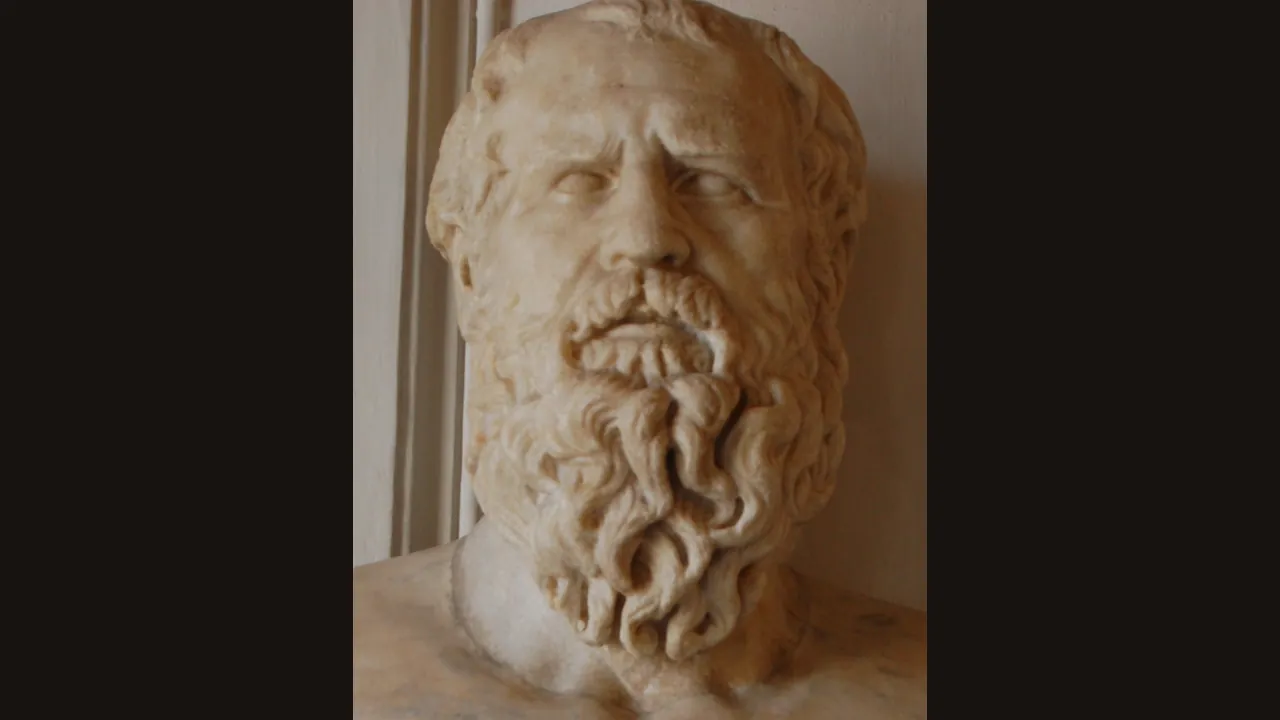
Greek thinker of Ephesus, on the coast of modern Turkey, famous for the doctrine that all things flow. He taught that fire is the first principle and that opposites are one. He lived about 535 to 475 BC, and his one book survives only in fragments.
Heraclitus came from Ephesus, a Greek city on the coast of Asia Minor, and flourished about 500 BC. Later writers describe an aristocrat of proud and solitary temper who surrendered a hereditary title to his brother, but the details rest on late sources. He wrote one book. Later tradition says he deposited it in the temple of Artemis at Ephesus. The book is lost, and some 130 fragments survive in quotations by Plato, Aristotle, the Stoics, and later authors.
The fragments teach that all things are in motion and nothing stays. His standing image is the river: new waters flow on those who step into the same rivers, so no one steps in the same river twice. He named fire the first principle, the form into which all things change and from which they arise again. Change, he taught, runs by a measure that he called the logos, an account of the world that men hear and fail to understand. Opposites belong together and pass into each other: day and night, war and peace, life and death. Strife between opposites is the world's normal order.
Plato set Heraclitus before his readers as the teacher of flux, against the unchanging being of Parmenides, and the Stoics took over his fire and his logos as governing principles of their own physics.
Facts
- Born
- About 535 BC, Ephesus, on the coast of what is now Turkey.
- Source: Encyclopaedia Britannica, Heraclitus
- Died
- About 475 BC.
- Source: Encyclopaedia Britannica, Heraclitus
- School
- Presocratic natural philosophy, in tension with the Eleatics.
- Source: Encyclopaedia Britannica, Heraclitus
- Known for
- The flux doctrine, summed up in later reports as no man steps in the same river twice, and the unity of opposites.
- Source: Encyclopaedia Britannica, Heraclitus
Sources
- Encyclopaedia Britannica, Heraclitus Source
Source links accessed 22 November 2026.
Images
Related
- Thales of MiletusSame civilization
- Darius ISame era
- Achaemenid EmpireSame era
- ConfuciusSame era
- Cyrus the GreatSame era
- The BuddhaSame era
What happened elsewhere
Pairings are by recorded year, not exact simultaneity.
- Darius IWhile Heraclitus (around 522 BC)
- Achaemenid EmpireWhile Heraclitus (around 550 BC)
- ConfuciusWhile Heraclitus (around 551 BC)
- ParmenidesWhile Heraclitus (around 515 BC)
- Cyrus the GreatWhile Heraclitus (around 559 BC)
Meanwhile
Meanwhile, around the world — drag to spin, click a pulsing marker.
Keep reading
Test yourself
When was Heraclitus born?
- About 535 BC, Ephesus, on the coast of what is now Turkey
- About 570 BC, Samos, Greece
- About 515 BC, Elea, in southern Italy
- About 460 BC, Abdera, Greece
Answer
About 535 BC, Ephesus, on the coast of what is now Turkey — Born: About 535 BC, Ephesus, on the coast of what is now Turkey.
When did Heraclitus die?
- About 475 BC
- About 370 BC
- About 289 BC
- 1200
Answer
About 475 BC — Died: About 475 BC.
What is Heraclitus known for?
- The flux doctrine, summed up in later reports as no man steps in the same river twice, and the unity of opposites
- The Daodejing: act by not forcing, value softness over hardness, and let the Way carry what striving cannot
- The claim that all things are number, and the theorem about right triangles that carries his name. What is his and what is his followers' cannot be separated
- The Four Noble Truths, the Eightfold Path, and the doctrines of no self and dependent arising, taught for 45 years after his enlightenment at Bodh Gaya
Answer
The flux doctrine, summed up in later reports as no man steps in the same river twice, and the unity of opposites — Known for: The flux doctrine, summed up in later reports as no man steps in the same river twice, and the unity of opposites.
Which school of thought was Heraclitus part of?
- Presocratic natural philosophy, in tension with the Eleatics
- Milesian school, the first of the Presocratic natural philosophers
- Buddhism, founded on his teaching
- Pythagoreanism, a blend of mathematics, music, and religious rule
Answer
Presocratic natural philosophy, in tension with the Eleatics — School: Presocratic natural philosophy, in tension with the Eleatics.
True or false: Greek thinker of Ephesus, on the coast of modern Turkey, famous for the doctrine that all things flow.
- True
- False
Answer
True — True. Greek thinker of Ephesus, on the coast of modern Turkey, famous for the doctrine that all things flow.
My notes
Highlights on this page
None yet.
Spotted an error on this page? Email [email protected] and it will be checked against the sources.