
Ruler · Iron Age · Achaemenid Empire · Iran
Cyrus the Great
r. 559–530 BC
Founder of the Persian Empire, ruling from 559 to 530 BC. He overthrew the Medes, took Lydia and its king Croesus, and captured Babylon in 539 BC without a siege. His empire ran from the Aegean to Central Asia, the largest the world had yet seen.
Cyrus was king of Anshan, a Persian land in the Zagros mountains under the overlordship of the Medes. His reign is usually dated 559 to 530 BC. About 553 BC he revolted against Astyages, the Median king, who was also, in Herodotus's telling, his grandfather. The war lasted about three years. Herodotus says Astyages's army mutinied and handed their king over. The Nabonidus Chronicle, a Babylonian record written close to the events, says Astyages marched against Cyrus and his own troops rebelled and delivered him in chains. Cyrus took the Median capital Ecbatana and with it the Median empire, and he treated the Medes as partners rather than subjects. In a few years a local Persian king held the Iranian plateau.
His next great opponent was Croesus of Lydia, the richest king in the Greek imagination, whose realm covered the western half of Asia Minor. In 546 BC Croesus crossed the Halys river to attack, fought an indecisive battle at Pteria, and withdrew to Sardis for the winter, sending his allies home. Cyrus followed him at once, against the season, defeated the Lydian cavalry outside Sardis, and took the city by siege after a soldier found a way up the unguarded slope of the citadel. The exact year is disputed, with some scholars arguing for 547 BC. Croesus was captured. What happened to him next divides the sources. Herodotus says Cyrus put him on a pyre and then spared him. The Nabonidus Chronicle may record his death. Greek tradition kept him alive as an adviser at the Persian court. Cyrus's generals then reduced the Greek cities of the Ionian coast one by one, and Persian power reached the Aegean.
Cyrus spent years campaigning in the east, in Central Asia, securing the far borders of the empire. The record of those wars is thin and mostly legend. In the west he faced Babylon, where Nabonidus had ruled for a decade and alienated the priesthood of the great temple of Marduk by neglecting its festivals. In the autumn of 539 BC Cyrus defeated the Babylonian army at Opis on the Tigris. Babylon itself opened its gates without a siege, and Babylonian records say his general Gobryas entered the city first, with Cyrus following days later. The empire of Babylon, with Syria and Palestine included, passed to Persia in a single campaign.
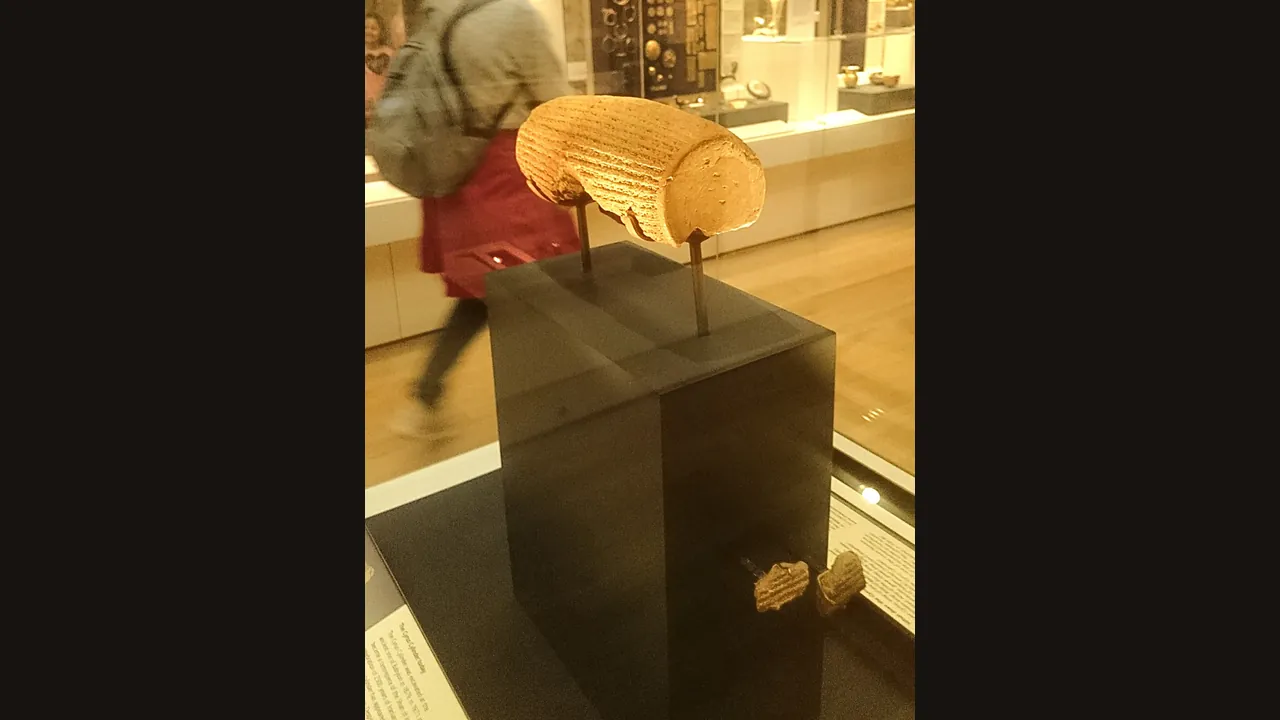
Cyrus presented himself in Babylon not as a foreign conqueror but as the king Marduk had chosen to set things right. The Cyrus Cylinder, a clay barrel inscription written by Babylonian priests in his name, says he returned the statues of gods to their temples and brought displaced peoples back to their homes. The Hebrew Bible gives the same policy from the receiving end. The books of Ezra and Isaiah record that Cyrus freed the Jews exiled in Babylon to return to Jerusalem and rebuild their temple, and Isaiah calls him the anointed of the Lord, the only foreigner given that title. The policy was consistent across the empire. Subject peoples kept their gods, their laws, and their local rulers where they submitted. Persian governors and garrisons stood behind them. Historians note that the policy served imperial interest as much as mercy, since it lowered the cost of holding new provinces, but its effect on the peoples concerned was real either way.
The empire Cyrus built ran from the Aegean Sea to Central Asia, the largest the world had yet seen, and he built it in about twenty years. It did not fall apart at his death, which marks him off from many conquerors. His son Cambyses added Egypt in 525 BC, and Darius organized the whole into the satrapy system that governed Persia for two centuries.
Cyrus died in 530 BC on campaign in the east. Herodotus says he was killed fighting the Massagetae beyond the Jaxartes river and that their queen Tomyris had his head cut off and plunged into a skin filled with blood. Herodotus himself admits that many stories of Cyrus's death were told and that he chose the one he found most credible. Ctesias, a Greek doctor at the Persian court, says Cyrus died of wounds after a battle against the Derbices. Xenophon says he died peacefully at home. No account can be verified against the others. His body was carried to Pasargadae, the capital he had built in Persia, and laid in a stone tomb that still stands there, emptied of its gold by thieves in the time of Alexander, who ordered it repaired. The evidence for the reign comes from three kinds of sources, and each kind pulls in a different direction. The Babylonian chronicles and the Cylinder are contemporary but speak for courts. Herodotus wrote a century later and mixed record with folktale. Xenophon's Cyropaedia turned Cyrus into an ideal ruler for Greek readers and is the least reliable of the three as history.
Facts
- Reign
- 559 to 530 BC.
- Source: Encyclopaedia Britannica, Cyrus the Great
- Died
- 530 BC, on campaign in the east.
- Source: Encyclopaedia Britannica, Cyrus the Great
- Realm
- The Achaemenid Persian Empire.
- Source: Encyclopaedia Britannica, Cyrus the Great
- Known for
- The capture of Babylon in 539 BC and the Cyrus Cylinder.
- Source: Encyclopaedia Britannica, Cyrus the Great
Sources
- Encyclopaedia Britannica, Cyrus the Great Source
Source links accessed 22 November 2026.
Images
Related
- IranConnected
- Achaemenid EmpireSame civilization
- Darius ISame civilization
- The BuddhaSame era
- ConfuciusSame era
- PythagorasSame era
What happened elsewhere
Pairings are by recorded year, not exact simultaneity.
- The BuddhaWhile Cyrus the Great (around 563 BC)
- ConfuciusWhile Cyrus the Great (around 551 BC)
- PythagorasWhile Cyrus the Great (around 570 BC)
- HeraclitusWhile Cyrus the Great (around 535 BC)
- LaoziWhile Cyrus the Great (600 BC)
Meanwhile
Meanwhile, around the world — drag to spin, click a pulsing marker.
Keep reading
Test yourself
When did Cyrus the Great die?
- 530 BC, on campaign in the east
- 1347, Munich, Germany, probably of the plague
- About 262 BC, Athens
- 270, in Campania, Italy
Answer
530 BC, on campaign in the east — Died: 530 BC, on campaign in the east.
When did Cyrus the Great reign?
- 559 to 530 BC
- 27 BC to 14 AD as Augustus
- 668 to about 627 BC
- 522 to 486 BC
Answer
559 to 530 BC — Reign: 559 to 530 BC.
What realm did Cyrus the Great rule?
- The Achaemenid Persian Empire
- Babylon, raised to rule over Sumer and Akkad
- The Achaemenid Persian Empire at its full extent
- An empire from Greece to India, divided after his death among his generals
Answer
The Achaemenid Persian Empire — Realm: The Achaemenid Persian Empire.
What is Cyrus the Great known for?
- The capture of Babylon in 539 BC and the Cyrus Cylinder
- Actium (31 BC) and the founding of the Principate
- The arrival of Cortes (1519) and the fall of Tenochtitlan
- The hajj of 1324 and the gold wealth of Mali
Answer
The capture of Babylon in 539 BC and the Cyrus Cylinder — Known for: The capture of Babylon in 539 BC and the Cyrus Cylinder.
True or false: Founder of the Persian Empire, ruling from 559 to 530 BC.
- True
- False
Answer
True — True. Founder of the Persian Empire, ruling from 559 to 530 BC.
My notes
Highlights on this page
None yet.
Myth vs. evidence
The myth
The Cyrus Cylinder proves Cyrus was a uniquely tolerant conqueror, centuries ahead of his time.
The evidence
The cylinder is a royal building inscription in a standard Mesopotamian genre, composed by Babylonian priests in the name of their god Marduk. Restoring temples and returning peoples was shrewd imperial policy, and earlier kings of Assyria and Babylon had used versions of the same practice.
Sources: British Museum, the Cyrus Cylinder; Amelie Kuhrt, The Cyrus Cylinder and Achaemenid Imperial Policy
Spotted an error on this page? Email [email protected] and it will be checked against the sources.