

Philosopher · Iron Age · Nepal
The Buddha
c. 563–c. 483 BC (traditional)
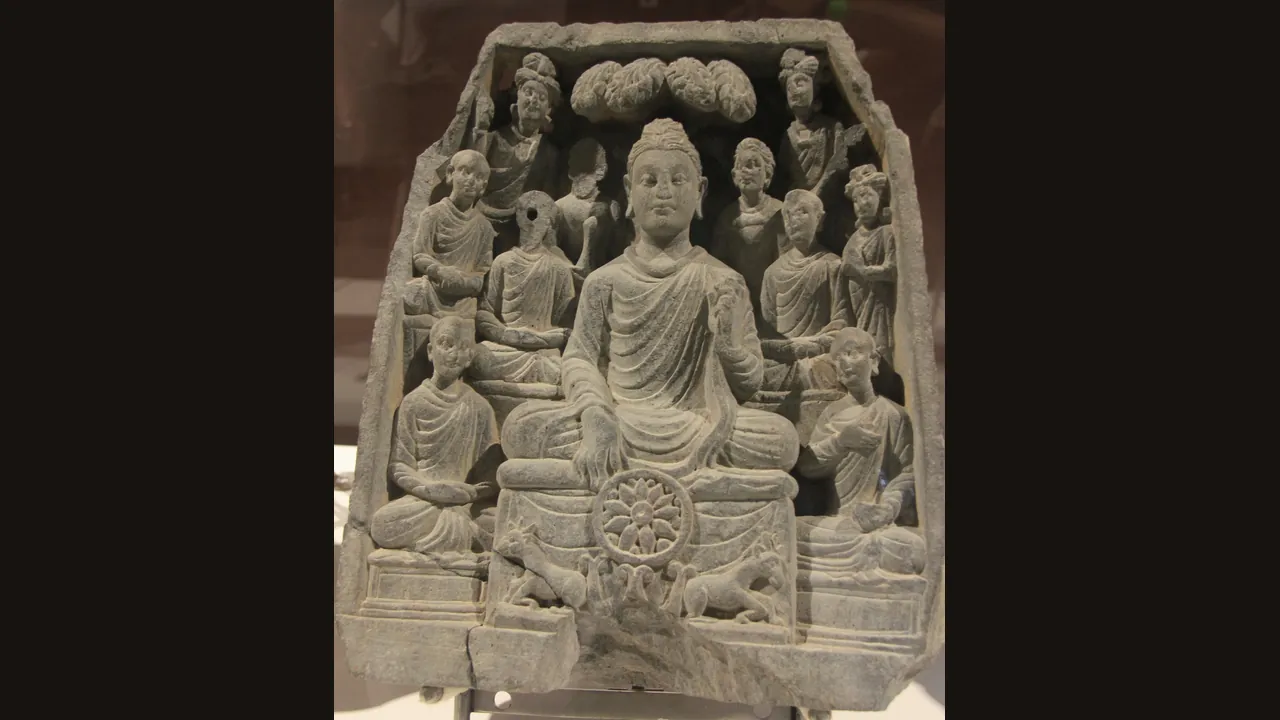
Siddhartha Gautama, the awakened one, whose teaching on suffering and its end founded Buddhism, one of the world's great philosophical and religious traditions. Tradition dates him about 563 to 483 BC; some scholars place him about a century later.
The tradition's account presents Siddhartha Gautama as a prince of the Shakya clan, born at Lumbini and raised at Kapilavastu. It tells that he saw an old man, a sick man, a corpse, and a wandering ascetic and left home at twenty nine. After six years of austerity he took food again, sat beneath the Bodhi tree at Bodh Gaya and attained awakening, then taught for forty five years and died at Kushinagar. Historians treat a teacher of the Shakya people as the core behind this account, while the details come from later texts, and they dispute his dates. The traditional dating is about 563 to 483 BC; many scholars place his life a century later, about 480 to 400 BC.
His teaching begins from the Four Noble Truths: there is suffering; suffering arises from craving; suffering can cease; and the way to its cessation is the Noble Eightfold Path. The path gathers right view, intention, speech, action, livelihood, effort, mindfulness, and concentration. His doctrine of dependent origination holds that all phenomena arise in dependence on conditions, and from this he drew the teaching of no self: a person is a changing bundle of physical and mental processes and carries no permanent soul. He set his way between sensual indulgence and self mortification and called it the middle way. He founded an order of monks and an order of nuns.
Facts
- Born
- Traditionally about 563 BC, Lumbini, in what is now Nepal, a prince of the Shakya clan.
- Source: Encyclopaedia Britannica, Buddha
- Died
- Traditionally about 483 BC, Kushinagar, India. Some scholars date his life about 480 to 400 BC.
- Source: Encyclopaedia Britannica, Buddha
- School
- Buddhism, founded on his teaching.
- Source: Encyclopaedia Britannica, Buddha
- Known for
- The Four Noble Truths, the Eightfold Path, and the doctrines of no self and dependent arising, taught for 45 years after his enlightenment at Bodh Gaya.
- Source: Encyclopaedia Britannica, Buddha
Sources
- Encyclopaedia Britannica, Buddha Source
Source links accessed 22 November 2026.
Images
Related
- NagarjunaConnected
- Adi ShankaraConnected
- Cyrus the GreatSame era
- PythagorasSame era
- ConfuciusSame era
- Achaemenid EmpireSame era
What happened elsewhere
Pairings are by recorded year, not exact simultaneity.
- Cyrus the GreatWhile The Buddha (around 559 BC)
- PythagorasWhile The Buddha (around 570 BC)
- ConfuciusWhile The Buddha (around 551 BC)
- Achaemenid EmpireWhile The Buddha (around 550 BC)
- HeraclitusWhile The Buddha (around 535 BC)
Meanwhile
Meanwhile, around the world — drag to spin, click a pulsing marker.
Keep reading
Test yourself
When was The Buddha born?
- Traditionally about 563 BC, Lumbini, in what is now Nepal, a prince of the Shakya clan
- About 624 BC, Miletus, on the coast of what is now Turkey
- About 570 BC, Samos, Greece
- About 535 BC, Ephesus, on the coast of what is now Turkey
Answer
Traditionally about 563 BC, Lumbini, in what is now Nepal, a prince of the Shakya clan — Born: Traditionally about 563 BC, Lumbini, in what is now Nepal, a prince of the Shakya clan.
When did The Buddha die?
- Traditionally about 483 BC, Kushinagar, India. Some scholars date his life about 480 to 400 BC
- About 475 BC
- About 495 BC, Metapontum, in southern Italy
- About 546 BC. The dates are traditional, not records
Answer
Traditionally about 483 BC, Kushinagar, India. Some scholars date his life about 480 to 400 BC — Died: Traditionally about 483 BC, Kushinagar, India. Some scholars date his life about 480 to 400 BC.
Which school of thought was The Buddha part of?
- Buddhism, founded on his teaching
- Daoism, the way of effortless action
- Milesian school, the first of the Presocratic natural philosophers
- Pythagoreanism, a blend of mathematics, music, and religious rule
Answer
Buddhism, founded on his teaching — School: Buddhism, founded on his teaching.
True or false: Siddhartha Gautama, the awakened one, whose teaching on suffering and its end founded Buddhism, one of the world's great philosophical and religious traditions.
- True
- False
Answer
True — True. Siddhartha Gautama, the awakened one, whose teaching on suffering and its end founded Buddhism, one of the world's great philosophical and religious traditions.
My notes
Highlights on this page
None yet.
Spotted an error on this page? Email [email protected] and it will be checked against the sources.