

Philosopher · Early Middle Ages · India
Adi Shankara
c. 788–c. 820 (traditional)
Indian thinker who consolidated Advaita Vedanta, the nondualist school holding that the self and ultimate reality are one. Tradition credits him with commentaries on the Upanishads and the founding of four monasteries. Dates about 788 to 820 are traditional and debated.
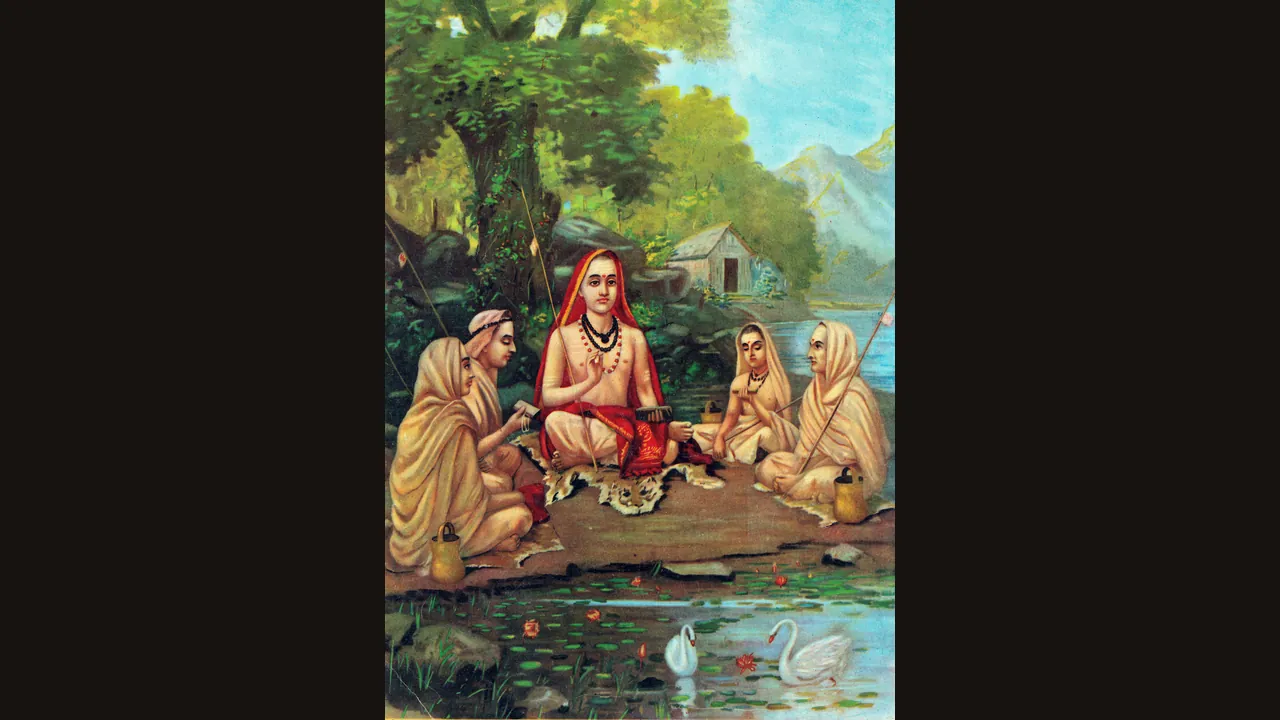
Shankara, called Adi Shankara, is placed by tradition about 788 to 820, with the dates debated. He was born at Kalady in Kerala. Tradition says he took the vows of a sannyasin, a renouncer, while still a boy, studied under Govindapada on the banks of the Narmada river. Tradition credits him with commentaries on the Brahma Sutras, on the principal Upanishads, and on the Bhagavad Gita, and with the founding of four monasteries at the four corners of India. Scholars accept a core of the commentaries as his while disputing many attached hymns and manuals.
His teaching, Advaita Vedanta, holds that brahman, ultimate reality, alone is real, and that the self, atman, is brahman and not a separate thing. His commentary on the Brahma Sutras opens with the analysis of superimposition: the qualities of the not self, body, senses, and ego, are laid over the self, and this error is avidya, ignorance, the root of bondage. The world of things he describes as appearance, graded as neither real in the way brahman is real nor unreal in the way a barren woman's son is unreal. He assigned liberation to knowledge alone and gave action and ritual a preparatory role. Among his central texts stands the Upanishadic sentence tat tvam asi, that thou art, from the Chandogya Upanishad, which he read as teaching the identity of self and brahman.
Facts
- Lived
- Traditionally about 788 to 820. Some scholars place him earlier.
- Source: Encyclopaedia Britannica, Shankara
- From
- Kalady, Kerala, India.
- Source: Encyclopaedia Britannica, Shankara
- School
- Advaita Vedanta, absolute nondualism.
- Source: Encyclopaedia Britannica, Shankara
- Known for
- The claim that atman is brahman, that plurality is illusion, and commentaries that made Vedanta the dominant Hindu philosophy.
- Source: Encyclopaedia Britannica, Shankara
Sources
- Encyclopaedia Britannica, Shankara Source
Source links accessed 22 November 2026.
Images
Related
- The BuddhaConnected
- Al KindiSame era
- Harun al-RashidSame era
- Abbasid CaliphateSame era
- CharlemagneSame era
- Alfred the GreatSame era
What happened elsewhere
Pairings are by recorded year, not exact simultaneity.
- Al KindiWhile Adi Shankara (around 801)
- Harun al-RashidWhile Adi Shankara (around 766)
Meanwhile
Meanwhile, around the world — drag to spin, click a pulsing marker.
Keep reading
My notes
Highlights on this page
None yet.
Spotted an error on this page? Email [email protected] and it will be checked against the sources.