

Ruler · Early Middle Ages · Carolingian Empire · France
Charlemagne
740s–814
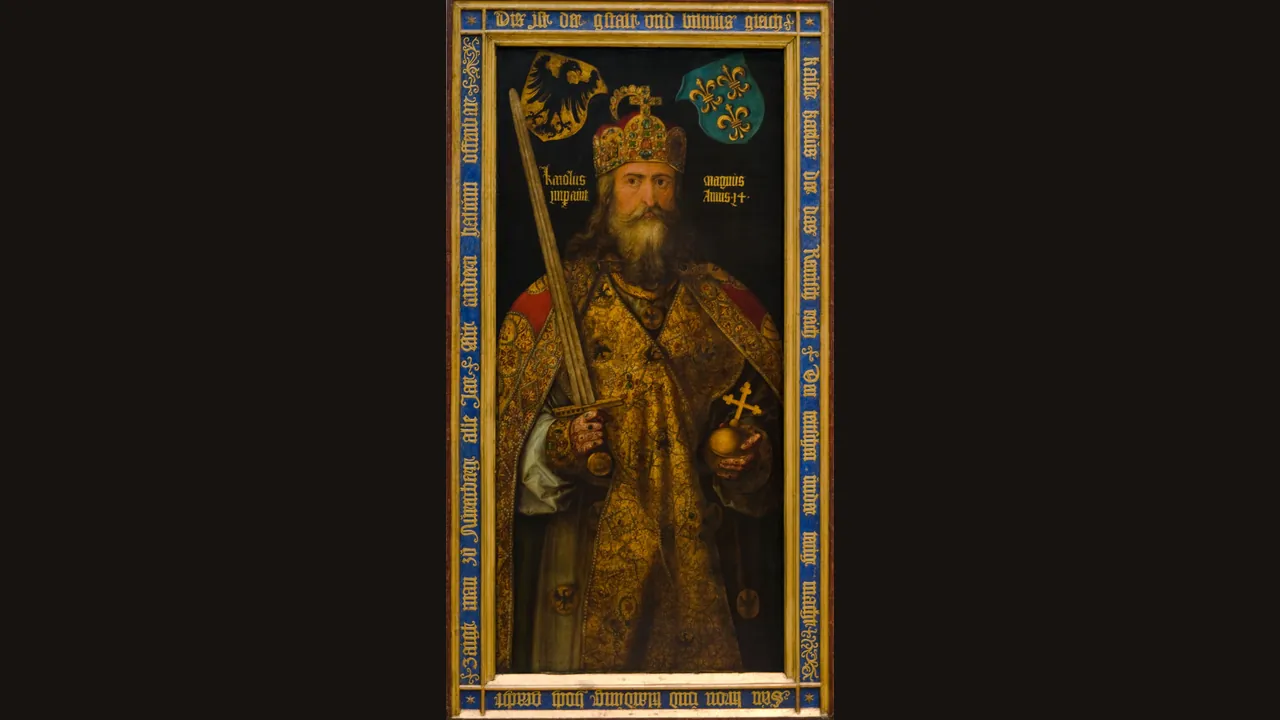
King of the Franks from 768 and emperor from 800 to his death in 814, born in the 740s. He conquered the Saxons, Lombards and much of central Europe, reuniting the west under one rule for the first time since Rome. Crowned emperor by the pope on Christmas Day 800, he sponsored the Carolingian Renaissance of learning.
Charles, known to history as Charlemagne or Charles the Great, was the elder son of Pepin the Short, the first Carolingian king of the Franks. The year of his birth is not recorded for certain. Einhard gives no date, and the traditional year of 742 in some annals conflicts with the evidence of his career. Many modern scholars argue for 747 or 748. Pepin died in 768, and the kingdom was divided between Charles and his brother Carloman. Carloman died in 771, and Charles ruled the whole Frankish realm alone from that year until his own death in 814.
His reign was a life spent on campaign. In 773 the Lombard king Desiderius threatened the pope, and Charles crossed the Alps, besieged Pavia, and took the Lombard crown for himself in 774. The Saxon wars began in 772 and ran, with truces, for more than thirty years. The Saxons east of the Rhine were pagans who raided Frankish territory, and Charles answered with invasion, forced baptism, and deportation. The Royal Frankish Annals record that after a Saxon revolt in 782 he had 4,500 prisoners executed at Verden. The figure comes from his own court's annals, and while historians accept that a mass execution took place, the number and its details may have been damaged in copying. The Saxon leader Widukind submitted and accepted baptism in 785, but fighting flared again and full submission came only in 804.
In 778 Charles campaigned in Spain against Muslim rulers and failed to hold Saragossa. On the march home, Basque fighters ambushed his rearguard at Roncevaux in the Pyrenees and killed his commander Roland. The disaster, minor in itself, became the seed of the Song of Roland, the great French epic written three centuries later. In the east Charles deposed Duke Tassilo of Bavaria in 788 and absorbed the duchy. Between 791 and 803 his armies destroyed the Avar khaganate on the Danube, a steppe power that had taken tribute from the Franks for decades. Its hoard of captured treasure, carried back to Aachen in wagon trains, made Charles rich. He organized conquered edges of the empire as marches, border districts under military counts, and by 800 he ruled most of western and central Europe. No single ruler had held so much of the west since the Roman emperors.
In Rome in 799, a faction of the Roman nobility attacked Pope Leo III in the street and tried to blind him. Leo escaped to Charles at Paderborn and asked for help. Charles came to Rome in 800, held a trial that cleared the pope, and attended Mass in St Peter's on Christmas Day. As Charles rose from prayer, Leo placed a crown on his head and the congregation acclaimed him emperor. The meaning of the coronation is disputed. Einhard wrote that Charles said he would not have entered the church that day if he had known the pope's intention. Scholars argue over whether that line records real anger at a ceremony that made the emperor look like the pope's creation, or a planned show of modesty. In 812 an embassy from Constantinople recognized Charles as an emperor, though not as emperor of the Romans.
At home Charles governed through counts in the local districts and through missi dominici, pairs of royal inspectors sent out to hear complaints and report on the counts. His capitularies, chapters of written orders, covered everything from military service to the price of grain and the duties of estate managers. He reformed the coinage around a silver penny, with 240 pence to a pound of silver, a system whose names survived in Britain into modern times. At his court at Aachen he gathered scholars from across Europe, among them Alcuin of York, who ran the palace school. The Admonitio generalis of 789 ordered schools for the clergy and set standards for preaching and teaching. Scribes in his monasteries copied Latin manuscripts in a clear new hand, Carolingian minuscule, and most classical Latin literature that exists today survives because copies were made in this period. The revival of learning is called the Carolingian Renaissance.
Charles had many wives and children, and in his Division of the Kingdoms of 806 he planned to split the empire among his three legitimate sons, following Frankish custom. Two of them died before him. In 813 he crowned the survivor, Louis, as co emperor at Aachen, without the pope present. He died in January 814 after a fever, and was buried the same day in the chapel at Aachen. Within a generation his grandsons had divided the empire at Verdun in 843 into western, middle, and eastern kingdoms, from which France and Germany later grew. The main sources are the Royal Frankish Annals, kept at court, and the Life of Charlemagne by Einhard, who served him and modeled the work on Suetonius. The monk Notker wrote anecdotes two generations later that entertain more than they inform.
Facts
- Born
- In the 740s. The traditional date is 742; many scholars argue for 747 or 748.
- Source: Encyclopaedia Britannica, Charlemagne
- Died
- 814, Aachen.
- Source: Encyclopaedia Britannica, Charlemagne
- Reign
- King of the Franks 768 to 814; emperor 800 to 814.
- Source: Encyclopaedia Britannica, Charlemagne
- Realm
- The Carolingian Empire, covering France, Germany and northern Italy.
- Source: Encyclopaedia Britannica, Charlemagne
- Known for
- The imperial coronation of 800 and the Carolingian Renaissance.
- Source: Encyclopaedia Britannica, Charlemagne
Sources
- Encyclopaedia Britannica, Charlemagne Source
Source links accessed 22 November 2026.
Images
Related
- FranceConnected
- Abbasid CaliphateSame era
- Harun al-RashidSame era
- Adi ShankaraSame era
- Al KindiSame era
- Umayyad CaliphateSame era
What happened elsewhere
Pairings are by recorded year, not exact simultaneity.
- Abbasid CaliphateWhile Charlemagne (750)
- Harun al-RashidWhile Charlemagne (around 766)
Meanwhile
Meanwhile, around the world — drag to spin, click a pulsing marker.
Keep reading
Test yourself
When was Charlemagne born?
- In the 740s. The traditional date is 742; many scholars argue for 747 or 748
- 646
- About 848, Wantage
- 912
Answer
In the 740s. The traditional date is 742; many scholars argue for 747 or 748 — Born: In the 740s. The traditional date is 742; many scholars argue for 747 or 748.
When did Charlemagne die?
- 814, Aachen
- 809, on campaign in Persia
- 973, Memleben
- 565, Constantinople
Answer
814, Aachen — Died: 814, Aachen.
When did Charlemagne reign?
- King of the Franks 768 to 814; emperor 800 to 814
- 527 to 565
- 626 to 649
- 634 to 644
Answer
King of the Franks 768 to 814; emperor 800 to 814 — Reign: King of the Franks 768 to 814; emperor 800 to 814.
What realm did Charlemagne rule?
- The Carolingian Empire, covering France, Germany and northern Italy
- The Umayyad Caliphate from Spain to Central Asia
- Tang dynasty China
- Germany and northern Italy, as the Holy Roman Empire
Answer
The Carolingian Empire, covering France, Germany and northern Italy — Realm: The Carolingian Empire, covering France, Germany and northern Italy.
True or false: King of the Franks from 768 and emperor from 800 to his death in 814, born in the 740s.
- True
- False
Answer
True — True. King of the Franks from 768 and emperor from 800 to his death in 814, born in the 740s.
My notes
Highlights on this page
None yet.
Myth vs. evidence
The myth
Charlemagne was a French king, the founder of France.
The evidence
He was king of the Franks, whose realm covered much of what later became both France and Germany, centuries before either nation existed. Both countries claim him because his empire was divided among his grandsons in 843, and the western and eastern parts grew into France and Germany.
Sources: Einhard, Life of Charlemagne; Treaty of Verdun, 843
Spotted an error on this page? Email [email protected] and it will be checked against the sources.