

Philosopher · Iron Age · Greek colonies · Greece
Pythagoras
c. 570–c. 495 BC
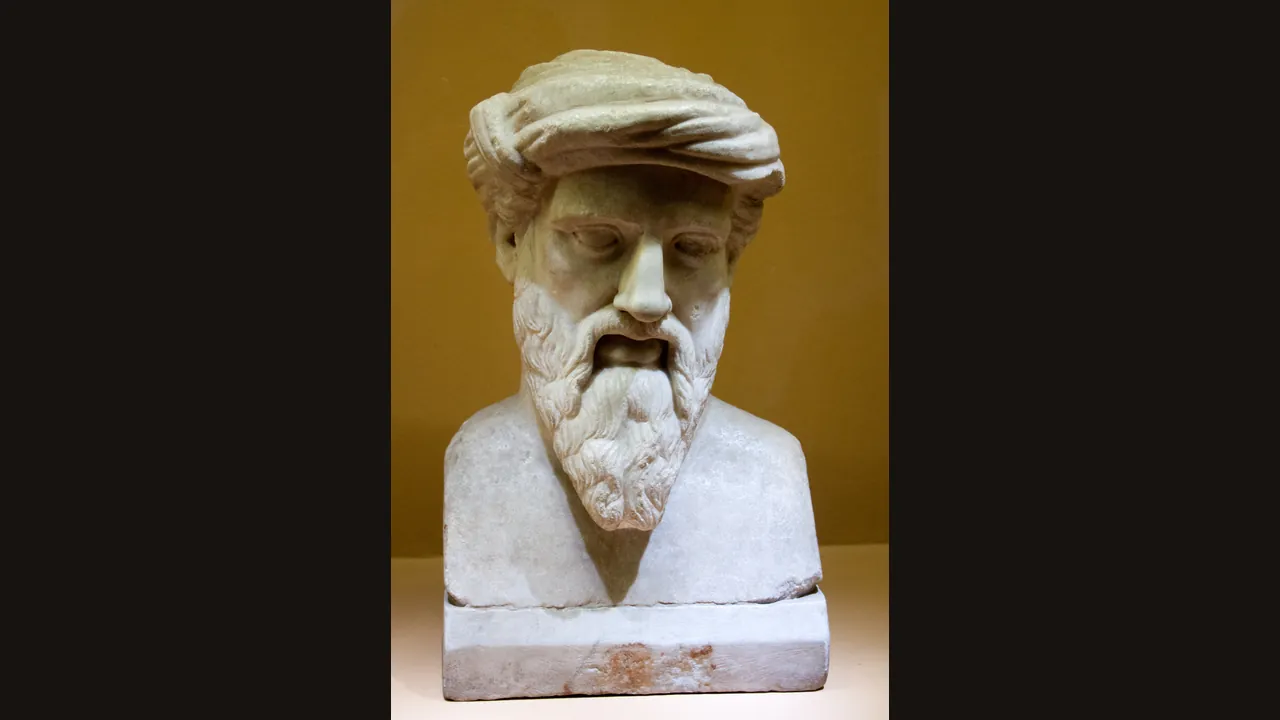
Greek thinker born on Samos who settled at Croton in southern Italy and founded a religious brotherhood. His followers taught that number is the nature of all things. He wrote nothing himself, and lived about 570 to 495 BC.
Pythagoras was born on the island of Samos about 570 BC. Later writers report travels in Egypt and the Near East, but the accounts are late and cannot be checked. About 530 BC he settled at Croton, a Greek city in southern Italy, and founded a community that joined religious observance to the study of number, music, and the heavens. He wrote nothing that survives. His followers learned the teaching as sayings held in memory, and later writers mixed the master's doctrine with the school's until the two cannot be separated.
The community lived by shared rules covering food, dress, and speech. The teaching held that number is the nature of all things. The ratios of whole numbers give the intervals of the musical scale, and the same kind of order was said to run through the movements of the sun, moon, and planets. The theorem on right triangles carries his name, though Babylonian tablets show the relation was known long before, and no proof by Pythagoras survives. The school also taught that the soul survives death and passes into another body, human or animal, and its rule barred members from eating beans and, in many accounts, meat.
Pythagorean teaching reached the main line of Greek philosophy through Plato, who traveled to Italy and Sicily, met Pythagorean thinkers there, and set number at the center of his account of the world.
Facts
- Born
- About 570 BC, Samos, Greece.
- Source: Encyclopaedia Britannica, Pythagoras
- Died
- About 495 BC, Metapontum, in southern Italy.
- Source: Encyclopaedia Britannica, Pythagoras
- School
- Pythagoreanism, a blend of mathematics, music, and religious rule.
- Source: Encyclopaedia Britannica, Pythagoras
- Known for
- The claim that all things are number, and the theorem about right triangles that carries his name. What is his and what is his followers' cannot be separated.
- Source: Encyclopaedia Britannica, Pythagoras
Sources
- Encyclopaedia Britannica, Pythagoras Source
Source links accessed 22 November 2026.
Images
Related
- GreeceConnected
- ItalyConnected
- ParmenidesSame civilization
- The BuddhaSame era
- Cyrus the GreatSame era
- ConfuciusSame era
What happened elsewhere
Pairings are by recorded year, not exact simultaneity.
- The BuddhaWhile Pythagoras (around 563 BC)
- Cyrus the GreatWhile Pythagoras (around 559 BC)
- ConfuciusWhile Pythagoras (around 551 BC)
- Achaemenid EmpireWhile Pythagoras (around 550 BC)
- LaoziWhile Pythagoras (around 600 BC)
Meanwhile
Meanwhile, around the world — drag to spin, click a pulsing marker.
Keep reading
Test yourself
When was Pythagoras born?
- About 570 BC, Samos, Greece
- About 515 BC, Elea, in southern Italy
- About 535 BC, Ephesus, on the coast of what is now Turkey
- About 460 BC, Abdera, Greece
Answer
About 570 BC, Samos, Greece — Born: About 570 BC, Samos, Greece.
When did Pythagoras die?
- About 495 BC, Metapontum, in southern Italy
- 180, on the Danube frontier, likely of plague
- About 135, Nicopolis, Greece
- About 873, Baghdad
Answer
About 495 BC, Metapontum, in southern Italy — Died: About 495 BC, Metapontum, in southern Italy.
Which school of thought was Pythagoras part of?
- Pythagoreanism, a blend of mathematics, music, and religious rule
- Milesian school, the first of the Presocratic natural philosophers
- Presocratic natural philosophy, in tension with the Eleatics
- Daoism, the way of effortless action
Answer
Pythagoreanism, a blend of mathematics, music, and religious rule — School: Pythagoreanism, a blend of mathematics, music, and religious rule.
True or false: Greek thinker born on Samos who settled at Croton in southern Italy and founded a religious brotherhood.
- True
- False
Answer
True — True. Greek thinker born on Samos who settled at Croton in southern Italy and founded a religious brotherhood.
My notes
Highlights on this page
None yet.
Spotted an error on this page? Email [email protected] and it will be checked against the sources.