

Civilization · Iron Age · Achaemenid Empire
Achaemenid Empire
550–330 BCE
The Achaemenid Empire was the first Persian Empire and the largest the ancient world had seen. Cyrus the Great founded it in 550 BCE; at its height it ruled from India to Greece. Alexander the Great destroyed it in 330 BCE.
The Achaemenid Empire was the state founded by Cyrus II of Persia, a king of the Achaemenid family. Cyrus defeated the Medes in 550 BCE, then Lydia, then Babylon in 539 BCE, and his son Cambyses added Egypt in 525 BCE. At its greatest extent the empire ran from the Indus valley to the Balkans and from Central Asia to Egypt. Aramaic served as the language of administration across the provinces, alongside Old Persian and Elamite.
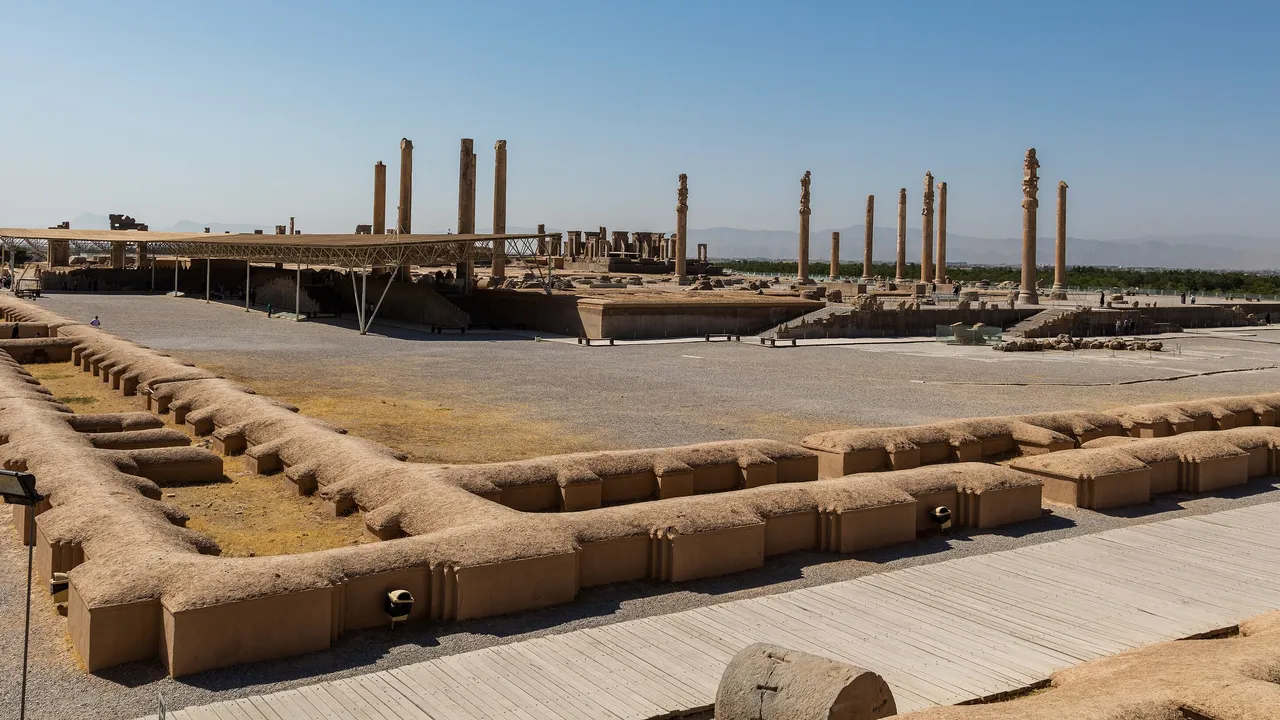
Darius I, who reigned 522 to 486 BCE, organized the empire into provinces called satrapies, each under a satrap answerable to the king. He set royal judges over the provinces, issued a gold coinage called the daric, and built the Royal Road from Sardis to Susa with posting stations for royal messengers. The kings built their palaces at Pasargadae, Susa, and Persepolis, where carved reliefs show the peoples of the empire bringing tribute.
Persian armies invaded Greece in 490 BCE and again in 480 to 479 BCE and were turned back both times. The empire held together for a further century and a half, with revolts in Egypt and the western provinces. Alexander of Macedon defeated Darius III at Gaugamela in 331 BCE and took Persepolis in 330 BCE. Darius was killed that year by one of his own satraps, and the empire ended with his death.
Watch
The Sack of Athens and the Themistoclean Wall, 480–478 BC
Events · 2026-10-10
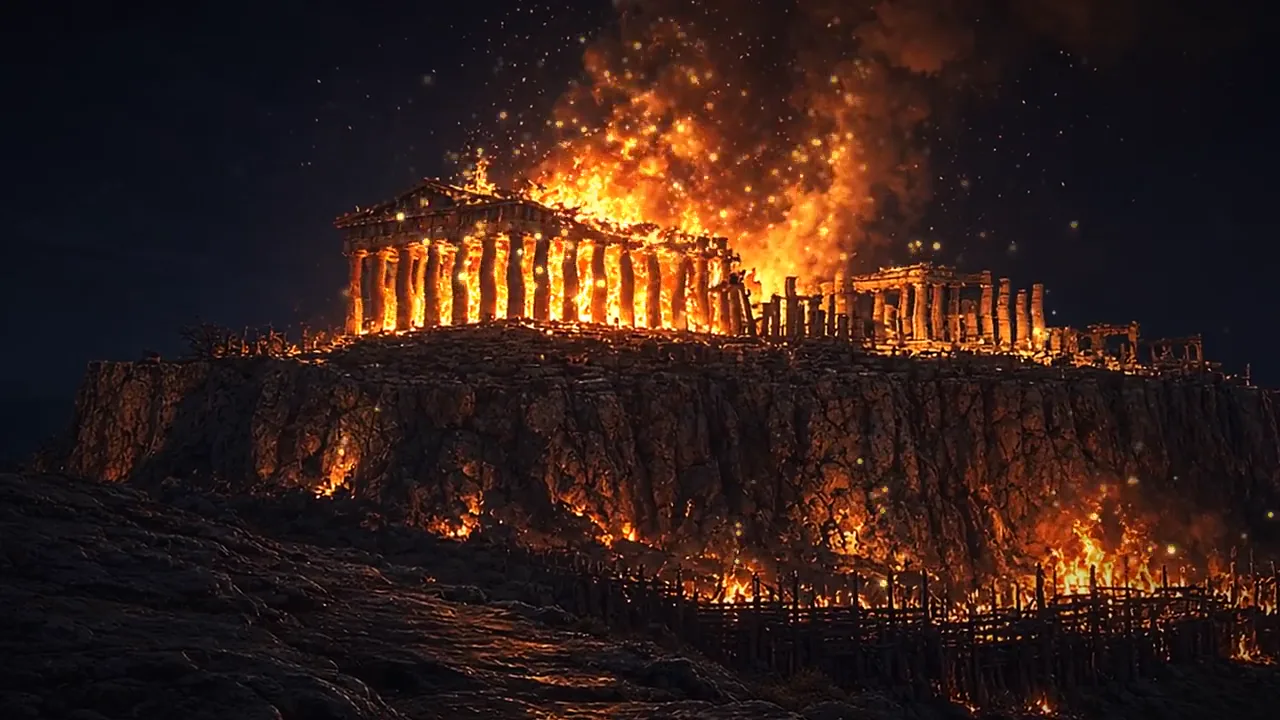
In 480 BC, Xerxes’ Persian forces invaded Athens, reducing the Acropolis and the sacred temples to ash.
Following Greece’s decisive victory at Salamis, the Athenians returned to find their homes in ruins, and their first task was to secure their future.
Under the direction of Themistocles, the citizens built a defensive perimeter known as the Themistoclean Wall. Fearing a fortified Athens would dominate Greece, rival Sparta urgently demanded they halt construction. Recognizing the threat to Athenian sovereignty, Themistocles used tactical deception.
He traveled to Sparta to negotiate, deliberately stalling discussions while every Athenian, man, woman, and child worked frantically around the clock using recycled rubble, tombstones, and shattered temple columns.
By the time Sparta realized the ploy, the fortifications were already high enough to withstand a siege. The wall gave the rebuilt city a defensible circuit, and its building told Sparta that Athens would answer to no one. The naval empire rested on other foundations: the two hundred triremes the Laurion silver had bought in 483 BC, and the Delian League founded in 478 BC, whose tribute paid for the fleet and, in time, for the building of the golden age. A generation later the Long Walls joined Athens to its port at Piraeus, and that corridor, not the city wall alone, let Athens live by sea through a siege.
Facts
- Founded
- 550 BCE, Cyrus the Great united the Medes and Persians.
- Source: Encyclopaedia Britannica, Achaemenid Empire
- Ended
- 330 BCE, conquered by Alexander the Great.
- Source: Encyclopaedia Britannica, Achaemenid Empire
- Heartland
- Persia, capitals Pasargadae, Persepolis, and Susa, in present day Iran.
- Source: Encyclopaedia Britannica, Achaemenid Empire
- Major rulers
- Cyrus the Great, the founder; Darius I, the organizer; Xerxes I, who invaded Greece.
- Source: Encyclopaedia Britannica, Achaemenid Empire
Sources
- Encyclopaedia Britannica, Achaemenid Empire Source
Source links accessed 22 November 2026.
Images
Related
- Cyrus the GreatSame civilization
- Darius ISame civilization
- ConfuciusSame era
- The BuddhaSame era
- HeraclitusSame era
- PythagorasSame era
What happened elsewhere
Pairings are by recorded year, not exact simultaneity.
- ConfuciusWhile Achaemenid Empire (around 551 BC)
- The BuddhaWhile Achaemenid Empire (around 563 BC)
- HeraclitusWhile Achaemenid Empire (around 535 BC)
- PythagorasWhile Achaemenid Empire (around 570 BC)
- ParmenidesWhile Achaemenid Empire (around 515 BC)
Meanwhile
Meanwhile, around the world — drag to spin, click a pulsing marker.
Keep reading
Test yourself
When was Achaemenid Empire founded?
- 550 BCE, Cyrus the Great united the Medes and Persians
- 1979, after the Islamic Revolution
- 1768, unification by Prithvi Narayan Shah
- 1839, independence recognized by the Treaty of London
Answer
550 BCE, Cyrus the Great united the Medes and Persians — Founded: 550 BCE, Cyrus the Great united the Medes and Persians.
When did Achaemenid Empire end?
- 330 BCE, conquered by Alexander the Great
- 539 BCE, conquered by Cyrus the Great of Persia
- 539 BCE, when Cyrus the Great took Babylon for Persia
- 30 BCE, death of Cleopatra; Egypt became a Roman province
Answer
330 BCE, conquered by Alexander the Great — Ended: 330 BCE, conquered by Alexander the Great.
Where was the heartland of Achaemenid Empire?
- Persia, capitals Pasargadae, Persepolis, and Susa, in present day Iran
- Northern Mesopotamia, capitals Assur, Nineveh, and Nimrud
- The Tigris Euphrates valley, in present day Iraq and eastern Syria
- Central Anatolia, capital Hattusa, in present day Turkey
Answer
Persia, capitals Pasargadae, Persepolis, and Susa, in present day Iran — Heartland: Persia, capitals Pasargadae, Persepolis, and Susa, in present day Iran.
True or false: The Achaemenid Empire was the first Persian Empire and the largest the ancient world had seen.
- True
- False
Answer
True — True. The Achaemenid Empire was the first Persian Empire and the largest the ancient world had seen.
Articles
My notes
Highlights on this page
None yet.
Spotted an error on this page? Email [email protected] and it will be checked against the sources.