

Philosopher · Iron Age · Greek Ionia · Turkey
Thales of Miletus
c. 624–c. 546 BC
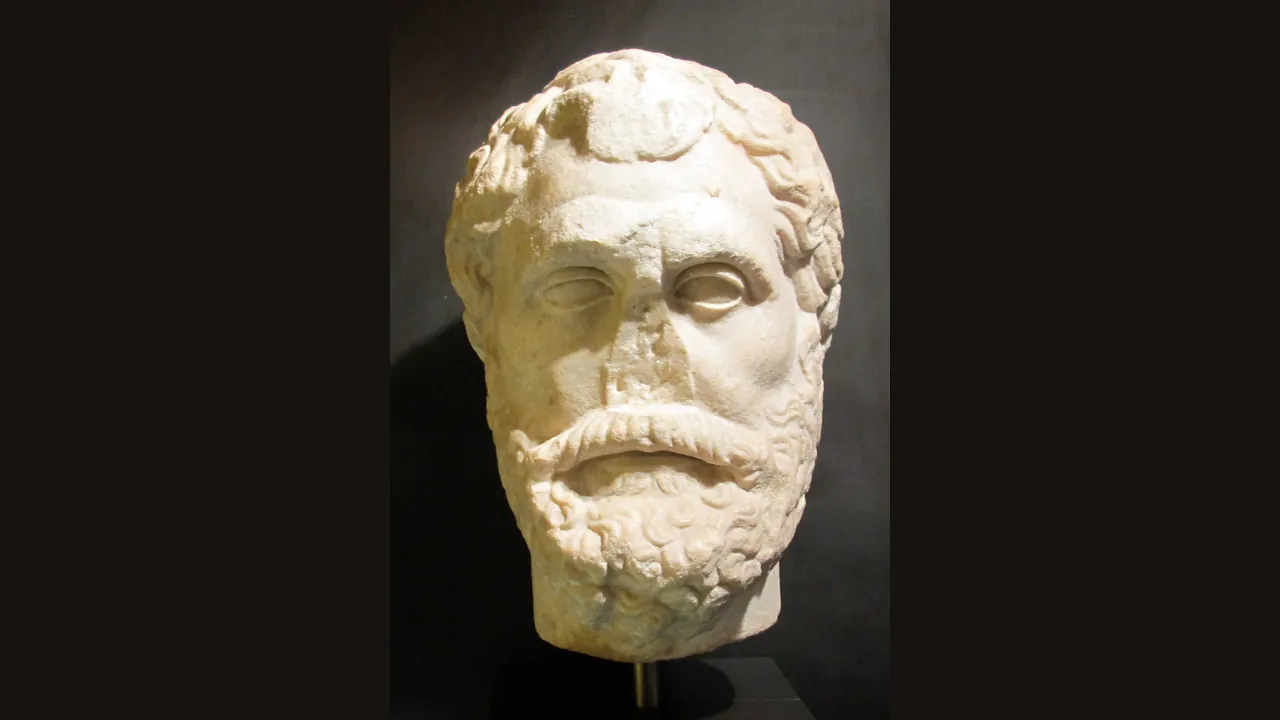
Greek thinker from Miletus, on the coast of modern Turkey, counted as the first philosopher in the Western tradition. He looked for one underlying stuff behind all things and named it water. He lived about 624 to 546 BC, and almost nothing certain survives about his life.
Thales lived at Miletus, a Greek trading city on the coast of Asia Minor, in the late seventh and early sixth centuries BC. The dates handed down for his life, about 624 to 546 BC, come from later writers and rest on no records from his own time. No writing of his survives, and the ancients themselves disagreed about whether he wrote anything at all. Reports about him come chiefly from Herodotus, Plato, Aristotle, and the biographer Diogenes Laertius, who wrote some eight centuries later.
Aristotle reports that Thales named water as the first principle, the underlying stuff from which all things come. He is said to have pictured the earth as resting on water, and to have held that the magnet has life because it moves iron. Herodotus reports that he predicted the solar eclipse of 585 BC, which ended a battle between the Lydians and the Medes. Aristotle tells a story of Thales renting every olive press in Miletus before a large harvest and profiting from the monopoly. Plato tells a contrary story, of Thales falling into a well while watching the stars and being laughed at by a Thracian servant girl.
Aristotle names Thales the founder of the inquiry into nature, and two younger men of Miletus, Anaximander and Anaximenes, took up his search for a first principle in the next generation.
Facts
- Born
- About 624 BC, Miletus, on the coast of what is now Turkey.
- Source: Encyclopaedia Britannica, Thales of Miletus
- Died
- About 546 BC. The dates are traditional, not records.
- Source: Encyclopaedia Britannica, Thales of Miletus
- School
- Milesian school, the first of the Presocratic natural philosophers.
- Source: Encyclopaedia Britannica, Thales of Miletus
- Known for
- Naming water as the first principle of all things. Herodotus reports that he predicted the solar eclipse of 585 BC.
- Source: Encyclopaedia Britannica, Thales of Miletus
Sources
- Encyclopaedia Britannica, Thales of Miletus Source
Source links accessed 22 November 2026.
Images
Related
- GreeceConnected
- HeraclitusSame civilization
- LaoziSame era
- AshurbanipalSame era
- PythagorasSame era
- The BuddhaSame era
What happened elsewhere
Pairings are by recorded year, not exact simultaneity.
- LaoziWhile Thales of Miletus (around 600 BC)
- JapanWhile Thales of Miletus (around 660 BC)
- AshurbanipalWhile Thales of Miletus (around 668 BC)
- PythagorasWhile Thales of Miletus (around 570 BC)
- The BuddhaWhile Thales of Miletus (around 563 BC)
Meanwhile
Meanwhile, around the world — drag to spin, click a pulsing marker.
Keep reading
Test yourself
When was Thales of Miletus born?
- About 624 BC, Miletus, on the coast of what is now Turkey
- About 334 BC, Citium, Cyprus
- About 515 BC, Elea, in southern Italy
- About 460 BC, Abdera, Greece
Answer
About 624 BC, Miletus, on the coast of what is now Turkey — Born: About 624 BC, Miletus, on the coast of what is now Turkey.
When did Thales of Miletus die?
- About 546 BC. The dates are traditional, not records
- About 475 BC
- About 495 BC, Metapontum, in southern Italy
- Traditionally about 483 BC, Kushinagar, India. Some scholars date his life about 480 to 400 BC
Answer
About 546 BC. The dates are traditional, not records — Died: About 546 BC. The dates are traditional, not records.
What is Thales of Miletus known for?
- Naming water as the first principle of all things. Herodotus reports that he predicted the solar eclipse of 585 BC
- The claim that all things are number, and the theorem about right triangles that carries his name. What is his and what is his followers' cannot be separated
- The flux doctrine, summed up in later reports as no man steps in the same river twice, and the unity of opposites
- The Four Noble Truths, the Eightfold Path, and the doctrines of no self and dependent arising, taught for 45 years after his enlightenment at Bodh Gaya
Answer
Naming water as the first principle of all things. Herodotus reports that he predicted the solar eclipse of 585 BC — Known for: Naming water as the first principle of all things. Herodotus reports that he predicted the solar eclipse of 585 BC.
Which school of thought was Thales of Miletus part of?
- Milesian school, the first of the Presocratic natural philosophers
- Pythagoreanism, a blend of mathematics, music, and religious rule
- Daoism, the way of effortless action
- Buddhism, founded on his teaching
Answer
Milesian school, the first of the Presocratic natural philosophers — School: Milesian school, the first of the Presocratic natural philosophers.
True or false: Greek thinker from Miletus, on the coast of modern Turkey, counted as the first philosopher in the Western tradition.
- True
- False
Answer
True — True. Greek thinker from Miletus, on the coast of modern Turkey, counted as the first philosopher in the Western tradition.
My notes
Highlights on this page
None yet.
Spotted an error on this page? Email [email protected] and it will be checked against the sources.