

Civilization · Classical Greece · Greece
Classical Athens
5th–4th century BC
The city-state of Athens in the 5th and 4th centuries BC. A container for the philosophers and texts placed there, not a history of the city.
Athens stood in Attica, the southeastern corner of central Greece, with its port at Piraeus. The city's classical period runs from the democratic reforms of Cleisthenes in 508 BCE to the loss of independence in 322 BCE. Athenians spoke Greek, and the population joined a citizen body of adult men with women, resident foreigners, and slaves, who had no vote.
Adult male citizens governed Athens directly. They voted in the assembly on war, law, and finance, filled a council of five hundred by lot to prepare business, and staffed juries chosen by lot. Ten generals were elected each year and could be reelected. Citizens could vote to exile a man for ten years by ostracism, without a charge or trial. Athens led the Delian League of Greek states from 478 BCE, and the league's treasury moved to Athens in 454 BCE; allied tribute paid for the Parthenon and other buildings on the Acropolis. Athens fought Sparta in the Peloponnesian War from 431 to 404 BCE and lost, surrendering its fleet and walls. Democracy returned in 403 BCE, and the restored city tried and executed Socrates in 399 BCE.
Macedon defeated Athens and its allies at Chaeronea in 338 BCE. Athens rose again in 322 BCE and lost the Lamian War. Macedon placed a garrison over the city and replaced the democracy with rule by the wealthy, ending the classical period.
Watch
The Sack of Athens and the Themistoclean Wall, 480–478 BC
Events · 2026-10-10
In 480 BC, Xerxes’ Persian forces invaded Athens, reducing the Acropolis and the sacred temples to ash.
Following Greece’s decisive victory at Salamis, the Athenians returned to find their homes in ruins, and their first task was to secure their future.
Under the direction of Themistocles, the citizens built a defensive perimeter known as the Themistoclean Wall. Fearing a fortified Athens would dominate Greece, rival Sparta urgently demanded they halt construction. Recognizing the threat to Athenian sovereignty, Themistocles used tactical deception.
He traveled to Sparta to negotiate, deliberately stalling discussions while every Athenian, man, woman, and child worked frantically around the clock using recycled rubble, tombstones, and shattered temple columns.
By the time Sparta realized the ploy, the fortifications were already high enough to withstand a siege. The wall gave the rebuilt city a defensible circuit, and its building told Sparta that Athens would answer to no one. The naval empire rested on other foundations: the two hundred triremes the Laurion silver had bought in 483 BC, and the Delian League founded in 478 BC, whose tribute paid for the fleet and, in time, for the building of the golden age. A generation later the Long Walls joined Athens to its port at Piraeus, and that corridor, not the city wall alone, let Athens live by sea through a siege.
Facts
- Trial of Socrates
- 399 BC. Athens tried Socrates for impiety and corrupting the young, and put him to death.
- Source: Encyclopaedia Britannica, Socrates
- Plato's Academy
- Founded at Athens about 387 BC.
- Source: Encyclopaedia Britannica, Plato
- Aristotle's Lyceum
- Founded at Athens about 335 BC.
- Source: Encyclopaedia Britannica, Aristotle
Sources
- Encyclopaedia Britannica, Aristotle Source
- Encyclopaedia Britannica, Plato Source
- Encyclopaedia Britannica, Socrates Source
Source links accessed 22 November 2026.
Related
What happened elsewhere
Pairings are by recorded year, not exact simultaneity.
- Roman RepublicWhile Classical Athens (509 BC)
- ParmenidesWhile Classical Athens (around 515 BC)
- Darius IWhile Classical Athens (522 BC)
- MoziWhile Classical Athens (around 470 BC)
- HeraclitusWhile Classical Athens (around 535 BC)
Meanwhile
Meanwhile, around the world — drag to spin, click a pulsing marker.
Keep reading
Articles
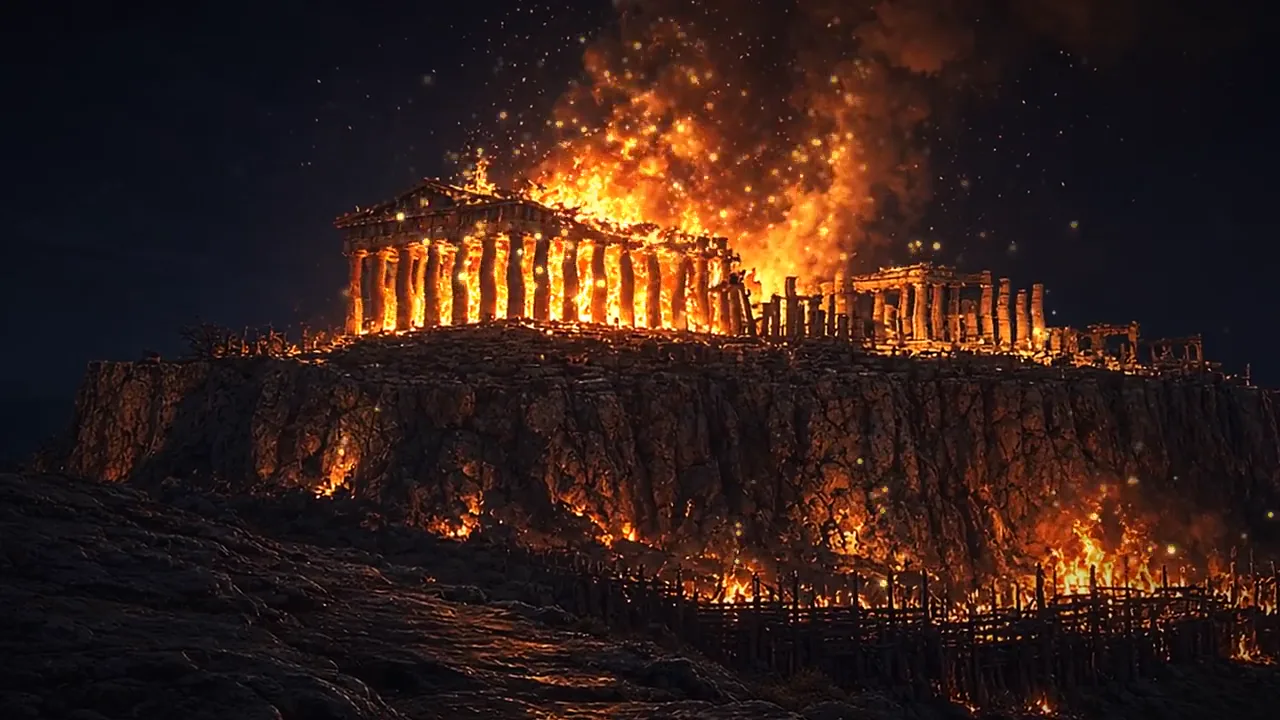 The Sack of Athens and the Themistoclean Wall, 480–478 BCIn 480 BC, Xerxes’ Persian forces invaded Athens, reducing the Acropolis and the sacred temples to ash.Read
 Before You Curse AmericaLiberty produces unequal outcomes because men are unequal in talent, judgment, appetite, luck, family, and will. Unequal outcomes produce comparison. Comparison can turn into envy.Read
My notes
Highlights on this page
None yet.
Myth vs. evidence
The myth
Three hundred Spartans held the pass at Thermopylae alone against the Persian army.
The evidence
About seven thousand Greeks held the pass at the start. When Leonidas sent most of them away, seven hundred Thespians and four hundred Thebans stayed and died beside the three hundred Spartans. Herodotus records them; the later retelling dropped them.
Sources: Herodotus, Histories 7.202 to 7.228
Spotted an error on this page? Email [email protected] and it will be checked against the sources.