

Philosopher · Classical antiquity · Classical Greece · Turkey
Diogenes of Sinope
c. 404–323 BC
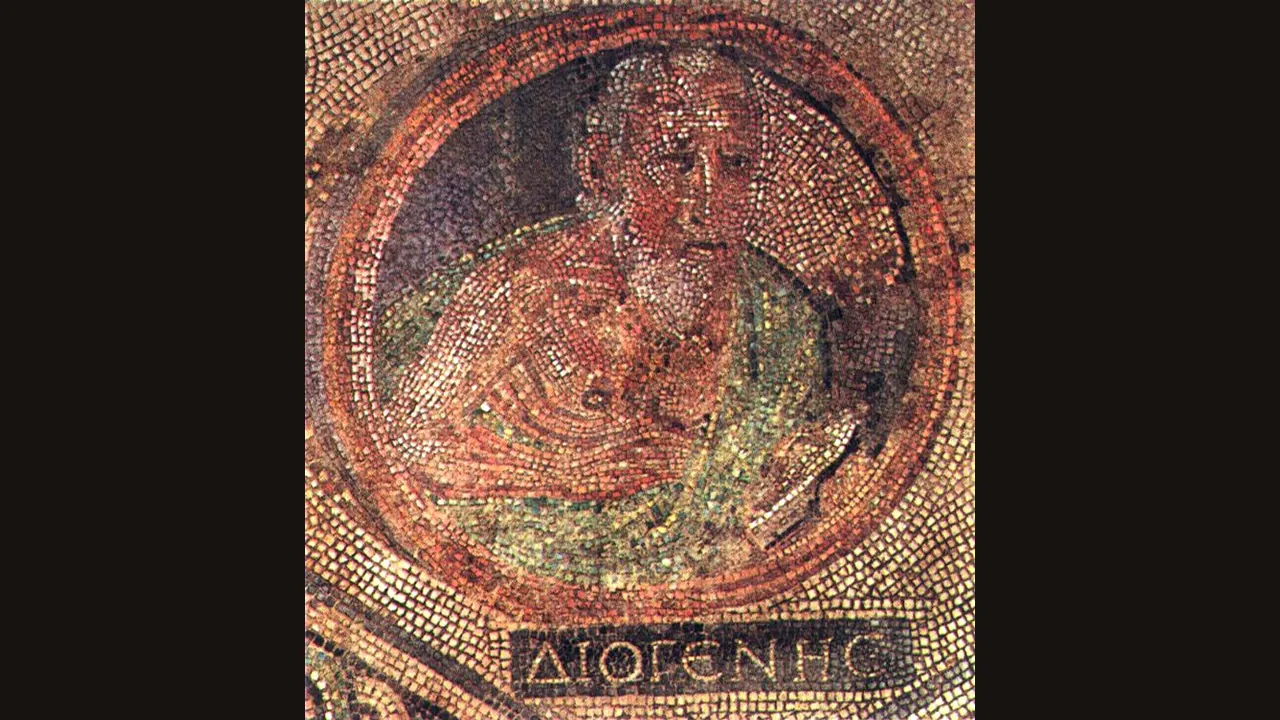
Greek Cynic born at Sinope on the Black Sea coast of modern Turkey who lived in deliberate poverty at Athens and Corinth. He owned a cloak, a staff, and a tub to sleep in. He lived about 404 to 323 BC and wrote nothing that survives.
Diogenes came from Sinope, a Greek city on the Black Sea, and lived about 404 to 323 BC. Later writers say he was exiled after a scandal over the city's coinage involving his father, a money changer. He came to Athens and attached himself to Antisthenes, a pupil of Socrates and founder of the Cynic way of life. In later life he lived at Corinth. Diogenes Laertius reports that pirates captured him on a voyage and sold him at Crete to a Corinthian named Xeniades, in whose household he served and taught.
His teaching was his life. He held that virtue is a matter of deeds rather than arguments, and that a man needs almost nothing: a cloak, a staff, a wallet, and a place to sleep, which for him was an earthenware jar. He trained himself to bear heat, cold, and hunger, and he performed natural acts in public to show that custom, not nature, brands them disgraceful. Later writers report that he carried a lit lantern in daylight, looking, he said, for a man, and that when Alexander the Great offered him any favor, he asked the king to stand out of his sunlight. He is also said to have called himself a citizen of the world.
The Cynic line ran through his pupil Crates to Zeno of Citium, who founded Stoicism, and the Stoics kept the Cynic teaching that nature, not custom, sets the standard for life.
Facts
- Born
- About 404 BC, Sinope, on the Black Sea coast of what is now Turkey.
- Source: Encyclopaedia Britannica, Diogenes
- Died
- 323 BC, Corinth, Greece, in the same year as Alexander the Great.
- Source: Encyclopaedia Britannica, Diogenes
- School
- Cynicism, the practice of shamelessness and self sufficiency.
- Source: Encyclopaedia Britannica, Diogenes
- Known for
- Living in a tub, carrying a lantern in daylight looking for an honest man, and telling Alexander to stand out of his sunlight. The stories are later, not records.
- Source: Encyclopaedia Britannica, Diogenes
Sources
- Encyclopaedia Britannica, Diogenes Source
Source links accessed 22 November 2026.
Images
Related
- Zeno of CitiumConnected
- PyrrhoSame civilization
- MenciusSame era
- ZhuangziSame era
- Alexander the GreatSame era
- DemocritusSame era
What happened elsewhere
Pairings are by recorded year, not exact simultaneity.
Meanwhile
Meanwhile, around the world — drag to spin, click a pulsing marker.
Keep reading
Test yourself
When was Diogenes of Sinope born?
- About 404 BC, Sinope, on the Black Sea coast of what is now Turkey
- About 372 BC, in the state of Zou, China
- 341 BC, Samos, Greece
- About 50, Hierapolis, in what is now Turkey, enslaved in Rome
Answer
About 404 BC, Sinope, on the Black Sea coast of what is now Turkey — Born: About 404 BC, Sinope, on the Black Sea coast of what is now Turkey.
When did Diogenes of Sinope die?
- 323 BC, Corinth, Greece, in the same year as Alexander the Great
- About 450 BC
- About 420 BC
- About 235 BC
Answer
323 BC, Corinth, Greece, in the same year as Alexander the Great — Died: 323 BC, Corinth, Greece, in the same year as Alexander the Great.
Which school of thought was Diogenes of Sinope part of?
- Cynicism, the practice of shamelessness and self sufficiency
- Epicureanism, taught in the Garden at Athens
- Academic skepticism, with Stoic leanings in ethics
- Confucianism, its realist wing
Answer
Cynicism, the practice of shamelessness and self sufficiency — School: Cynicism, the practice of shamelessness and self sufficiency.
True or false: Greek Cynic born at Sinope on the Black Sea coast of modern Turkey who lived in deliberate poverty at Athens and Corinth.
- True
- False
Answer
True — True. Greek Cynic born at Sinope on the Black Sea coast of modern Turkey who lived in deliberate poverty at Athens and Corinth.
My notes
Highlights on this page
None yet.
Spotted an error on this page? Email [email protected] and it will be checked against the sources.