

Philosopher · Classical antiquity · Classical Greece · Greece
Pyrrho
c. 360–c. 270 BC
Greek thinker from Elis who founded philosophical skepticism, teaching suspension of judgment as the road to calm. He wrote nothing; his pupil Timon is the main source. He lived about 360 to 270 BC.
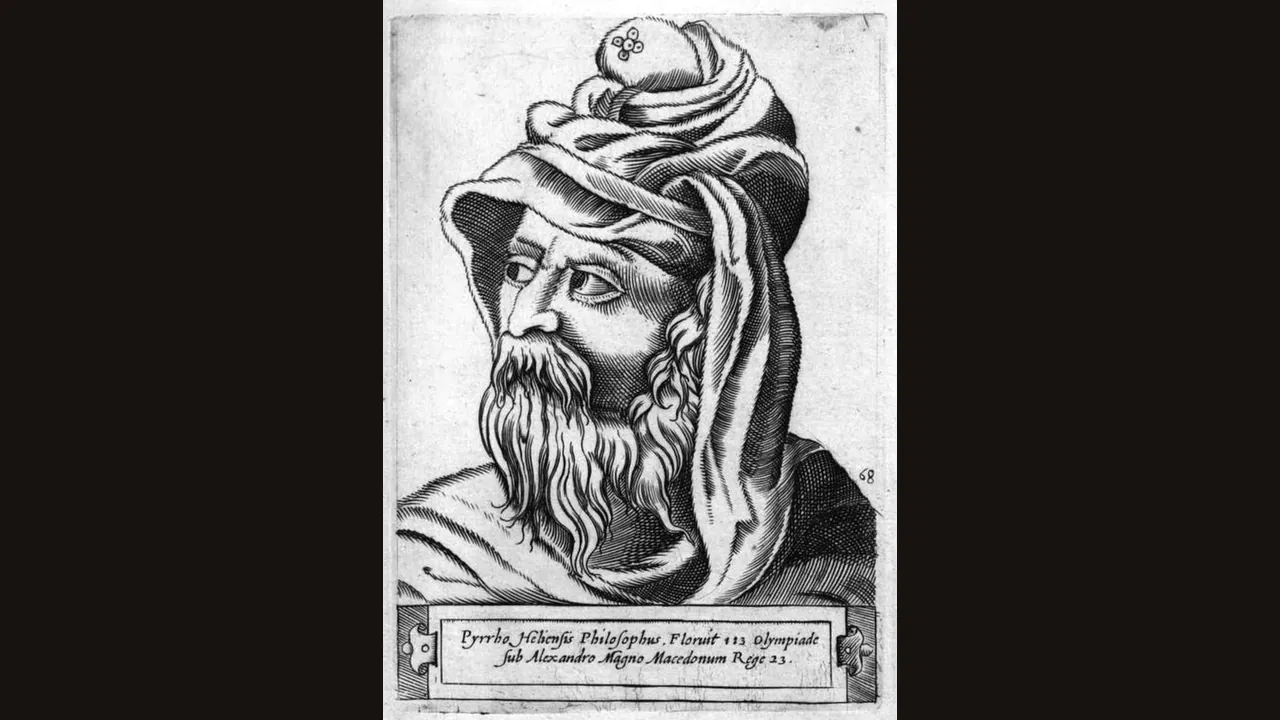
Pyrrho came from Elis in the western Peloponnese and lived about 360 to 270 BC. He began as a painter, then studied under Anaxarchus and followed him into the service of Alexander the Great. Diogenes Laertius reports that the expedition took him as far as India, where he met the naked philosophers the Greeks called gymnosophists. He returned to Elis and lived quietly there. Later writers say his city made him its chief priest and that Athens granted him citizenship. He wrote nothing.
His teaching survives through his pupil Timon of Phlius, who set it down in verse and prose, and through later summaries. Pyrrho held that things are by nature undecidable: no sense report and no argument settles how a thing really is, since for every position an opposing position of equal strength can be set against it. The proper response is suspension of judgment, and of each thing a man should say no more than that it is or is not, or both, or neither. Timon reported that freedom from disturbance followed this withholding as a shadow follows a body.
The school Pyrrho founded kept his name, and its arguments survive in full in the Outlines of Pyrrhonism of Sextus Empiricus, a physician writing about five centuries later.
Facts
- Born
- About 360 BC, Elis, Greece.
- Source: Encyclopaedia Britannica, Pyrrho
- Died
- About 270 BC.
- Source: Encyclopaedia Britannica, Pyrrho
- School
- Pyrrhonism, the first skeptical school.
- Source: Encyclopaedia Britannica, Pyrrho
- Known for
- Suspension of judgment: since things are undecidable, the wise withhold assent and gain tranquility.
- Source: Encyclopaedia Britannica, Pyrrho
Sources
- Encyclopaedia Britannica, Pyrrho Source
Source links accessed 22 November 2026.
Images
Related
- GreeceConnected
- Sextus EmpiricusConnected
- Diogenes of SinopeSame civilization
- Alexander the GreatSame era
- ZhuangziSame era
- MenciusSame era
What happened elsewhere
Pairings are by recorded year, not exact simultaneity.
- ZhuangziWhile Pyrrho (around 369 BC)
- MenciusWhile Pyrrho (around 372 BC)
- Zeno of CitiumWhile Pyrrho (around 334 BC)
- Mauryan EmpireWhile Pyrrho (around 322 BC)
- XunziWhile Pyrrho (around 310 BC)
Meanwhile
Meanwhile, around the world — drag to spin, click a pulsing marker.
Keep reading
Test yourself
When was Pyrrho born?
- About 360 BC, Elis, Greece
- About 515 BC, Elea, in southern Italy
- About 334 BC, Citium, Cyprus
- 106 BC, Arpinum, Italy
Answer
About 360 BC, Elis, Greece — Born: About 360 BC, Elis, Greece.
When did Pyrrho die?
- About 270 BC
- About 235 BC
- About 450 BC
- About 420 BC
Answer
About 270 BC — Died: About 270 BC.
What is Pyrrho known for?
- Suspension of judgment: since things are undecidable, the wise withhold assent and gain tranquility
- Atoms and the void as the explanation of all change, and an ethics of cheerfulness
- The measure doctrine: man is the measure of all things. Plato made him the target of the dialogue Theaetetus
- The doctrine of emptiness: things exist only in dependence on causes and concepts, and the two truths, conventional and ultimate
Answer
Suspension of judgment: since things are undecidable, the wise withhold assent and gain tranquility — Known for: Suspension of judgment: since things are undecidable, the wise withhold assent and gain tranquility.
Which school of thought was Pyrrho part of?
- Pyrrhonism, the first skeptical school
- Stoicism, named for the Stoa Poikile where he taught
- Confucianism, its realist wing
- Epicureanism, taught in the Garden at Athens
Answer
Pyrrhonism, the first skeptical school — School: Pyrrhonism, the first skeptical school.
True or false: Greek thinker from Elis who founded philosophical skepticism, teaching suspension of judgment as the road to calm.
- True
- False
Answer
True — True. Greek thinker from Elis who founded philosophical skepticism, teaching suspension of judgment as the road to calm.
My notes
Highlights on this page
None yet.
Spotted an error on this page? Email [email protected] and it will be checked against the sources.