
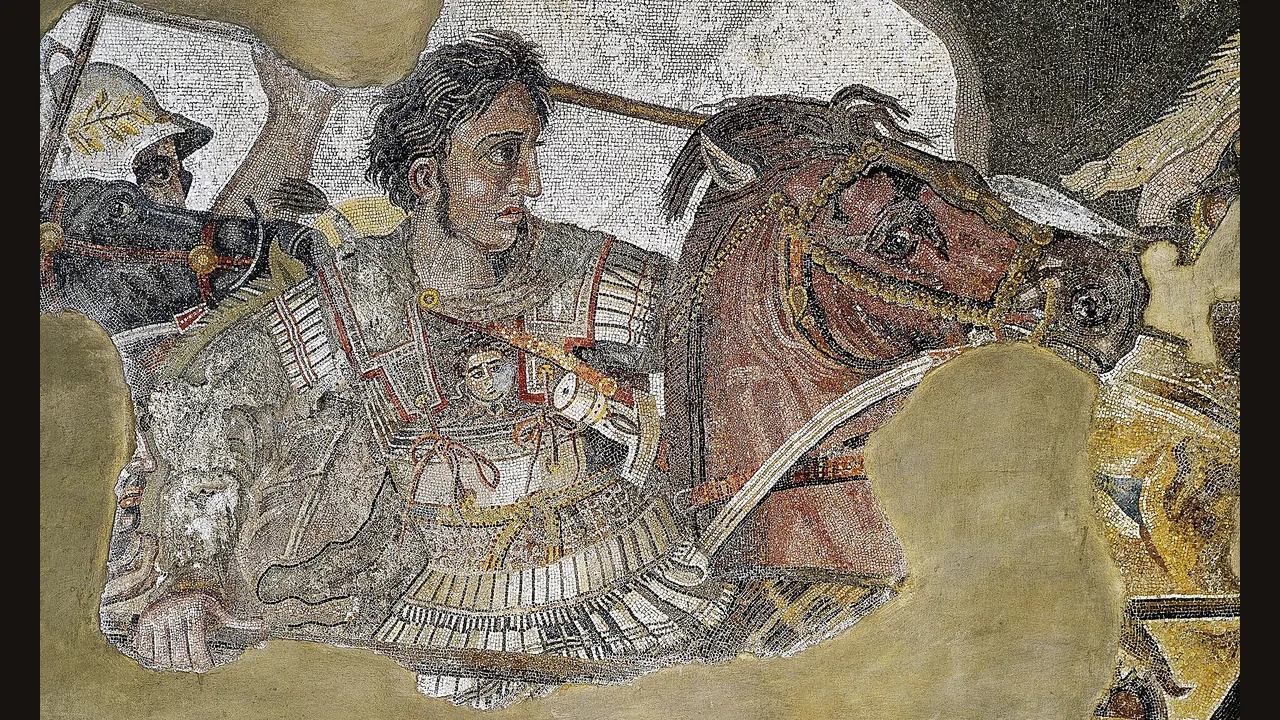
Ruler · Classical antiquity · Macedonian Empire · Greece
Alexander the Great
356–323 BC
King of Macedon from 336 to 323 BC, who conquered the Persian Empire before he was thirty three. He defeated Darius III at Issus and Gaugamela, founded Alexandria in Egypt, and marched to India before his army refused to go further. He died at Babylon in 323 BC and his generals divided the empire.
Alexander was born at Pella in 356 BC, the son of Philip II of Macedon and Olympias of Epirus. Philip had turned Macedon into the strongest power in Greece with a reformed army built around the sarissa, a pike far longer than Greek spears, and a professional cavalry. From about the age of thirteen to sixteen Alexander was taught by Aristotle at Mieza, and he carried a copy of the Iliad with him for the rest of his life. At the Battle of Chaeronea in 338 BC, aged eighteen, he commanded the cavalry that broke the Greek allied line. In 336 BC Philip was murdered at Aegae by a bodyguard, and Alexander became king at twenty.
He spent his first two years securing the throne. Greek states that revolted when Philip died submitted again. When Thebes rose in 335 BC Alexander stormed the city and destroyed it, sparing only the temples and the house of the poet Pindar. Six thousand Thebans died and the rest were sold into slavery, and no Greek city revolted again while he lived.
In the spring of 334 BC Alexander crossed into Asia with an army the sources put between 40,000 and 50,000 men. He defeated the Persian satraps at the Granicus river and then moved down the coast of Asia Minor, taking ports so the Persian fleet would have no bases. In November 333 BC he met Darius III, the Persian king, at Issus in Cilicia and routed his much larger army. Darius escaped, but his mother, wife, and children fell into Alexander's hands. Alexander refused an offer of half the empire and marched south. Tyre, an island fortress, held out for seven months in 332 BC until Alexander built a causeway to its walls. He founded Alexandria in Egypt that winter and visited the oracle of Ammon at Siwah, where the priests greeted him as the son of the god.
In October 331 BC Alexander met Darius again at Gaugamela in Mesopotamia and destroyed the last great Persian field army. Babylon and Susa surrendered, and his men took the royal treasure. In the spring of 330 BC Persepolis, the ceremonial capital of Persia, burned. Arrian and Diodorus give different accounts, and historians still dispute whether the fire was an accident at a drinking party, an act of revenge for the Persian burning of Athens in 480 BC, or a deliberate policy. Darius was murdered that summer by his own kinsman Bessus, who claimed the throne. Alexander pursued him into Bactria and Sogdiana, in what is now Afghanistan and Central Asia, and spent two hard years fighting local resistance. In 327 BC he married Roxane, the daughter of a Bactrian chief.
In 326 BC Alexander crossed the Indus into India and defeated King Porus at the Hydaspes river, restoring him as a subordinate ally afterward. At the Hyphasis river his men, soaked by the monsoon and worn by eight years of marching, refused to go further east. Alexander turned back. He led part of the army through the Gedrosian desert, where heat and short water killed large numbers. The figures in the sources are unreliable, but all agree the crossing was the worst loss of the expedition. By 324 BC he was back in Babylon, ruling an empire that ran from Greece to the Indus.
The last year of his life brought purges of officials, a mutiny at Opis settled by speeches and reconciliation, and the death of his closest friend Hephaestion at Ecbatana. Alexander planned an invasion of Arabia. In June 323 BC, after a drinking bout and a fever that worsened over days, he died at Babylon aged thirty two. The cause is unknown and will stay unknown. Modern writers have proposed malaria, typhoid fever, and poisoning, among others, and the ancient accounts do not carry enough reliable clinical detail to settle the question.
Alexander left no adult heir and no clear instruction for the succession. The story that he gave his ring to Perdiccas and said the empire should go to the strongest comes from later writers and may be invention. His generals fought over the inheritance for forty years, and out of their wars came the Hellenistic kingdoms, Ptolemaic Egypt, the Seleucid empire in Asia, and Antigonid Macedon. Greek cities, Greek language, and Greek coinage spread across the Near East, and Greek remained a language of government there for centuries. The surviving accounts are all late. Arrian, writing in the second century AD, used the lost memoirs of Ptolemy and Aristobulus and is judged the most careful. Plutarch, Diodorus, Curtius Rufus, and Justin preserve other traditions, and all of them rest on contemporary works that no longer exist.
Facts
- Born
- 356 BC, Pella, Macedon.
- Source: Encyclopaedia Britannica, Alexander the Great
- Died
- 323 BC, Babylon.
- Source: Encyclopaedia Britannica, Alexander the Great
- Reign
- 336 to 323 BC.
- Source: Encyclopaedia Britannica, Alexander the Great
- Realm
- An empire from Greece to India, divided after his death among his generals.
- Source: Encyclopaedia Britannica, Alexander the Great
- Known for
- Issus (333 BC), Gaugamela (331 BC), and the founding of Alexandria.
- Source: Encyclopaedia Britannica, Alexander the Great
Sources
- Encyclopaedia Britannica, Alexander the Great Source
Source links accessed 22 November 2026.
Images
Related
What happened elsewhere
Pairings are by recorded year, not exact simultaneity.
- ZhuangziWhile Alexander the Great (around 369 BC)
- MenciusWhile Alexander the Great (around 372 BC)
- Zeno of CitiumWhile Alexander the Great (around 334 BC)
- Mauryan EmpireWhile Alexander the Great (around 322 BC)
- XunziWhile Alexander the Great (around 310 BC)
Meanwhile
Meanwhile, around the world — drag to spin, click a pulsing marker.
Keep reading
Test yourself
When was Alexander the Great born?
- 356 BC, Pella, Macedon
- About 495 BC, Athens
- About 272, Naissus (now Nis in Serbia)
- 63 BC, Rome
Answer
356 BC, Pella, Macedon — Born: 356 BC, Pella, Macedon.
When did Alexander the Great die?
- 323 BC, Babylon
- 210 BC, on tour in eastern China
- 337, near Nicomedia
- 429 BC, of plague, Athens
Answer
323 BC, Babylon — Died: 323 BC, Babylon.
When did Alexander the Great reign?
- 336 to 323 BC
- 27 BC to 14 AD as Augustus
- 306 to 337
- As king of Qin 246 to 221 BC; as emperor 221 to 210 BC
Answer
336 to 323 BC — Reign: 336 to 323 BC.
What realm did Alexander the Great rule?
- An empire from Greece to India, divided after his death among his generals
- Qin China, the first unified Chinese empire
- Han dynasty China
- The Maurya Empire, covering most of the Indian subcontinent
Answer
An empire from Greece to India, divided after his death among his generals — Realm: An empire from Greece to India, divided after his death among his generals.
True or false: King of Macedon from 336 to 323 BC, who conquered the Persian Empire before he was thirty three.
- True
- False
Answer
True — True. King of Macedon from 336 to 323 BC, who conquered the Persian Empire before he was thirty three.
My notes
Highlights on this page
None yet.
Myth vs. evidence
The myth
Alexander solved the Gordian knot with one blow of his sword.
The evidence
The earliest accounts disagree. Aristobulus, who was present, said Alexander removed the pin from the pole and pulled the yoke free. The sword blow appears in later writers, and it made the better story.
Sources: Arrian, Anabasis 2.3, citing Aristobulus; Plutarch, Life of Alexander 18
Spotted an error on this page? Email [email protected] and it will be checked against the sources.