

Philosopher · Classical antiquity · Classical Athens · Greece
Democritus
c. 460–c. 370 BC
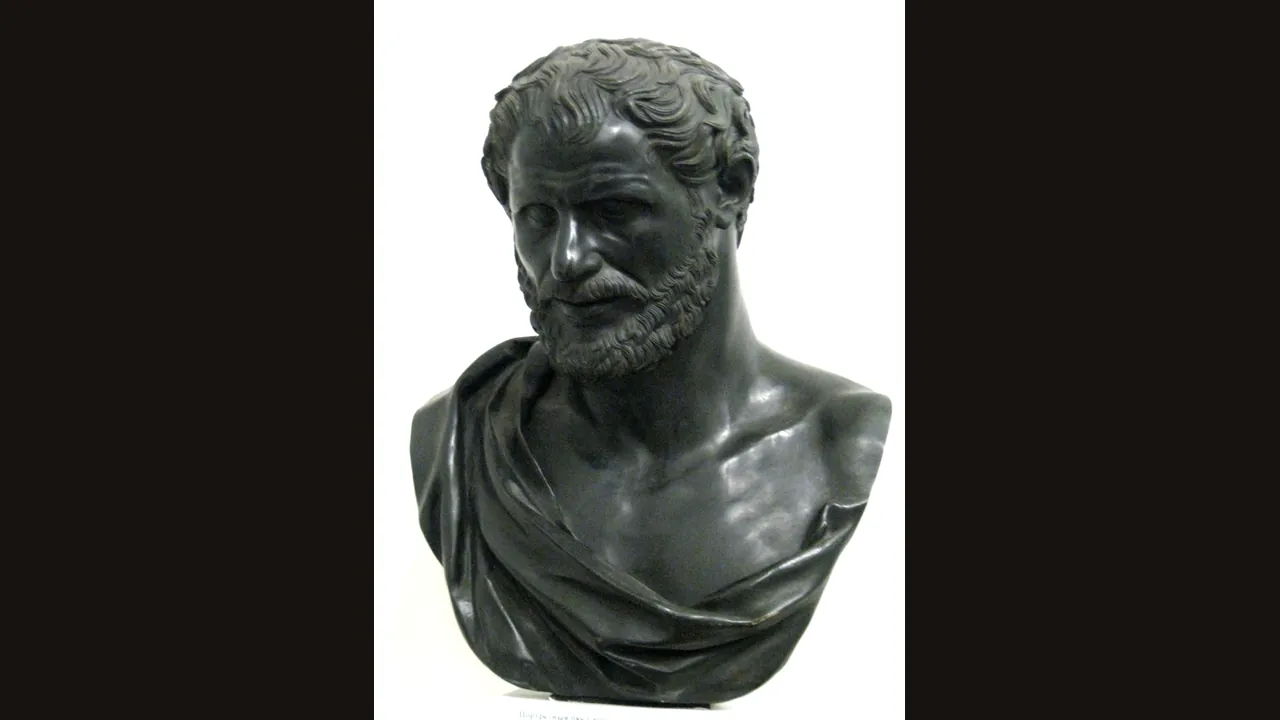
Greek thinker from Abdera who worked out the first full atomic theory: all things are made of indivisible atoms moving in empty void. He lived about 460 to 370 BC. His many books are lost; the theory survives through later reports and Epicurus.
Democritus came from Abdera in northern Greece and lived about 460 to 370 BC. Later writers report wide travels in Egypt and Persia, but the journeys cannot be verified. He studied under Leucippus, the founder of the atomic theory, and wrote on nature, mathematics, music, language, and conduct. Diogenes Laertius lists some seventy titles. Every book is lost, and the doctrine is known from the summaries and criticism of Aristotle and later authors, and from short fragments on ethics.
The theory holds that reality consists of atoms and void. Atoms are solid and indivisible; they differ in shape, size, and arrangement, and they move and collide in the empty space around them. Worlds form and dissolve as atoms gather and scatter, and this world is one among innumerable others. Qualities such as color, heat, and taste do not belong to atoms themselves. Democritus is reported to have said that by convention there is sweet and bitter, hot and cold, and color, while in truth there are atoms and void. In ethics he taught that cheerfulness of mind, won by measured pleasures and by freedom from fear and envy, is the aim of life.
Aristotle preserved the theory by arguing against it, and Epicurus took it over two generations later and made it the physics of his own school.
Facts
- Born
- About 460 BC, Abdera, Greece.
- Source: Encyclopaedia Britannica, Democritus
- Died
- About 370 BC.
- Source: Encyclopaedia Britannica, Democritus
- School
- Atomism, developed from his teacher Leucippus.
- Source: Encyclopaedia Britannica, Democritus
- Known for
- Atoms and the void as the explanation of all change, and an ethics of cheerfulness.
- Source: Encyclopaedia Britannica, Democritus
Sources
- Encyclopaedia Britannica, Democritus Source
Source links accessed 22 November 2026.
Images
Related
What happened elsewhere
Pairings are by recorded year, not exact simultaneity.
- MoziWhile Democritus (around 470 BC)
- Roman RepublicWhile Democritus (around 509 BC)
- ParmenidesWhile Democritus (around 515 BC)
- Diogenes of SinopeWhile Democritus (around 404 BC)
- Darius IWhile Democritus (around 522 BC)
Meanwhile
Meanwhile, around the world — drag to spin, click a pulsing marker.
Keep reading
Test yourself
When was Democritus born?
- About 460 BC, Abdera, Greece
- About 204, probably Lycopolis, Egypt
- 121, Rome, Italy
- About 310 BC, in the state of Zhao, China
Answer
About 460 BC, Abdera, Greece — Born: About 460 BC, Abdera, Greece.
When did Democritus die?
- About 370 BC
- About 286 BC
- About 450 BC
- About 391 BC
Answer
About 370 BC — Died: About 370 BC.
What is Democritus known for?
- Atoms and the void as the explanation of all change, and an ethics of cheerfulness
- The orations, the letters, and philosophical works like De re publica and De officiis that taught Rome to think in Greek categories
- The doctrine that human nature tends to good as water tends downhill, and that a ruler who starves his people loses the mandate to rule
- The doctrine of emptiness: things exist only in dependence on causes and concepts, and the two truths, conventional and ultimate
Answer
Atoms and the void as the explanation of all change, and an ethics of cheerfulness — Known for: Atoms and the void as the explanation of all change, and an ethics of cheerfulness.
Which school of thought was Democritus part of?
- Atomism, developed from his teacher Leucippus
- Confucianism, its idealist wing
- Cynicism, the practice of shamelessness and self sufficiency
- Stoicism, in its Roman practical form
Answer
Atomism, developed from his teacher Leucippus — School: Atomism, developed from his teacher Leucippus.
True or false: Greek thinker from Abdera who worked out the first full atomic theory: all things are made of indivisible atoms moving in empty void.
- True
- False
Answer
True — True. Greek thinker from Abdera who worked out the first full atomic theory: all things are made of indivisible atoms moving in empty void.
My notes
Highlights on this page
None yet.
Spotted an error on this page? Email [email protected] and it will be checked against the sources.