
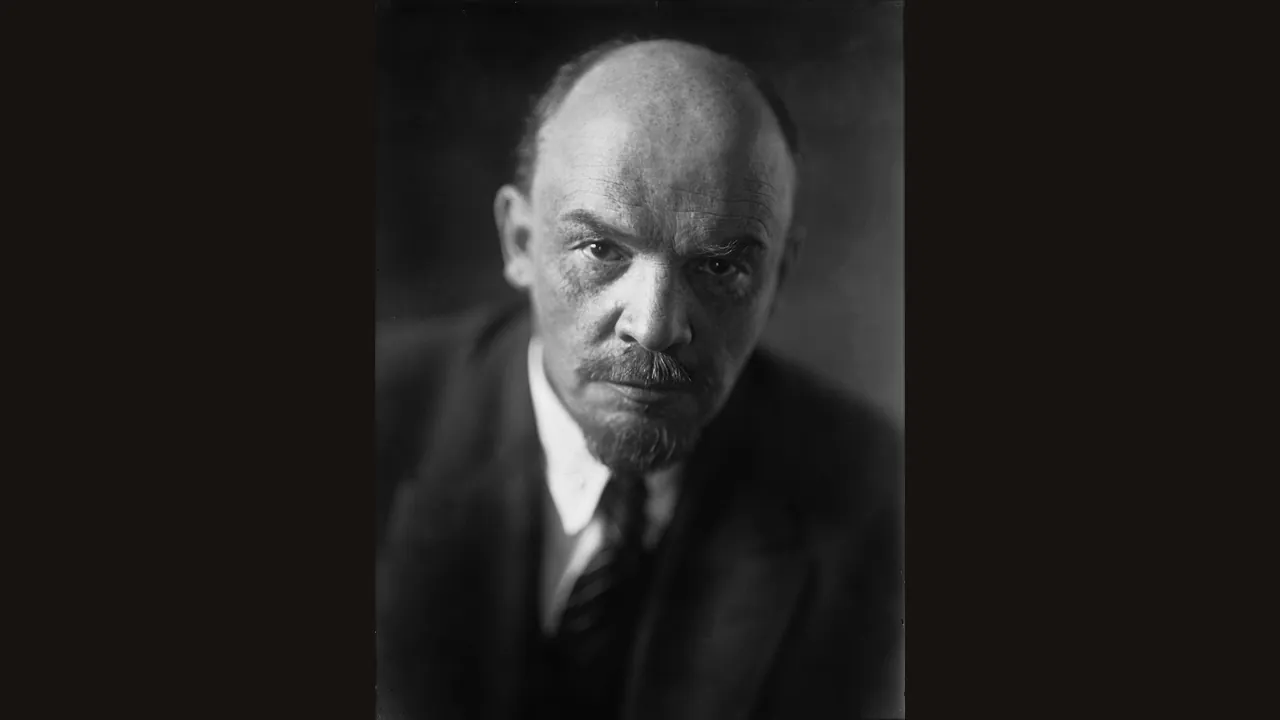
Ruler · Twentieth century · Russia
Vladimir Lenin
1870–1924
Leader of the Bolshevik Revolution, 1870 to 1924, born Vladimir Ulyanov, who created the first communist state. He seized power in Russia in October 1917, pulled Russia out of World War I, and won the civil war that followed. His New Economic Policy of 1921 retreated from full communism to save the economy.
Lenin, born Vladimir Ulyanov at Simbirsk in 1870, led the Bolsheviks and spent years in exile. He returned to Petrograd from Switzerland in April 1917. On 25 October 1917, Bolshevik forces seized the capital's bridges, telegraph offices, and government buildings and arrested the Provisional Government. Lenin headed the new government, the Council of People's Commissars, from 1917 to 1924. It decreed peace and land to the peasants, and signed the Treaty of Brest-Litovsk in March 1918, ceding territories to Germany.
In December 1917 the government created the Cheka, a police under Felix Dzerzhinsky. After an assassin wounded Lenin in August 1918, the government proclaimed the Red Terror, and the Cheka shot hostages and people classed as enemies of the revolution. Historians estimate the executions in the tens of thousands. During the civil war the state seized peasant grain under quotas, the prodrazvyorstka. Requisitioning and harvest failure produced the famine of 1921 and 1922, and historians estimate about five million deaths. In March 1921 Kronstadt sailors rose against the government, and the Red Army stormed their fortress across the ice and crushed the rising.
That month the Tenth Party Congress banned factions inside the party, and requisitioning gave way to a tax in kind under the New Economic Policy. The Soviet Union was formed in December 1922. Lenin suffered strokes from May 1922 and died at Gorki on 21 January 1924.
Watch
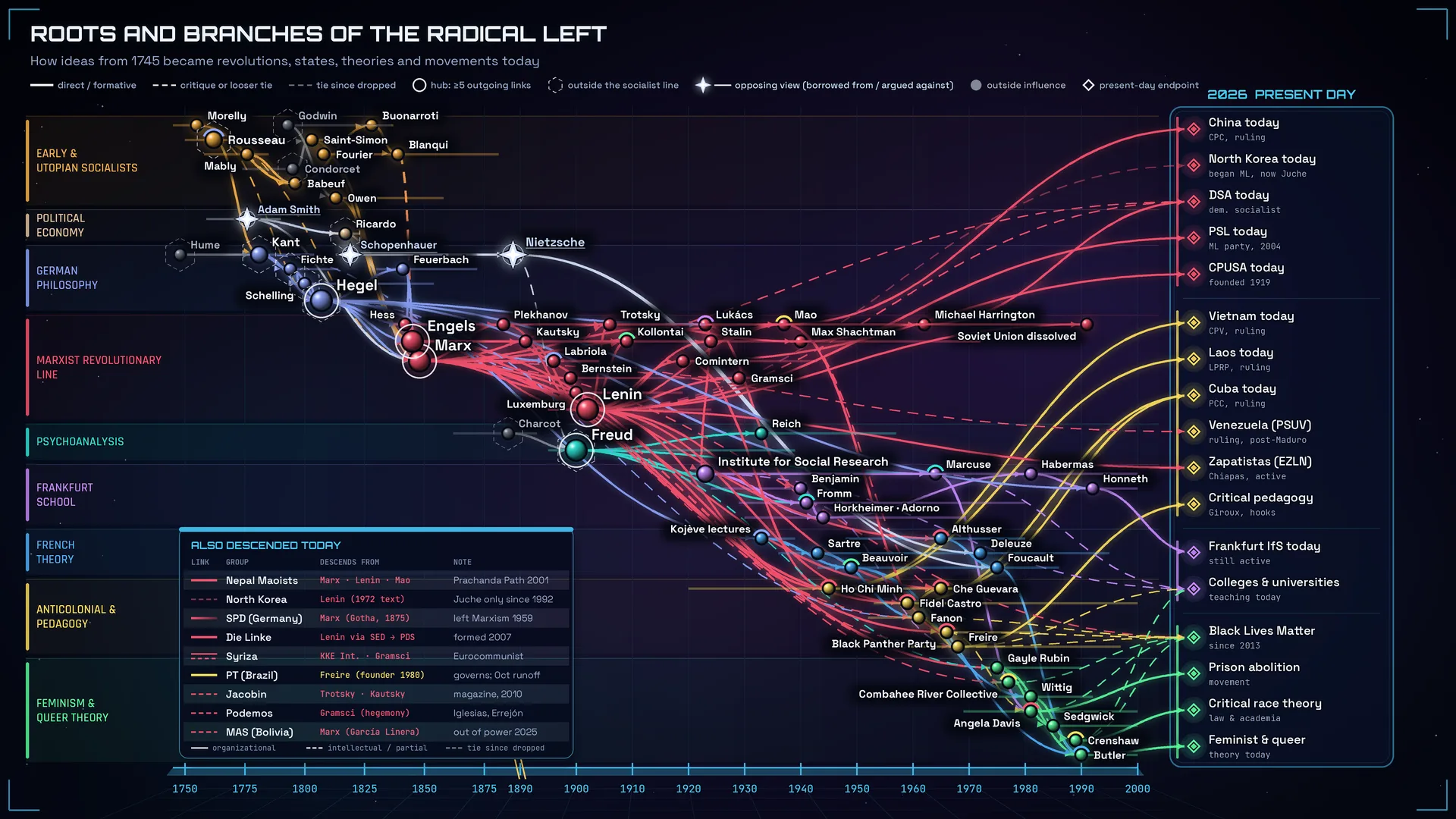
Roots and Branches of the Radical Left
Events · 2026-10-15
Socialism is presented as an economic theory. In reality, woven through every part of the theory are two things that must be adopted before socialism can "work properly": a pseudo-history of mankind, and a massive shift of worldview. Both rest on a fundamental lie about human nature: they blame man's conditions for what belongs to the man himself.
That ideology did not appear from nowhere. It grew out of long-standing ideas, taken up across a chain of events and twisted over time into a promise of a better way for human beings to live, which is why the whole runs far deeper and is far more complex than the economic label suggests. Along the way it was woven in and out of great thinkers, at different points and for different reasons. Some were used for it and some against it, and through all of it the idea kept building.
This map lays that out where it can be seen: the evolution of the ideas, the effects they had, and the chain of cause and effect that followed from thinker to thinker.
Facts
- Born
- 1870, Simbirsk.
- Source: Encyclopaedia Britannica, Vladimir Lenin
- Died
- 1924, Gorki, near Moscow.
- Source: Encyclopaedia Britannica, Vladimir Lenin
- Office
- Chairman of the Council of People's Commissars 1917 to 1924.
- Source: Encyclopaedia Britannica, Vladimir Lenin
- Known for
- The October Revolution (1917) and the founding of the Soviet Union (1922).
- Source: Encyclopaedia Britannica, Vladimir Lenin
Sources
- Encyclopaedia Britannica, Vladimir Lenin Source
Source links accessed 22 November 2026.
Images
Related
- Joseph StalinConnected
- RussiaConnected
- The ChekaSame civilization
- Soviet UnionSame civilization
- HolodomorSame civilization
- Stalin's TerrorSame civilization
What happened elsewhere
Pairings are by recorded year, not exact simultaneity.
- Bertrand RussellWhile Vladimir Lenin (1872)
- CanadaWhile Vladimir Lenin (1867)
- Winston ChurchillWhile Vladimir Lenin (1874)
- Sun Yat-senWhile Vladimir Lenin (1866)
- RomaniaWhile Vladimir Lenin (1878)
Meanwhile
Meanwhile, around the world — drag to spin, click a pulsing marker.
Keep reading
Test yourself
When was Vladimir Lenin born?
- 1870, Simbirsk
- 1881, Salonica
- 1889, Braunau am Inn, Austria
- 1883, Predappio
Answer
1870, Simbirsk — Born: 1870, Simbirsk.
When did Vladimir Lenin die?
- 1924, Gorki, near Moscow
- 1989, Tokyo
- 2016, Havana
- 1925, Beijing
Answer
1924, Gorki, near Moscow — Died: 1924, Gorki, near Moscow.
What is Vladimir Lenin known for?
- The October Revolution (1917) and the founding of the Soviet Union (1922)
- The wartime speeches of 1940 and the Nobel Prize in Literature (1953)
- The New Deal and American leadership in World War II
- The Cambodian genocide, 1975 to 1979
Answer
The October Revolution (1917) and the founding of the Soviet Union (1922) — Known for: The October Revolution (1917) and the founding of the Soviet Union (1922).
True or false: Leader of the Bolshevik Revolution, 1870 to 1924, born Vladimir Ulyanov, who created the first communist state.
- True
- False
Answer
True — True. Leader of the Bolshevik Revolution, 1870 to 1924, born Vladimir Ulyanov, who created the first communist state.
Articles
My notes
Highlights on this page
None yet.
Spotted an error on this page? Email [email protected] and it will be checked against the sources.