

Philosopher · Twentieth century · England
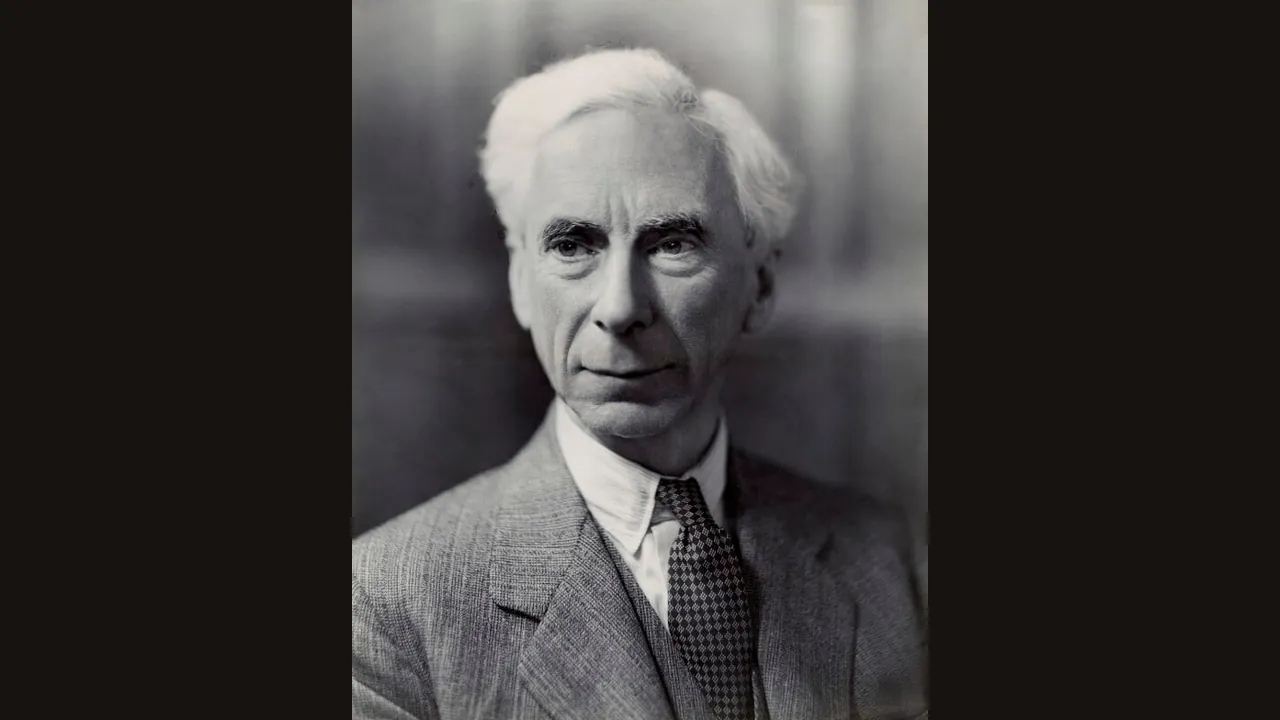
Bertrand Russell
1872–1970
English logician, philosopher, and public campaigner who co wrote Principia Mathematica and won the Nobel Prize in Literature in 1950. He moved from logic to pacifism to nuclear disarmament across a 98 year life, 1872 to 1970.
Bertrand Russell was born in 1872 at Trellech in Wales, the grandson of Lord John Russell, a former prime minister. Orphaned in early childhood, he was raised by his grandmother at Pembroke Lodge in Richmond. He studied mathematics and philosophy at Trinity College, Cambridge, and became a fellow in 1895. Cambridge removed his lectureship in 1916 over his antiwar campaigning, and in 1918 he spent six months in Brixton prison for a pacifist article. He received the Nobel Prize in Literature in 1950 and died in Wales in 1970.
Principia Mathematica, written with A. N. Whitehead and published from 1910 to 1913, derived arithmetic from a few logical axioms, guarded by a theory of types against self reference. The types answered the paradox Russell had found in Frege's system in 1901: the class of all classes that are not members of themselves both is and is not a member of itself. On Denoting of 1905 gave the theory of descriptions, analyzing phrases such as the present king of France as claims that exactly one thing answers to a description. The Problems of Philosophy of 1912 and A History of Western Philosophy of 1945 carried his thought to general readers. In his last decades he campaigned against nuclear weapons, signed the 1955 manifesto with Einstein, and was convicted twice at protest sit downs in his late eighties.
Facts
- Born
- 1872, Trellech, Wales.
- Source: Encyclopaedia Britannica, Bertrand Russell
- Died
- 1970, Penrhyndeudraeth, Wales.
- Source: Encyclopaedia Britannica, Bertrand Russell
- School
- Analytic philosophy; logical atomism.
- Source: Encyclopaedia Britannica, Bertrand Russell
- Known for
- Russell's paradox, the theory of descriptions, Principia Mathematica with Whitehead, and a century of political causes.
- Source: Encyclopaedia Britannica, Bertrand Russell
Sources
- Encyclopaedia Britannica, Bertrand Russell Source
Source links accessed 22 November 2026.
Images
Related
- Gottlob FregeConnected
- Ludwig WittgensteinConnected
- Karl PopperConnected
- Willard Van Orman QuineConnected
- Vladimir LeninSame era
- Winston ChurchillSame era
What happened elsewhere
Pairings are by recorded year, not exact simultaneity.
- Vladimir LeninWhile Bertrand Russell (1870)
- Winston ChurchillWhile Bertrand Russell (1874)
- CanadaWhile Bertrand Russell (1867)
- Joseph StalinWhile Bertrand Russell (1878)
- Sun Yat-senWhile Bertrand Russell (1866)
Meanwhile
Meanwhile, around the world — drag to spin, click a pulsing marker.
Keep reading
Test yourself
When was Bertrand Russell born?
- 1872, Trellech, Wales
- 1921, Baltimore, Maryland, United States
- 1908, Akron, Ohio, United States
- 1928, Philadelphia, Pennsylvania, United States
Answer
1872, Trellech, Wales — Born: 1872, Trellech, Wales.
When did Bertrand Russell die?
- 1970, Penrhyndeudraeth, Wales
- 1951, Cambridge, England
- 1976, Freiburg, Germany
- 2002, Lexington, Massachusetts
Answer
1970, Penrhyndeudraeth, Wales — Died: 1970, Penrhyndeudraeth, Wales.
What is Bertrand Russell known for?
- Russell's paradox, the theory of descriptions, Principia Mathematica with Whitehead, and a century of political causes
- Power knowledge, the panopticon, Madness and Civilization, and the History of Sexuality
- Bad faith, the look of the other, and the slogan that man is condemned to be free
- Being and Time, Dasein, being toward death, and the later critique of technology
Answer
Russell's paradox, the theory of descriptions, Principia Mathematica with Whitehead, and a century of political causes — Known for: Russell's paradox, the theory of descriptions, Principia Mathematica with Whitehead, and a century of political causes.
Which school of thought was Bertrand Russell part of?
- Analytic philosophy; logical atomism
- Generative linguistics; analytic philosophy of language
- Analytic philosophy; naturalism
- Deconstruction; post structuralism
Answer
Analytic philosophy; logical atomism — School: Analytic philosophy; logical atomism.
True or false: English logician, philosopher, and public campaigner who co wrote Principia Mathematica and won the Nobel Prize in Literature in 1950.
- True
- False
Answer
True — True. English logician, philosopher, and public campaigner who co wrote Principia Mathematica and won the Nobel Prize in Literature in 1950.
My notes
Highlights on this page
None yet.
Spotted an error on this page? Email [email protected] and it will be checked against the sources.