

Philosopher · Age of revolutions and empire · Germany
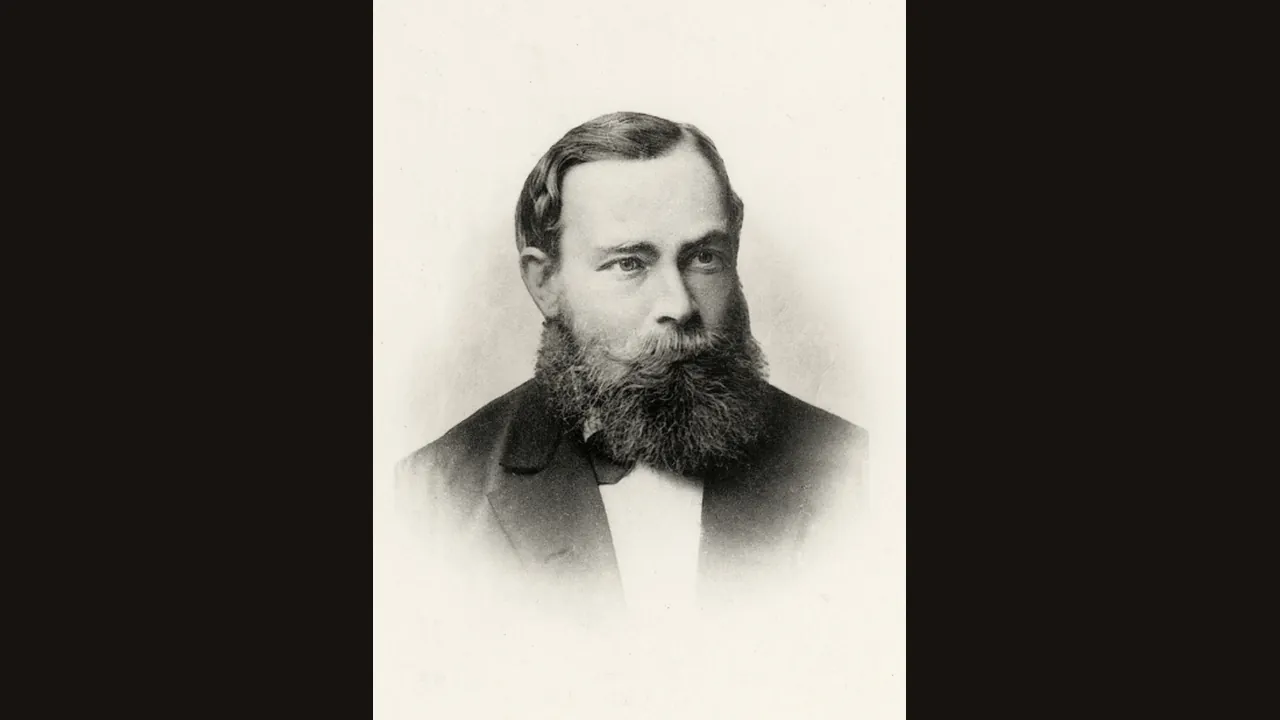
Gottlob Frege
1848–1925
German mathematician and logician who founded analytic philosophy by inventing modern logic. His Begriffsschrift of 1879 rebuilt reasoning on exact symbols. Russell's paradox broke his life's work, the reduction of arithmetic to logic. He lived 1848 to 1925.
Gottlob Frege was born in 1848 at Wismar, the son of a school headmaster. He studied at Jena and at Göttingen, where he took his doctorate in mathematics in 1873, and he taught mathematics at Jena, becoming a professor in 1896. His books and papers drew few readers in his lifetime. He retired in 1918 and died at Bad Kleinen in 1925.
The Begriffsschrift of 1879 gave the first system of predicate logic: it analyzed sentences by function and argument rather than subject and predicate, and it bound variables with quantifiers, so that statements about all things and some things gained exact form. Frege's program, logicism, held that arithmetic is logic, and The Foundations of Arithmetic of 1884 argued that a statement of number is an assertion about a concept. The Basic Laws of Arithmetic of 1893 and 1903 constructed the system. Its fifth basic law treated the extension of every concept as an object, and in June 1902 Russell wrote to Frege with the paradox of the class of all classes that are not members of themselves. Frege added an appendix to the second volume acknowledging that the law had to go. In the papers of 1892 he distinguished the sense of a sign, the way its object is presented, from its reference, and he held that words have meaning only within sentences.
Facts
- Born
- 1848, Wismar, Germany.
- Source: Encyclopaedia Britannica, Gottlob Frege
- Died
- 1925, Bad Kleinen, Germany.
- Source: Encyclopaedia Britannica, Gottlob Frege
- School
- Analytic philosophy, its founder; logicism.
- Source: Encyclopaedia Britannica, Gottlob Frege
- Known for
- Modern predicate logic, the sense and reference distinction, and the logicist program.
- Source: Encyclopaedia Britannica, Gottlob Frege
Sources
- Encyclopaedia Britannica, Gottlob Frege Source
Source links accessed 22 November 2026.
Images
Related
- Bertrand RussellConnected
- Ludwig WittgensteinConnected
- Friedrich NietzscheSame era
- MeijiSame era
- Gustave Le BonSame era
- Edmund HusserlSame era
What happened elsewhere
Pairings are by recorded year, not exact simultaneity.
- LiberiaWhile Gottlob Frege (1847)
- GuatemalaWhile Gottlob Frege (1847)
- MeijiWhile Gottlob Frege (1852)
- Dominican RepublicWhile Gottlob Frege (1844)
- New CaledoniaWhile Gottlob Frege (1853)
Meanwhile
Meanwhile, around the world — drag to spin, click a pulsing marker.
Keep reading
Test yourself
When was Gottlob Frege born?
- 1848, Wismar, Germany
- 1813, Copenhagen, Denmark
- 1788, Danzig, in what is now Poland
- 1798, Montpellier, France
Answer
1848, Wismar, Germany — Born: 1848, Wismar, Germany.
When did Gottlob Frege die?
- 1925, Bad Kleinen, Germany
- 1873, Avignon, France
- 1814, Berlin, of typhus
- 1854, Ragaz, Switzerland
Answer
1925, Bad Kleinen, Germany — Died: 1925, Bad Kleinen, Germany.
What is Gottlob Frege known for?
- Modern predicate logic, the sense and reference distinction, and the logicist program
- The System of Transcendental Idealism of 1800 and the philosophy of nature, Naturphilosophie
- On Liberty, Utilitarianism, and The Subjection of Women, an early argument for women's equality
- The world as will and representation, and the ethics of compassion and ascetic denial
Answer
Modern predicate logic, the sense and reference distinction, and the logicist program — Known for: Modern predicate logic, the sense and reference distinction, and the logicist program.
Which school of thought was Gottlob Frege part of?
- Analytic philosophy, its founder; logicism
- German idealism
- Existentialism, its Christian founder
- Utilitarianism and liberalism
Answer
Analytic philosophy, its founder; logicism — School: Analytic philosophy, its founder; logicism.
True or false: German mathematician and logician who founded analytic philosophy by inventing modern logic.
- True
- False
Answer
True — True. German mathematician and logician who founded analytic philosophy by inventing modern logic.
My notes
Highlights on this page
None yet.
Spotted an error on this page? Email [email protected] and it will be checked against the sources.