

Philosopher · Age of revolutions and empire · Czechia
Edmund Husserl
1859–1938
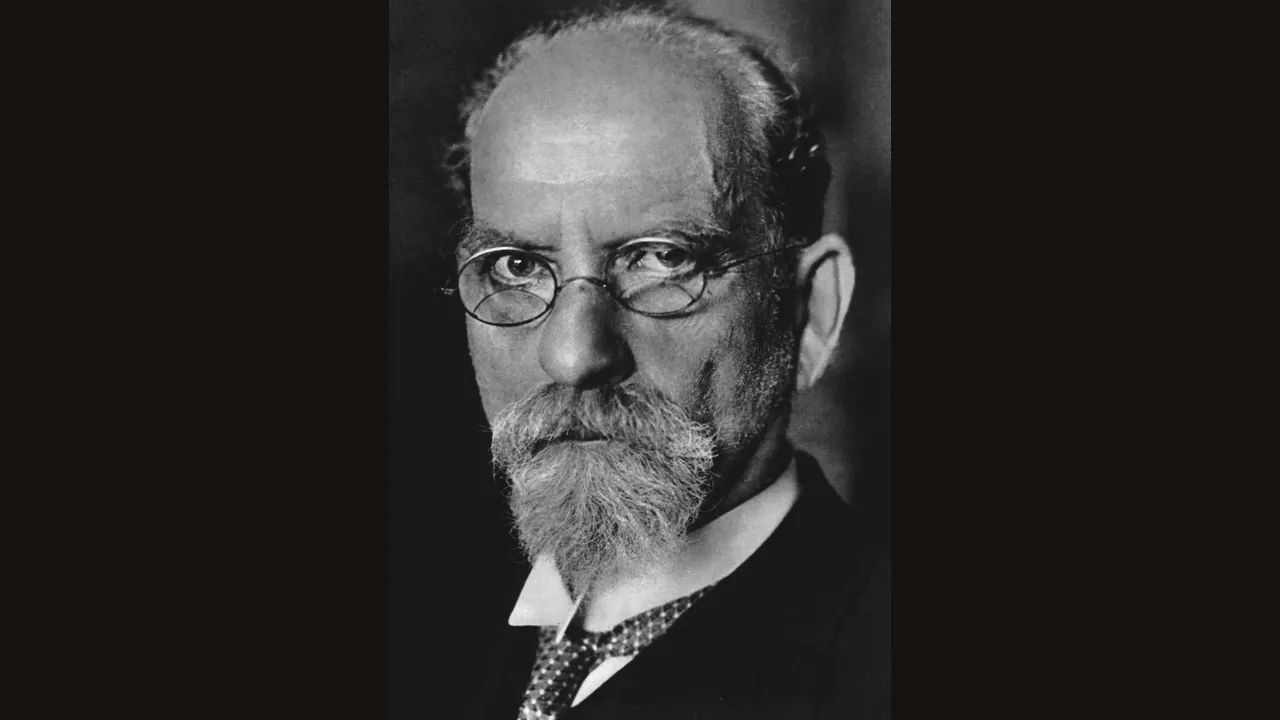
Moravian born German thinker who founded phenomenology, the study of things as they appear to consciousness. His motto was back to the things themselves. He lived 1859 to 1938, stripped of his posts by the Nazis.
Edmund Husserl was born in 1859 at Prossnitz in Moravia, then part of the Austrian Empire, into a Jewish merchant family. He studied mathematics at Leipzig and Berlin and took his doctorate at Vienna in 1883. Brentano's lectures at Vienna turned him from mathematics to philosophy. He taught at Halle from 1887, at Göttingen from 1901, and at Freiburg from 1916 to 1928. He had joined the Lutheran church in 1886; the Nazi racial laws still barred him from the university. He died at Freiburg in 1938.
Husserl founded phenomenology, the description of experience. The Logical Investigations of 1900 and 1901 attacked psychologism, the treatment of logic as a chapter of psychology, and defended the objectivity of meanings and truths. Consciousness, following Brentano, is intentional: every act aims at an object, perceiving at something perceived, remembering at something remembered. The reduction, or epoché, suspends belief in the existence of the world so that the structures of experience can be described without presupposition, and free variation strips an example to its essence. Ideas of 1913 presented the method as a complete transcendental philosophy. The Crisis of European Sciences, published in part in 1936, charged the sciences with forgetting the lifeworld they presuppose.
Facts
- Born
- 1859, Prossnitz, Moravia, in what is now Czechia.
- Source: Encyclopaedia Britannica, Edmund Husserl
- Died
- 1938, Freiburg, Germany.
- Source: Encyclopaedia Britannica, Edmund Husserl
- School
- Phenomenology, its founder.
- Source: Encyclopaedia Britannica, Edmund Husserl
- Known for
- Intentionality, the phenomenological reduction, and the Logical Investigations of 1900.
- Source: Encyclopaedia Britannica, Edmund Husserl
Sources
- Encyclopaedia Britannica, Edmund Husserl Source
Source links accessed 22 November 2026.
Images
Related
- Martin HeideggerConnected
- Jean-Paul SartreConnected
- Jacques DerridaConnected
- MeijiSame era
- Gottlob FregeSame era
- Friedrich NietzscheSame era
What happened elsewhere
Pairings are by recorded year, not exact simultaneity.
- ItalyWhile Edmund Husserl (1861)
- New CaledoniaWhile Edmund Husserl (1853)
- MeijiWhile Edmund Husserl (1852)
- Sun Yat-senWhile Edmund Husserl (1866)
- CanadaWhile Edmund Husserl (1867)
Meanwhile
Meanwhile, around the world — drag to spin, click a pulsing marker.
Keep reading
Test yourself
When was Edmund Husserl born?
- 1859, Prossnitz, Moravia, in what is now Czechia
- 1770, Stuttgart, Germany
- 1813, Copenhagen, Denmark
- 1762, Rammenau, Saxony, Germany
Answer
1859, Prossnitz, Moravia, in what is now Czechia — Born: 1859, Prossnitz, Moravia, in what is now Czechia.
When did Edmund Husserl die?
- 1938, Freiburg, Germany
- 1857, Paris
- 1855, Copenhagen
- 1860, Frankfurt, Germany
Answer
1938, Freiburg, Germany — Died: 1938, Freiburg, Germany.
What is Edmund Husserl known for?
- Intentionality, the phenomenological reduction, and the Logical Investigations of 1900
- The Wissenschaftslehre, the science of knowledge, and the Addresses to the German Nation of 1808
- The leap of faith, the three stages of life, aesthetic, ethical, religious, and the attack on comfortable Christendom
- Modern predicate logic, the sense and reference distinction, and the logicist program
Answer
Intentionality, the phenomenological reduction, and the Logical Investigations of 1900 — Known for: Intentionality, the phenomenological reduction, and the Logical Investigations of 1900.
Which school of thought was Edmund Husserl part of?
- Phenomenology, its founder
- Existentialism, its Christian founder
- Marxism, historical materialism
- Utilitarianism and liberalism
Answer
Phenomenology, its founder — School: Phenomenology, its founder.
True or false: Moravian born German thinker who founded phenomenology, the study of things as they appear to consciousness.
- True
- False
Answer
True — True. Moravian born German thinker who founded phenomenology, the study of things as they appear to consciousness.
My notes
Highlights on this page
None yet.
Spotted an error on this page? Email [email protected] and it will be checked against the sources.