

Philosopher · Age of revolutions and empire · Germany
Friedrich Nietzsche
1844–1900
German thinker who announced the death of God and demanded a revaluation of all values. Thus Spoke Zarathustra, Beyond Good and Evil, and the Genealogy of Morals made him philosophy's great stylist and destroyer. He collapsed in 1889 and lived 1844 to 1900.
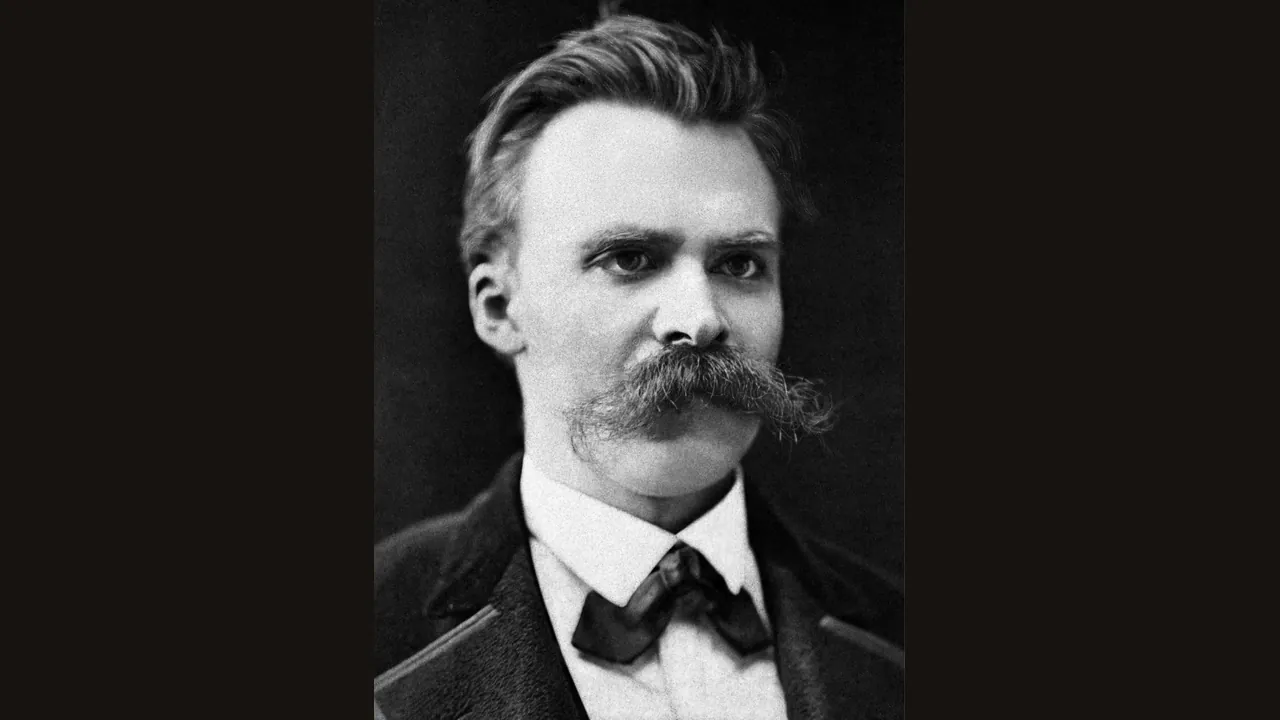
Friedrich Nietzsche was born in Röcken in Saxony in 1844, the son of a Lutheran pastor who died when the boy was four. He was raised in Naumburg by his mother, grandmother, sister Elisabeth, and two aunts, and he excelled at the boarding school of Schulpforta. He studied theology and then philology at Bonn and Leipzig, where in 1865 he read Schopenhauer and found his philosopher. Leipzig recommended him to the chair of classical philology at Basel, which he took at twenty four, renouncing his Prussian citizenship and never acquiring another. In 1870 he served as a medical orderly in the war against France, caught dysentery and diphtheria, and came home with his health ruined.
At Basel he fell under the spell of Richard Wagner, whom he visited constantly at Tribschen, and his first book, The Birth of Tragedy of 1872, read Greek tragedy as the marriage of two drives, the Apollonian, which gives form and image, and the Dionysian, which dissolves form in ecstasy and suffering. The book was a manifesto for Wagner's art disguised as scholarship, and the young philologist Ulrich von Wilamowitz Moellendorff savaged it, ending his standing in the profession. The break with Wagner came over his antisemitism, his German nationalism, and the Christianity of Parsifal, and the friendship curdled into a feud in print. His health collapsed under migraines and failing eyesight, and in 1879 he resigned his chair. He spent the next decade wandering between the Swiss Alps, the French Riviera, and Italy, writing in short intense bursts. His proposal of marriage to Lou Salomé, carried by Paul Rée in 1882, was refused, and two friendships soured.
The books of this decade made his name after his death. The Gay Science of 1882 prints his most famous sentence in the mouth of a madman: God is dead, and we have killed him. The sentence records a cultural judgment rather than a celebration: educated Europe had ceased to believe, and the morality built on that belief was losing its foundation, so nihilism stood at the door. The same book poses the test of eternal recurrence, the thought that one's life will repeat itself exactly, forever, and asks whether a man can will it so. Thus Spoke Zarathustra, written between 1883 and 1885, preaches the Übermensch, who creates his own values after God's death, against the comfortable last man. Beyond Good and Evil followed in 1886 and On the Genealogy of Morals in 1887. The Genealogy argues that morality has a history. Master morality, the valuation of the noble, calls itself good and the common bad. Slave morality begins when ressentiment becomes creative in the priestly type and revalues weakness as humility, poverty as virtue, and impotence as goodness. Modern democratic morality, in his reading, is the heir of that slave revolt.
The will to power runs through the late books as his name for the drive in all life to grow, overcome, and impose form. The book published under that title after his death was assembled by his sister from his notebooks and is not a work he prepared. Scholars dispute how central the doctrine is to his finished thought; the critical edition by Giorgio Colli and Mazzino Montinari settled the textual facts without settling the interpretation. He despised antisemites and called them a class governed by resentment; he broke with German nationalism; he also praised rank, severity, and war, denied that pity should govern conduct, and treated democracy and socialism as herd movements. Democratic readers who keep the critic of Christianity and discard the aristocrat are editing him, and the texts do not permit the edit.
In January 1889 in Turin his mind broke. The famous story that he embraced a beaten horse rests on late anecdote and cannot be verified. He lived eleven more years in collapse, under his mother's care, then his sister's, growing famous across Europe, and died at Weimar in 1900. Elisabeth Förster Nietzsche, whose husband Bernhard Förster had been a leading antisemitic agitator, ran the Nietzsche Archive and dressed her brother's remains in the nationalism he had scorned. The Nazi regime honored him accordingly. After 1945, Walter Kaufmann's scholarship documented Nietzsche's contempt for antisemitism and German nationalism and largely broke the fascist claim on him. A newer dispute continues: critics such as Domenico Losurdo argue that the aristocratic radicalism is the core of the thought and genuinely dangerous, while defenders answer that a thinker is not answerable for uses his own stated positions condemn.
He reshaped the questions of existentialism, supplied Foucault with the genealogical method, and stands behind Derrida's reading of texts, while Freud acknowledged that Nietzsche's guesses about the mind anticipated psychoanalysis. Novelists and poets from Thomas Mann to Yeats built on him. Modern arguments about morality as disguised power descend from the Genealogy, and his diagnosis of resentment as the engine of moralizing politics remains the sharpest weapon of its kind.
Watch
Roots and Branches of the Radical Left
Events · 2026-10-15
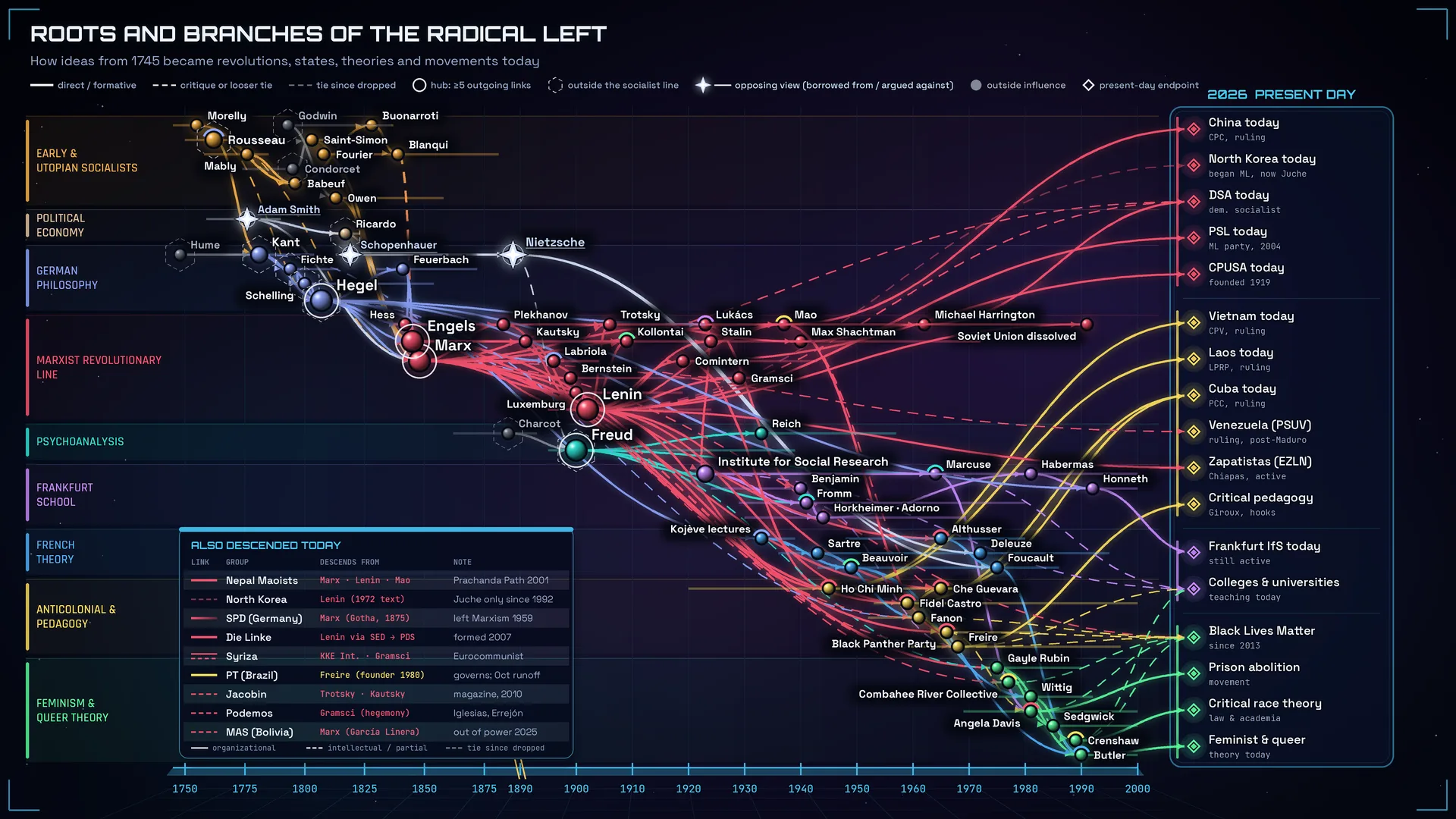
Socialism is presented as an economic theory. In reality, woven through every part of the theory are two things that must be adopted before socialism can "work properly": a pseudo-history of mankind, and a massive shift of worldview. Both rest on a fundamental lie about human nature: they blame man's conditions for what belongs to the man himself.
That ideology did not appear from nowhere. It grew out of long-standing ideas, taken up across a chain of events and twisted over time into a promise of a better way for human beings to live, which is why the whole runs far deeper and is far more complex than the economic label suggests. Along the way it was woven in and out of great thinkers, at different points and for different reasons. Some were used for it and some against it, and through all of it the idea kept building.
This map lays that out where it can be seen: the evolution of the ideas, the effects they had, and the chain of cause and effect that followed from thinker to thinker.
Facts
- Born
- 1844, Röcken, Germany.
- Source: Encyclopaedia Britannica, Friedrich Nietzsche
- Died
- 1900, Weimar, Germany, after eleven years of mental collapse.
- Source: Encyclopaedia Britannica, Friedrich Nietzsche
- School
- None; the critic of all schools.
- Source: Encyclopaedia Britannica, Friedrich Nietzsche
- Known for
- God is dead, the will to power, the Übermensch, master and slave morality, and the eternal recurrence.
- Source: Encyclopaedia Britannica, Friedrich Nietzsche
Sources
- Encyclopaedia Britannica, Friedrich Nietzsche Source
Source links accessed 22 November 2026.
Images
Related
- Arthur SchopenhauerConnected
- Michel FoucaultConnected
- Albert CamusConnected
- Gustave Le BonSame era
- Gottlob FregeSame era
- MeijiSame era
What happened elsewhere
Pairings are by recorded year, not exact simultaneity.
- Dominican RepublicWhile Friedrich Nietzsche (1844)
- Gustave Le BonWhile Friedrich Nietzsche (1841)
- LiberiaWhile Friedrich Nietzsche (1847)
- El SalvadorWhile Friedrich Nietzsche (1841)
- GuatemalaWhile Friedrich Nietzsche (1847)
Meanwhile
Meanwhile, around the world — drag to spin, click a pulsing marker.
Keep reading
Test yourself
When was Friedrich Nietzsche born?
- 1844, Röcken, Germany
- 1848, Wismar, Germany
- 1788, Danzig, in what is now Poland
- 1818, Trier, Germany
Answer
1844, Röcken, Germany — Born: 1844, Röcken, Germany.
When did Friedrich Nietzsche die?
- 1900, Weimar, Germany, after eleven years of mental collapse
- 1925, Bad Kleinen, Germany
- 1873, Avignon, France
- 1860, Frankfurt, Germany
Answer
1900, Weimar, Germany, after eleven years of mental collapse — Died: 1900, Weimar, Germany, after eleven years of mental collapse.
What is Friedrich Nietzsche known for?
- God is dead, the will to power, the Übermensch, master and slave morality, and the eternal recurrence
- On Liberty, Utilitarianism, and The Subjection of Women, an early argument for women's equality
- The leap of faith, the three stages of life, aesthetic, ethical, religious, and the attack on comfortable Christendom
- The dialectic of the Logic and the Phenomenology, the master and slave struggle, and the claim that the real is the rational. The formula 'thesis, antithesis, synthesis' attached to his name comes from Fichte and later textbooks, not from Hegel
Answer
God is dead, the will to power, the Übermensch, master and slave morality, and the eternal recurrence — Known for: God is dead, the will to power, the Übermensch, master and slave morality, and the eternal recurrence.
Which school of thought was Friedrich Nietzsche part of?
- None; the critic of all schools
- Existentialism, its Christian founder
- Analytic philosophy, its founder; logicism
- Post Kantian pessimism, drawing on Indian thought
Answer
None; the critic of all schools — School: None; the critic of all schools.
True or false: German thinker who announced the death of God and demanded a revaluation of all values.
- True
- False
Answer
True — True. German thinker who announced the death of God and demanded a revaluation of all values.
Articles
My notes
Highlights on this page
None yet.
Spotted an error on this page? Email [email protected] and it will be checked against the sources.