

Philosopher · Twentieth century · France
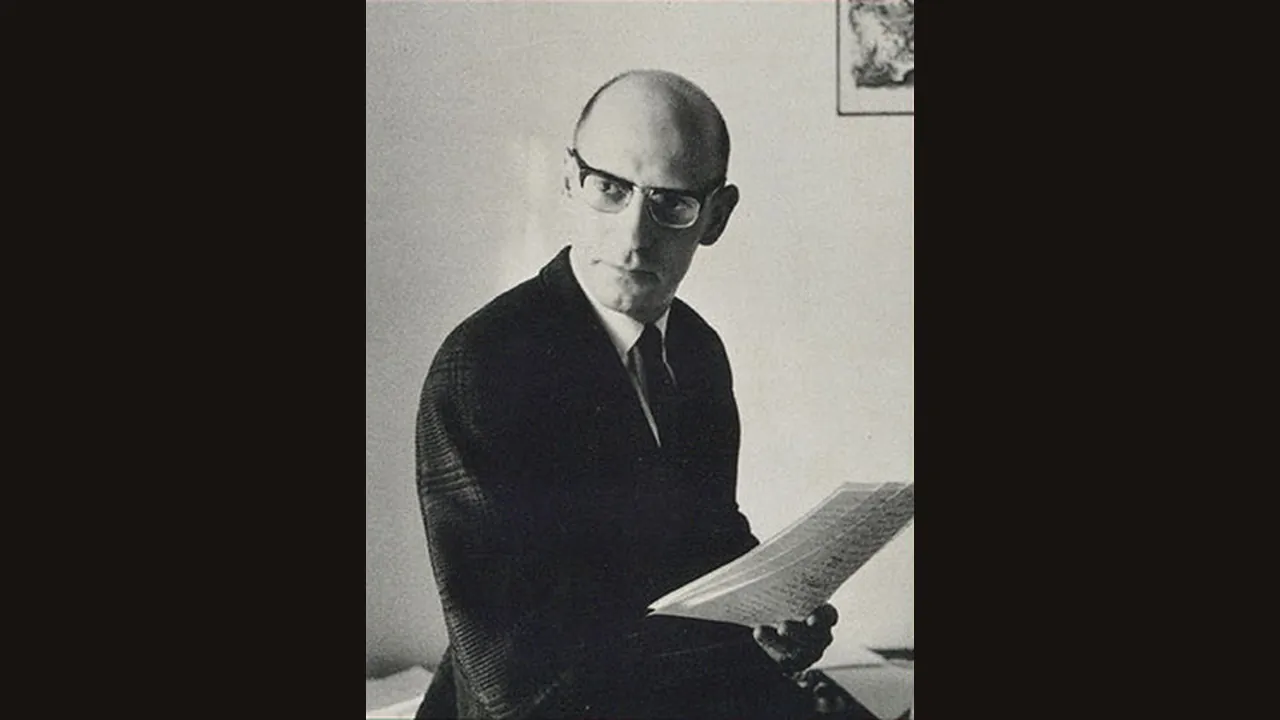
Michel Foucault
1926–1984
French thinker who studied how power works through prisons, clinics, and the categories of knowledge itself. Discipline and Punish of 1975 showed the modern soul as a product of surveillance. He lived 1926 to 1984.
Foucault was born in Poitiers in 1926 and studied philosophy and psychology at the École Normale Supérieure in Paris. He taught in Uppsala, Warsaw, and Hamburg, then at Clermont-Ferrand and at the experimental university at Vincennes. From 1970 until his death he held the chair in the History of Systems of Thought at the Collège de France. He died in Paris in 1984.
His early books study the institutions and categories that sort people: Madness and Civilization (1961) treats the confinement of the mad; The Birth of the Clinic (1963) treats medical perception; The Order of Things (1966) describes the epistemes, the deep rules of knowledge that he says governed successive ages. He called the method archaeology, and his later genealogy, adapted from Nietzsche, traces how practices produce the objects they claim only to find. Discipline and Punish (1975) argues that modern power works less by public spectacle than by discipline: timetables, examinations, and surveillance train bodies, with Bentham's Panopticon as the model building. The first volume of The History of Sexuality (1976) joins power and knowledge in the single term power-knowledge, and it names biopower as his term for power directed at whole populations through the regulation of births, health, and mortality.
Watch
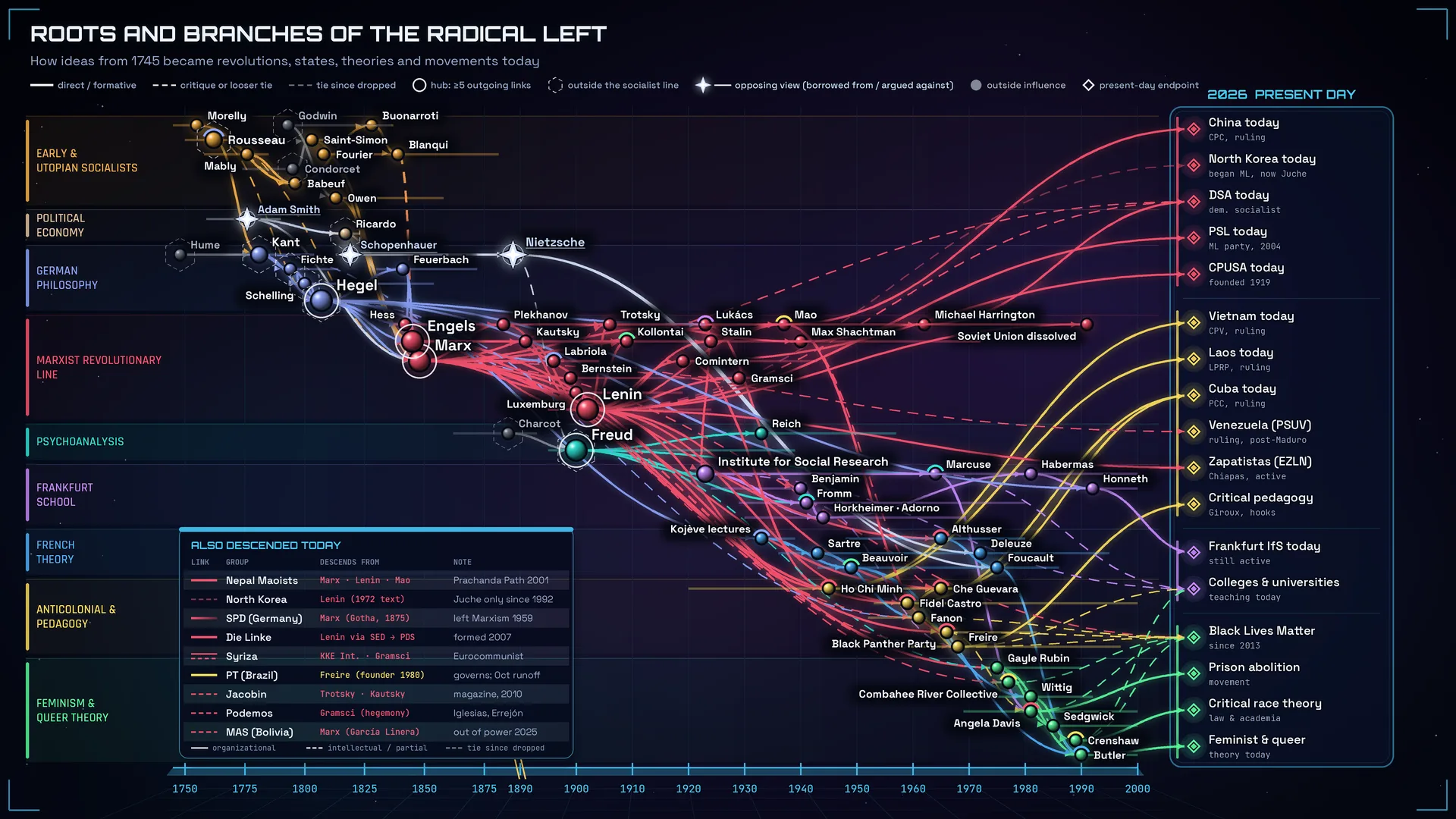
Roots and Branches of the Radical Left
Events · 2026-10-15
Socialism is presented as an economic theory. In reality, woven through every part of the theory are two things that must be adopted before socialism can "work properly": a pseudo-history of mankind, and a massive shift of worldview. Both rest on a fundamental lie about human nature: they blame man's conditions for what belongs to the man himself.
That ideology did not appear from nowhere. It grew out of long-standing ideas, taken up across a chain of events and twisted over time into a promise of a better way for human beings to live, which is why the whole runs far deeper and is far more complex than the economic label suggests. Along the way it was woven in and out of great thinkers, at different points and for different reasons. Some were used for it and some against it, and through all of it the idea kept building.
This map lays that out where it can be seen: the evolution of the ideas, the effects they had, and the chain of cause and effect that followed from thinker to thinker.
Facts
- Born
- 1926, Poitiers, France.
- Source: Encyclopaedia Britannica, Michel Foucault
- Died
- 1984, Paris, of AIDS related illness.
- Source: Encyclopaedia Britannica, Michel Foucault
- School
- Post structuralism; histories of systems of thought.
- Source: Encyclopaedia Britannica, Michel Foucault
- Known for
- Power knowledge, the panopticon, Madness and Civilization, and the History of Sexuality.
- Source: Encyclopaedia Britannica, Michel Foucault
Sources
- Encyclopaedia Britannica, Michel Foucault Source
Source links accessed 22 November 2026.
Images
Related
- Friedrich NietzscheConnected
- Jacques DerridaConnected
- Fidel CastroSame era
- Chinese Civil WarSame era
- Pol PotSame era
- Noam ChomskySame era
What happened elsewhere
Pairings are by recorded year, not exact simultaneity.
- Fidel CastroWhile Michel Foucault (1926)
- Chinese Civil WarWhile Michel Foucault (1927)
- Pol PotWhile Michel Foucault (1925)
- Noam ChomskyWhile Michel Foucault (1928)
- Jürgen HabermasWhile Michel Foucault (1929)
Meanwhile
Meanwhile, around the world — drag to spin, click a pulsing marker.
Keep reading
Test yourself
When was Michel Foucault born?
- 1926, Poitiers, France
- 1928, Philadelphia, Pennsylvania, United States
- 1905, Paris, France
- 1889, Vienna, Austria
Answer
1926, Poitiers, France — Born: 1926, Poitiers, France.
When did Michel Foucault die?
- 1984, Paris, of AIDS related illness
- 1976, Freiburg, Germany
- 1986, Paris
- 1960, near Sens, France, in a car crash
Answer
1984, Paris, of AIDS related illness — Died: 1984, Paris, of AIDS related illness.
What is Michel Foucault known for?
- Power knowledge, the panopticon, Madness and Civilization, and the History of Sexuality
- Universal grammar, the poverty of the stimulus argument, and the manufacturing consent critique of media
- Differance, the critique of the metaphysics of presence, and readings of Plato, Rousseau, and Husserl
- The picture theory of meaning, language games, family resemblance, and private language arguments
Answer
Power knowledge, the panopticon, Madness and Civilization, and the History of Sexuality — Known for: Power knowledge, the panopticon, Madness and Civilization, and the History of Sexuality.
Which school of thought was Michel Foucault part of?
- Post structuralism; histories of systems of thought
- Analytic philosophy; logical atomism
- Existentialism
- Generative linguistics; analytic philosophy of language
Answer
Post structuralism; histories of systems of thought — School: Post structuralism; histories of systems of thought.
True or false: French thinker who studied how power works through prisons, clinics, and the categories of knowledge itself.
- True
- False
Answer
True — True. French thinker who studied how power works through prisons, clinics, and the categories of knowledge itself.
Articles
My notes
Highlights on this page
None yet.
Spotted an error on this page? Email [email protected] and it will be checked against the sources.