

Philosopher · Twentieth century · Germany
Jürgen Habermas
1929–
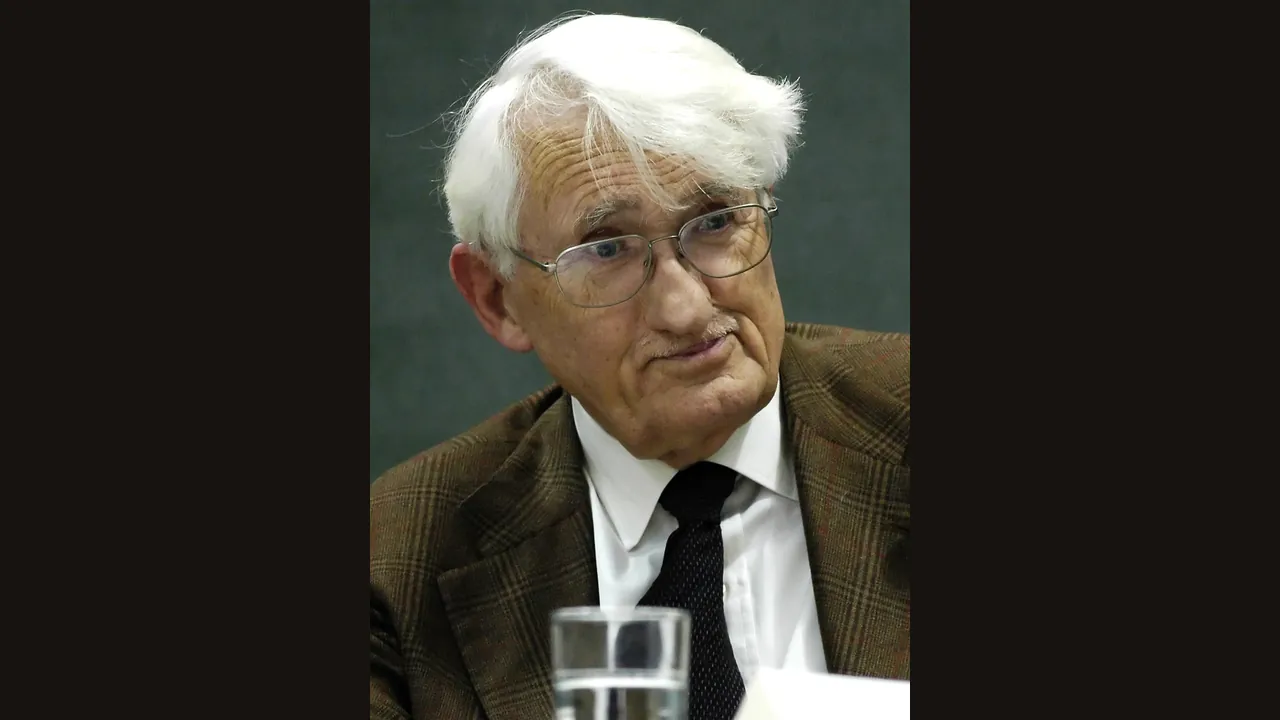
German thinker, the leading heir of the Frankfurt School, who defended reason as communication: free discussion among equals can reach the truth. His Theory of Communicative Action appeared in 1981. Born 1929, living.
Habermas was born in Düsseldorf in 1929 and took his doctorate at Bonn in 1954. He worked as an assistant to Theodor Adorno at the Institute for Social Research in Frankfurt, taught at Heidelberg and Frankfurt, and directed the Max Planck Institute at Starnberg from 1971 to 1981 before returning to Frankfurt. He belongs to the second generation of the Frankfurt School.
The Structural Transformation of the Public Sphere (1962) describes the public sphere of the eighteenth century, private persons meeting in coffeehouses and through newspapers to debate common concerns, and traces its decline under mass media and organized interests. The Theory of Communicative Action (1981) separates communicative action, speech aimed at understanding, from strategic action, speech used as a tool to steer others. Speech, he argues, raises claims to truth, to moral rightness, and to sincerity, and speakers can be asked to redeem those claims with reasons. The ideal speech situation names the conditions of a discussion free of coercion, where the better argument alone carries weight. His discourse ethics states that a norm binds only when all persons affected by it could accept it as participants in rational discourse. Between Facts and Norms (1992) applies the account to law and democracy.
Watch
Roots and Branches of the Radical Left
Events · 2026-10-15
Socialism is presented as an economic theory. In reality, woven through every part of the theory are two things that must be adopted before socialism can "work properly": a pseudo-history of mankind, and a massive shift of worldview. Both rest on a fundamental lie about human nature: they blame man's conditions for what belongs to the man himself.
That ideology did not appear from nowhere. It grew out of long-standing ideas, taken up across a chain of events and twisted over time into a promise of a better way for human beings to live, which is why the whole runs far deeper and is far more complex than the economic label suggests. Along the way it was woven in and out of great thinkers, at different points and for different reasons. Some were used for it and some against it, and through all of it the idea kept building.
This map lays that out where it can be seen: the evolution of the ideas, the effects they had, and the chain of cause and effect that followed from thinker to thinker.
Facts
- Born
- 1929, Düsseldorf, Germany.
- Source: Encyclopaedia Britannica, Jürgen Habermas
- School
- Critical theory; discourse ethics.
- Source: Encyclopaedia Britannica, Jürgen Habermas
- Known for
- The public sphere, communicative rationality, and the ideal speech situation.
- Source: Encyclopaedia Britannica, Jürgen Habermas
- Career
- Taught at Frankfurt and Starnberg; the most prominent living German philosopher.
- Source: Encyclopaedia Britannica, Jürgen Habermas
Sources
- Encyclopaedia Britannica, Jürgen Habermas Source
Source links accessed 22 November 2026.
Images
Related
- Immanuel KantConnected
- Hannah ArendtConnected
- Jacques DerridaSame era
- Noam ChomskySame era
- Chinese Civil WarSame era
- HolodomorSame era
What happened elsewhere
Pairings are by recorded year, not exact simultaneity.
- Vatican CityWhile Jürgen Habermas (1929)
- Jacques DerridaWhile Jürgen Habermas (1930)
- Noam ChomskyWhile Jürgen Habermas (1928)
- Chinese Civil WarWhile Jürgen Habermas (1927)
- HolodomorWhile Jürgen Habermas (1932)
Meanwhile
Meanwhile, around the world — drag to spin, click a pulsing marker.
Keep reading
Test yourself
When was Jürgen Habermas born?
- 1929, Düsseldorf, Germany
- 1889, Vienna, Austria
- 1930, El Biar, Algeria
- 1872, Trellech, Wales
Answer
1929, Düsseldorf, Germany — Born: 1929, Düsseldorf, Germany.
What is Jürgen Habermas known for?
- The public sphere, communicative rationality, and the ideal speech situation
- Power knowledge, the panopticon, Madness and Civilization, and the History of Sexuality
- Falsifiability as the mark of science, and The Open Society and Its Enemies of 1945
- Differance, the critique of the metaphysics of presence, and readings of Plato, Rousseau, and Husserl
Answer
The public sphere, communicative rationality, and the ideal speech situation — Known for: The public sphere, communicative rationality, and the ideal speech situation.
Which school of thought was Jürgen Habermas part of?
- Critical theory; discourse ethics
- Analytic philosophy, in two acts
- Existentialism and feminism
- Deconstruction; post structuralism
Answer
Critical theory; discourse ethics — School: Critical theory; discourse ethics.
True or false: German thinker, the leading heir of the Frankfurt School, who defended reason as communication: free discussion among equals can reach the truth.
- True
- False
Answer
True — True. German thinker, the leading heir of the Frankfurt School, who defended reason as communication: free discussion among equals can reach the truth.
Articles

My notes
Highlights on this page
None yet.
Spotted an error on this page? Email [email protected] and it will be checked against the sources.