

Event · Twentieth century · Ukraine
Holodomor
1932–1933
Famine in Soviet Ukraine and other regions, 1932–1933, driven by requisition, blacklists, passport controls and border seals. Death tolls are demographic estimates; genocide classification is debated.
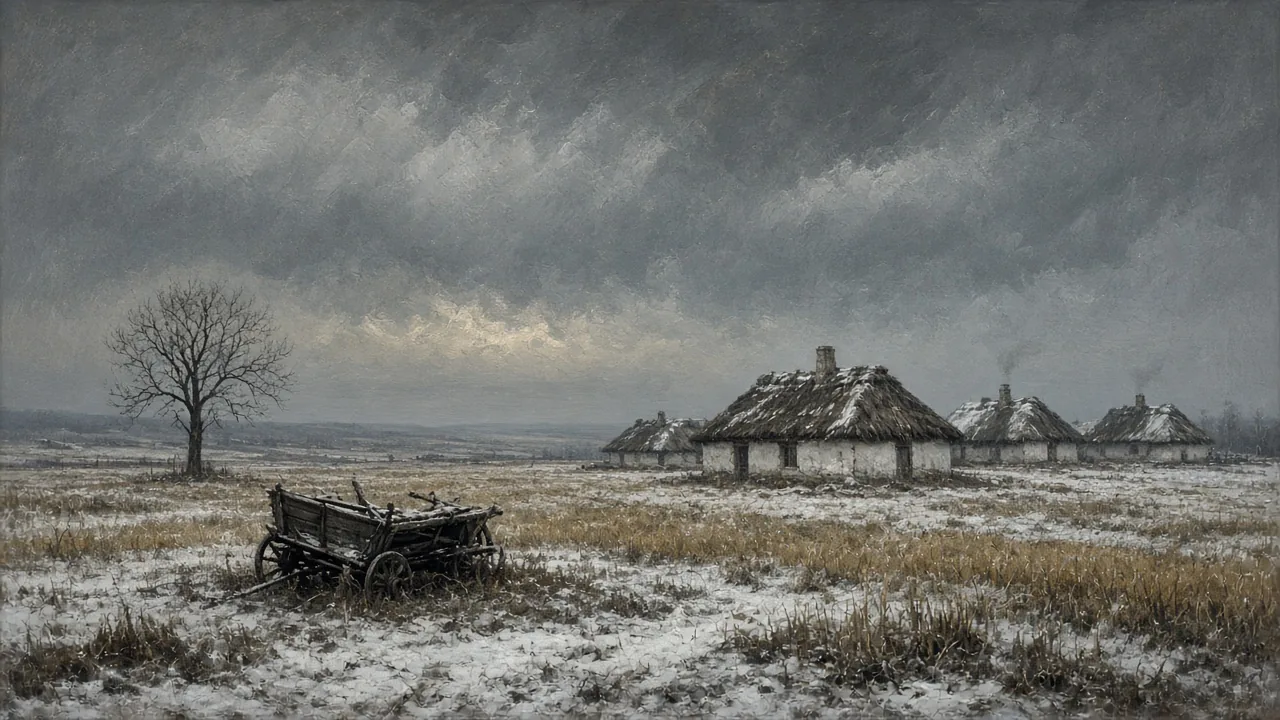
Famine is not a weather report when the state seals the exits and takes the grain. That is the fundamental truth of the Holodomor, the state-engineered famine that devastated Ukraine and other Soviet regions from 1932 to 1933. To understand how millions perished on some of the richest agricultural land on earth, one must look past natural explanations and trace the deliberate bureaucracy of coercion. The catastrophe was not born of drought or crop failure; it was manufactured through a sequence of calculated decrees, administrative border closures, punitive blacklists, and systematic food requisitions that turned an entire countryside into an open-air prison.
The disaster began with a series of sweeping policy decisions designed to break rural resistance to Soviet authority and extract agricultural wealth to fund state industrialization. From 1929 through early 1930, the Soviet leadership initiated forced collectivization alongside the systematic liquidation of the kulaks, a term applied to prosperous or politically recalcitrant peasants. This disrupted centuries of traditional farming practices, expropriated livestock, and placed the rural population under the direct administrative control of collective farm managers and state cadres. As production plummeted under collective management, state requisitions escalated rather than eased. When villages failed to meet unrealistic grain procurement quotas, the government deployed emergency requisition squads to seize not only stored grain, but also seed stock, emergency reserves, and personal food supplies. To legalise this confiscation and crush any attempt by starving peasants to protect their subsistence, the Soviet government enacted a series of draconian measures. On August 7, 1932, the regime passed the Decree on Socialist Property1, popularised as the "Law of Five Ears of Grain," which made any theft or unauthorized harvesting of collective farm property, even a handful of wheat, punishable by death by shooting. Under extenuating circumstances, sentences were commuted to ten years of hard labor in corrective labor camps, with all forms of amnesty strictly forbidden. On December 27, 1932, the government instituted a mandatory internal passport system2 to restrict population movement and lock the rural workforce onto collective farms. Internal passports were issued exclusively to urban workers, state employees, and city residents, while collective farmers were systematically denied them, effectively tying rural citizens to their villages in a status that persisted until 1974. Then, on January 22, 1933, Joseph Stalin and Vyacheslav Molotov signed a secret border-sealing directive3 commanding the OGPU secret police and state security apparatus to intercept and halt starving peasants attempting to flee Ukraine and the Northern Caucasus in search of food. Entitled "Preventing the Mass Exodus of Peasants who are Starving," the directive ordered state forces to turn refugees back at gunpoint and force them to return to their stripped villages.
Where standard grain requisitions failed to force compliance, the state deployed the black boards, or chorna doshka. Nominally created to penalize collective farms that defaulted on impossible grain quotas, blacklisting functioned in practice as an administrative blockade designed to isolate and starve targeted communities. When a village or district was placed on a black board, all state commerce and supply lines were severed instantly. Co-operative and state stores were shut down, consumer goods were confiscated, and all existing credit was immediately called in. Local party and collective farm leadership was purged and arrested, while OGPU contingents established armed cordons around the perimeter. The blockade applied indiscriminately to every resident, cutting off access to emergency supplies, trade, or external aid. In the Ukrainian SSR, 37 of 392 districts and more than 400 collective farms went on the board, concentrated heavily in Dnipropetrovsk oblast, where every single district contained at least one blacklisted village. In the worst blacklisted communities of Kharkiv oblast, local mortality rates exceeded forty percent. The black boards were used against Cossack villages in the Volga and Kuban and dozens of districts in Kazakhstan. The blacklists worked as quarantines meant to kill, not as economic adjustments.
The human consequences of these combined policies were immediate and staggering. By sealing internal borders and blocking transit points, the state removed the primary survival strategy available to starving populations: flight. In March 1933 alone, OGPU forces intercepted 219,460 fleeing peasants4 at railway stations, road checkpoints, and border crossings. Turning back these refugees forced them to return to empty granaries, resulting in an estimated 150,000 additional deaths from the policy of immobilization alone4. While millions starved across rural villages, the Soviet state continued to extract and export grain to international markets. In 1932 and 1933, the USSR exported approximately 1.8 million tonnes of grain5, a quantity calculated by economists as sufficient to feed five million people for a full year. Although export volumes were reduced compared to previous years as the scale of the crisis became undeniable, shipments never ceased. The government prioritized securing hard currency to purchase foreign industrial machinery over supplying basic rations to its agricultural producers.
Determining the precise demographic loss remains complex due to the regime's suppression and falsification of census data. Modern scholarly consensus, led by demographers and historians such as R.W. Davies and Stephen Wheatcroft, places total excess mortality across the entire Soviet Union between 5.5 million and 6.5 million people6. For Ukraine specifically, modern demographic studies estimate excess deaths between 2.6 million, calculated by French demographic research teams, and 3.9 million, established by the Harvard Ukrainian Research Institute7, with historian Timothy Snyder concluding a total near 3.3 million. Proportionally, the Kazakh famine was equally catastrophic: Kazakhstan lost between 1.3 million and 1.5 million people8, over a third of the Kazakh nation, due to forced sedentarization and livestock confiscation. Demographic breakdowns by Marek Sliwinski further highlight that 33.5 percent of all Ukrainian peasant men died during the famine period.
The legal and historical classification of the Holodomor remains a subject of intense academic and international debate. Raphael Lemkin, the legal scholar who coined the term genocide, described the Ukrainian famine as a central component9 of a broader Soviet campaign to destroy the social, cultural, and national framework of Ukraine. This perspective was supported by the U.S. Commission on the Ukraine Famine, led by historian James Mace, which concluded that Stalin and his inner circle intentionally used starvation as a weapon10 against the Ukrainian national movement. Conversely, other prominent historians, such as Stephen Kotkin, argue that while the policy was unquestionably murderous11 and state-directed, key decisions like border closures were executed to control the spread of famine-related epidemics and maintain state authority, rather than to exterminate a specific national group. Russian state historiography emphasizes that the famine affected multiple Soviet nationalities, including Russians, Kazakhs, and Germans, to reject the assertion that Ukrainians were single-mindedly targeted. Despite differing legal interpretations of intent, Soviet documents and survivor testimony establish a catastrophe driven by state policy. The deliberate confiscation of food, the enforcement of punitive blacklists, the institutionalization of internal passports, the armed containment of starving populations, and the continued export of food reserves remain fully documented facts of history. Internationally, recognition of the Holodomor as a genocide has grown significantly. Ukraine’s parliament officially recognized the famine as genocide in 2006, and by early 2025, approximately thirty-five nations, along with the European Parliament, had passed official resolutions12 acknowledging the Holodomor as an act of genocide against the Ukrainian people.
The administrative trail of the 1932–33 famine remains clear: empty granaries, blacklisted villages surrounded by armed guards, and millions of farmers forbidden to leave the land they cultivated. It remains the clearest case of a state using food as a weapon.
Sources
Primary sources
- Decree on Socialist Property of August 7, 1932 Soviet government, Decree on Socialist Property (1932).
- Internal passport system instituted December 27, 1932 Soviet government, Passport system decree (1932).
- Secret border-sealing directive of January 22, 1933 Stalin and Molotov, Preventing the Mass Exodus of Peasants who are Starving (1933).
- 219,460 peasants intercepted March 1933; 150,000 additional deaths from immobilization OGPU records, Soviet secret police reports (1933).
- 1.8 million tonnes of grain exported 1932-1933 Soviet trade records, Grain export statistics (1933).
Secondary sources
- 5.5 to 6.5 million excess deaths across USSR R.W. Davies and Stephen Wheatcroft, Demographic studies of Soviet famine (2004).
- 2.6 to 3.9 million excess deaths in Ukraine French demographic teams; Harvard Ukrainian Research Institute, Ukraine famine demographic studies (2008).
- 1.3 to 1.5 million deaths in Kazakhstan Demographic studies, Kazakh famine mortality estimates (2010).
- Lemkin described Ukrainian famine as genocide Raphael Lemkin, Soviet Genocide in Ukraine (1953).
- US Commission concluded intentional starvation as weapon James Mace, U.S. Commission on the Ukraine Famine, Report to Congress (1988).
- Kotkin argues border closures were about control, not extermination Stephen Kotkin, Stalin: Waiting for Hitler (2017).
- ~35 nations recognized Holodomor as genocide by early 2025 Various parliaments, Genocide recognition resolutions (2025).
Facts
- Peak years
- 1932–1933.
- Source: Encyclopaedia Britannica, Holodomor
- Ukraine excess deaths
- Scholarly estimates commonly about 2.6–3.9 million; Snyder near 3.3 million. USSR-wide excess deaths often about 5.5–6.5 million.
- Source: Davies & Wheatcroft; Harvard Ukrainian Research Institute; Timothy Snyder
- Border seal
- Stalin–Molotov directive, 22 January 1933, to stop peasants fleeing Ukraine and the North Caucasus.
- Source: Published Soviet archival directive
Sources
- Davies & Wheatcroft; Harvard Ukrainian Research Institute; Timothy Snyder
- Published Soviet archival directive
- Encyclopaedia Britannica, Holodomor Source
Source links accessed 22 November 2026.
Images
Related
- Joseph StalinConnected
- UkraineConnected
- RussiaConnected
- Twentieth centuryConnected
- Stalin's TerrorSame civilization
- Soviet UnionSame civilization
What happened elsewhere
Pairings are by recorded year, not exact simultaneity.
- IraqWhile Holodomor (1932)
- Saudi ArabiaWhile Holodomor (1932)
- Long MarchWhile Holodomor (1934)
- Jacques DerridaWhile Holodomor (1930)
- Jürgen HabermasWhile Holodomor (1929)
Meanwhile
Meanwhile, around the world — drag to spin, click a pulsing marker.
Keep reading
My notes
Highlights on this page
None yet.
Spotted an error on this page? Email [email protected] and it will be checked against the sources.