

Philosopher · Twentieth century · Germany
Hannah Arendt
1906–1975
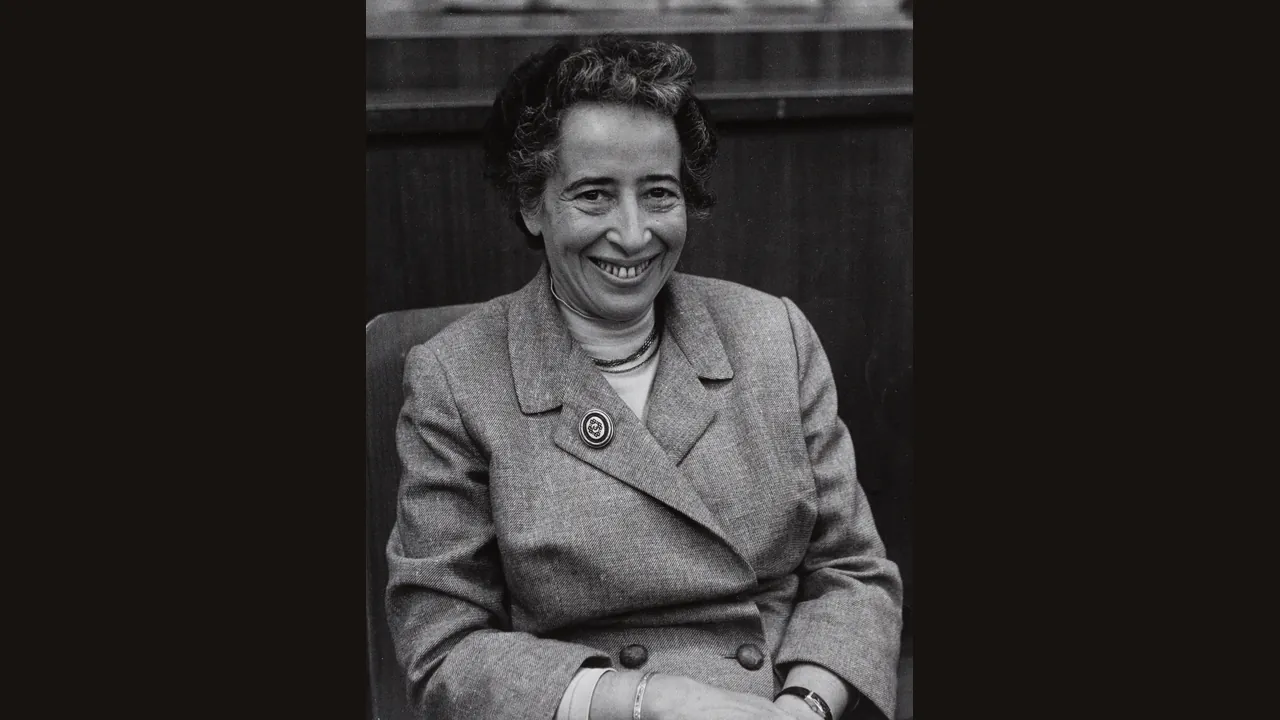
German Jewish thinker who fled the Nazis and became America's great theorist of totalitarianism. The Origins of Totalitarianism of 1951 traced the camps to imperialism and mass society. She lived 1906 to 1975.
Arendt was born in Linden, near Hanover, in 1906 and studied philosophy at Marburg, Freiburg, and Heidelberg, taking her doctorate under Karl Jaspers in 1929. Arrested briefly by the Gestapo in 1933, she fled to Paris and worked for Jewish refugee organizations. Interned in France in 1940, she escaped and reached New York in 1941. She worked in publishing and for Jewish organizations, and she later taught at Princeton, the University of Chicago, and the New School. She died in New York in 1975.
The Origins of Totalitarianism (1951) treats totalitarian rule as a new form of government, built on ideology and terror and aimed at total domination. The Human Condition (1958) divides the vita activa into labor, which serves the necessities of life; work, which fabricates the durable world of things; and action, speech and deed among equals, which she ranks as the properly political activity. Natality, the fact that each birth brings a beginner into the world, grounds her account of action as the capacity to begin something new. Reporting the trial of Adolf Eichmann, published as Eichmann in Jerusalem (1963), she described the defendant as thoughtless rather than demonic, a man who spoke in clichés and official language, and she named that quality the banality of evil.
Facts
- Born
- 1906, Linden, near Hanover, Germany.
- Source: Encyclopaedia Britannica, Hannah Arendt
- Died
- 1975, New York, United States.
- Source: Encyclopaedia Britannica, Hannah Arendt
- School
- Political theory, in the classical tradition.
- Source: Encyclopaedia Britannica, Hannah Arendt
- Known for
- The Origins of Totalitarianism, Eichmann in Jerusalem, and the phrase the banality of evil.
- Source: Encyclopaedia Britannica, Hannah Arendt
Sources
- Encyclopaedia Britannica, Hannah Arendt Source
Source links accessed 22 November 2026.
Images
Related
- Martin HeideggerConnected
- GermanyConnected
- Jürgen HabermasConnected
- Jean-Paul SartreSame era
- Simone de BeauvoirSame era
- Willard Van Orman QuineSame era
What happened elsewhere
Pairings are by recorded year, not exact simultaneity.
- Jean-Paul SartreWhile Hannah Arendt (1905)
- NorwayWhile Hannah Arendt (1905)
- Simone de BeauvoirWhile Hannah Arendt (1908)
- Willard Van Orman QuineWhile Hannah Arendt (1908)
- BulgariaWhile Hannah Arendt (1908)
Meanwhile
Meanwhile, around the world — drag to spin, click a pulsing marker.
Keep reading
Test yourself
When was Hannah Arendt born?
- 1906, Linden, near Hanover, Germany
- 1908, Akron, Ohio, United States
- 1889, Vienna, Austria
- 1902, Vienna, Austria
Answer
1906, Linden, near Hanover, Germany — Born: 1906, Linden, near Hanover, Germany.
When did Hannah Arendt die?
- 1975, New York, United States
- 1960, near Sens, France, in a car crash
- 1994, London, England
- 2002, Lexington, Massachusetts
Answer
1975, New York, United States — Died: 1975, New York, United States.
What is Hannah Arendt known for?
- The Origins of Totalitarianism, Eichmann in Jerusalem, and the phrase the banality of evil
- Differance, the critique of the metaphysics of presence, and readings of Plato, Rousseau, and Husserl
- The Stranger, The Myth of Sisyphus, The Rebel, and the Nobel Prize in Literature 1957
- Russell's paradox, the theory of descriptions, Principia Mathematica with Whitehead, and a century of political causes
Answer
The Origins of Totalitarianism, Eichmann in Jerusalem, and the phrase the banality of evil — Known for: The Origins of Totalitarianism, Eichmann in Jerusalem, and the phrase the banality of evil.
Which school of thought was Hannah Arendt part of?
- Political theory, in the classical tradition
- Generative linguistics; analytic philosophy of language
- The absurd; he refused the existentialist label
- Phenomenology turned to ontology; existentialism's source
Answer
Political theory, in the classical tradition — School: Political theory, in the classical tradition.
True or false: German Jewish thinker who fled the Nazis and became America's great theorist of totalitarianism.
- True
- False
Answer
True — True. German Jewish thinker who fled the Nazis and became America's great theorist of totalitarianism.
My notes
Highlights on this page
None yet.
Spotted an error on this page? Email [email protected] and it will be checked against the sources.