

Philosopher · Twentieth century · United States
Willard Van Orman Quine
1908–2000
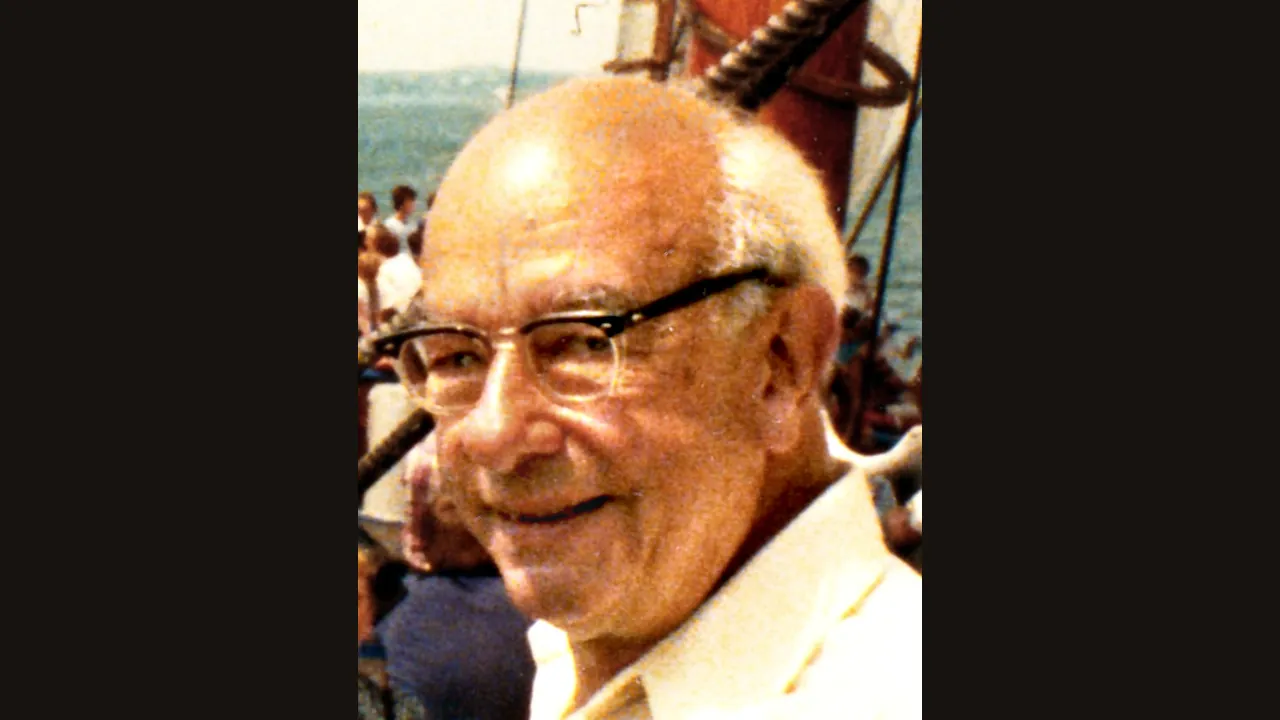
American logician who dominated analytic philosophy after the war. His Two Dogmas of Empiricism of 1951 attacked the analytic synthetic distinction and made philosophy continuous with science. He taught at Harvard and lived 1908 to 2000.
Quine was born in Akron, Ohio, in 1908 and took his doctorate at Harvard in 1932. He traveled to Vienna and Prague and met Rudolf Carnap, whose logical positivism his later work argued against. He joined the Harvard faculty in 1936 and remained there for his whole career, holding the Edgar Pierce chair in philosophy. He died in Boston in 2000.
Two Dogmas of Empiricism (1951) argues against two assumptions of the empiricism he inherited: the split between analytic truths, true by meaning, and synthetic truths, true by fact; and reductionism, the claim that each meaningful statement answers to its own set of confirming experiences. In their place he sets a holism in which statements meet experience as a corporate body, and no statement, not even a law of logic, stands immune to revision. Word and Object (1960) develops the indeterminacy of translation: the behavioral evidence available to a translator, he argues, fits rival translation manuals equally well, a point he makes with the word gavagai, spoken by a native informant in the presence of a rabbit. His naturalized epistemology treats the study of knowledge as a chapter of psychology, and his rule for ontology states that to be is to be the value of a bound variable.
Facts
- Born
- 1908, Akron, Ohio, United States.
- Source: Encyclopaedia Britannica, Willard Van Orman Quine
- Died
- 2000, Boston, United States.
- Source: Encyclopaedia Britannica, Willard Van Orman Quine
- School
- Analytic philosophy; naturalism.
- Source: Encyclopaedia Britannica, Willard Van Orman Quine
- Known for
- Two Dogmas of Empiricism, Word and Object, and the indeterminacy of translation.
- Source: Encyclopaedia Britannica, Willard Van Orman Quine
Sources
- Encyclopaedia Britannica, Willard Van Orman Quine Source
Source links accessed 22 November 2026.
Images
Related
- Bertrand RussellConnected
- Ludwig WittgensteinConnected
- Noam ChomskyConnected
- Simone de BeauvoirSame era
- Hannah ArendtSame era
- Jean-Paul SartreSame era
What happened elsewhere
Pairings are by recorded year, not exact simultaneity.
- Simone de BeauvoirWhile Willard Van Orman Quine (1908)
- BulgariaWhile Willard Van Orman Quine (1908)
- Hannah ArendtWhile Willard Van Orman Quine (1906)
- South AfricaWhile Willard Van Orman Quine (1910)
- Jean-Paul SartreWhile Willard Van Orman Quine (1905)
Meanwhile
Meanwhile, around the world — drag to spin, click a pulsing marker.
Keep reading
Test yourself
When was Willard Van Orman Quine born?
- 1908, Akron, Ohio, United States
- 1905, Paris, France
- 1889, Vienna, Austria
- 1921, Baltimore, Maryland, United States
Answer
1908, Akron, Ohio, United States — Born: 1908, Akron, Ohio, United States.
When did Willard Van Orman Quine die?
- 2000, Boston, United States
- 2002, Lexington, Massachusetts
- 1960, near Sens, France, in a car crash
- 1951, Cambridge, England
Answer
2000, Boston, United States — Died: 2000, Boston, United States.
What is Willard Van Orman Quine known for?
- Two Dogmas of Empiricism, Word and Object, and the indeterminacy of translation
- Being and Time, Dasein, being toward death, and the later critique of technology
- Power knowledge, the panopticon, Madness and Civilization, and the History of Sexuality
- A Theory of Justice, the veil of ignorance, and justice as fairness
Answer
Two Dogmas of Empiricism, Word and Object, and the indeterminacy of translation — Known for: Two Dogmas of Empiricism, Word and Object, and the indeterminacy of translation.
Which school of thought was Willard Van Orman Quine part of?
- Analytic philosophy; naturalism
- Existentialism and feminism
- Analytic philosophy; logical atomism
- Liberal political philosophy
Answer
Analytic philosophy; naturalism — School: Analytic philosophy; naturalism.
True or false: American logician who dominated analytic philosophy after the war.
- True
- False
Answer
True — True. American logician who dominated analytic philosophy after the war.
My notes
Highlights on this page
None yet.
Spotted an error on this page? Email [email protected] and it will be checked against the sources.