

Philosopher · Twentieth century · France
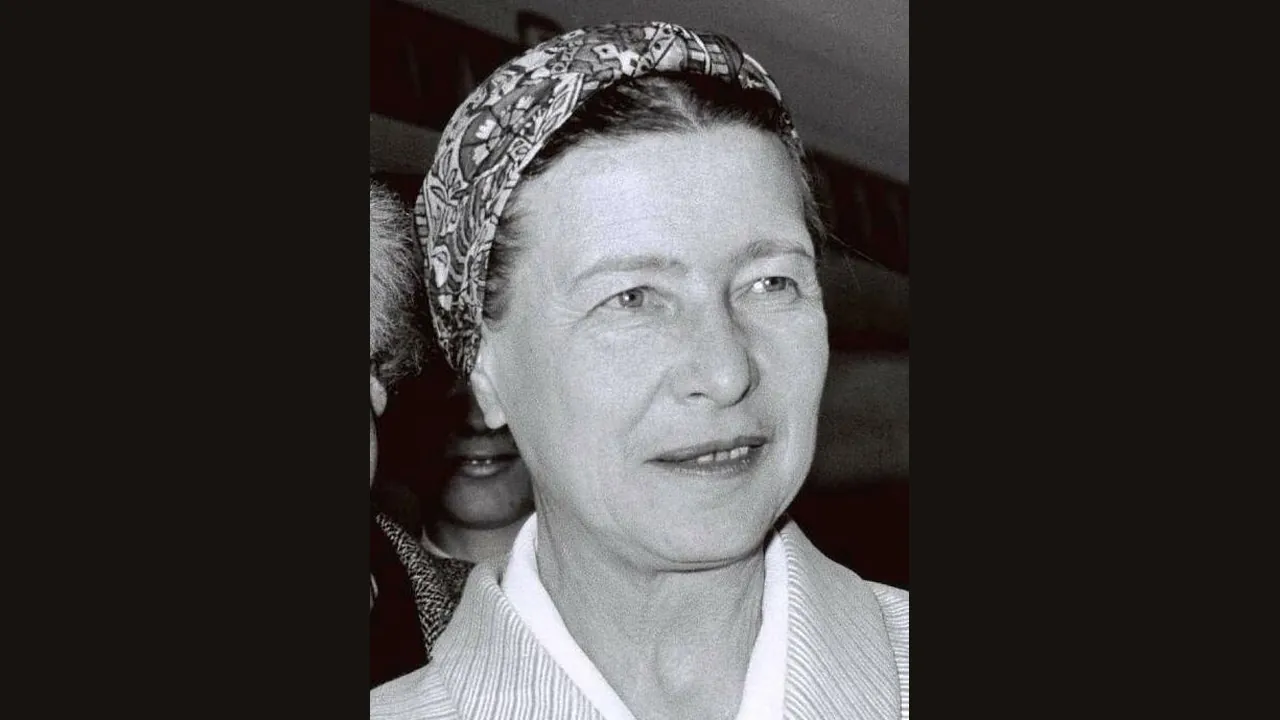
Simone de Beauvoir
1908–1986
French thinker whose Second Sex of 1949 founded modern feminist philosophy with the line one is not born, but becomes, a woman. Sartre's lifelong partner and his sharpest critic, she wrote ethics, novels, and memoirs. She lived 1908 to 1986.
Beauvoir was born in Paris in 1908 and studied philosophy at the Sorbonne, passing the agrégation examination in 1929. She taught in lycées in Marseille, Rouen, and Paris, and she lost her teaching post in 1943 after a complaint from a student's parent. She lived with Sartre from 1929 in a partnership the two kept outside marriage, and she wrote full time after the war. She died in Paris in 1986.
The Ethics of Ambiguity (1947) argues that a person wills his own freedom only by willing the freedom of others, and it treats oppression as the refusal of that claim. The Second Sex (1949) examines the condition of women through biology, history, psychoanalysis, literature, and myth. Its central claim holds that man sets himself up as the Subject and the essential, and woman as the Other and the inessential. Her best known sentence declares that one is not born, but rather becomes, a woman: the forms of femininity, she argues, are shaped by upbringing, custom, and economic position rather than fixed by nature. Her novels include She Came to Stay (1943) and The Mandarins (1954), which won the Prix Goncourt. Four volumes of memoirs, beginning with Memoirs of a Dutiful Daughter (1958), record her life in detail.
Watch
Roots and Branches of the Radical Left
Events · 2026-10-15
Socialism is presented as an economic theory. In reality, woven through every part of the theory are two things that must be adopted before socialism can "work properly": a pseudo-history of mankind, and a massive shift of worldview. Both rest on a fundamental lie about human nature: they blame man's conditions for what belongs to the man himself.
That ideology did not appear from nowhere. It grew out of long-standing ideas, taken up across a chain of events and twisted over time into a promise of a better way for human beings to live, which is why the whole runs far deeper and is far more complex than the economic label suggests. Along the way it was woven in and out of great thinkers, at different points and for different reasons. Some were used for it and some against it, and through all of it the idea kept building.
This map lays that out where it can be seen: the evolution of the ideas, the effects they had, and the chain of cause and effect that followed from thinker to thinker.
Facts
- Born
- 1908, Paris, France.
- Source: Encyclopaedia Britannica, Simone de Beauvoir
- Died
- 1986, Paris.
- Source: Encyclopaedia Britannica, Simone de Beauvoir
- School
- Existentialism and feminism.
- Source: Encyclopaedia Britannica, Simone de Beauvoir
- Known for
- The Second Sex, the ethics of ambiguity, and the analysis of woman as the Other.
- Source: Encyclopaedia Britannica, Simone de Beauvoir
Sources
- Encyclopaedia Britannica, Simone de Beauvoir Source
Source links accessed 22 November 2026.
Images
Related
- Jean-Paul SartreConnected
- Willard Van Orman QuineSame era
- Hannah ArendtSame era
- Albert CamusSame era
- Karl PopperSame era
- Twentieth centurySame era
What happened elsewhere
Pairings are by recorded year, not exact simultaneity.
- Willard Van Orman QuineWhile Simone de Beauvoir (1908)
- BulgariaWhile Simone de Beauvoir (1908)
- Hannah ArendtWhile Simone de Beauvoir (1906)
- South AfricaWhile Simone de Beauvoir (1910)
- NorwayWhile Simone de Beauvoir (1905)
Meanwhile
Meanwhile, around the world — drag to spin, click a pulsing marker.
Keep reading
Test yourself
When was Simone de Beauvoir born?
- 1908, Paris, France
- 1889, Vienna, Austria
- 1872, Trellech, Wales
- 1926, Poitiers, France
Answer
1908, Paris, France — Born: 1908, Paris, France.
When did Simone de Beauvoir die?
- 1986, Paris
- 2002, Lexington, Massachusetts
- 1980, Paris
- 1960, near Sens, France, in a car crash
Answer
1986, Paris — Died: 1986, Paris.
What is Simone de Beauvoir known for?
- The Second Sex, the ethics of ambiguity, and the analysis of woman as the Other
- Being and Time, Dasein, being toward death, and the later critique of technology
- The Origins of Totalitarianism, Eichmann in Jerusalem, and the phrase the banality of evil
- Differance, the critique of the metaphysics of presence, and readings of Plato, Rousseau, and Husserl
Answer
The Second Sex, the ethics of ambiguity, and the analysis of woman as the Other — Known for: The Second Sex, the ethics of ambiguity, and the analysis of woman as the Other.
Which school of thought was Simone de Beauvoir part of?
- Existentialism and feminism
- Generative linguistics; analytic philosophy of language
- Deconstruction; post structuralism
- Critical rationalism; philosophy of science
Answer
Existentialism and feminism — School: Existentialism and feminism.
True or false: French thinker whose Second Sex of 1949 founded modern feminist philosophy with the line one is not born, but becomes, a woman.
- True
- False
Answer
True — True. French thinker whose Second Sex of 1949 founded modern feminist philosophy with the line one is not born, but becomes, a woman.
Articles

My notes
Highlights on this page
None yet.
Spotted an error on this page? Email [email protected] and it will be checked against the sources.