

Philosopher · Twentieth century · France
Jean-Paul Sartre
1905–1980
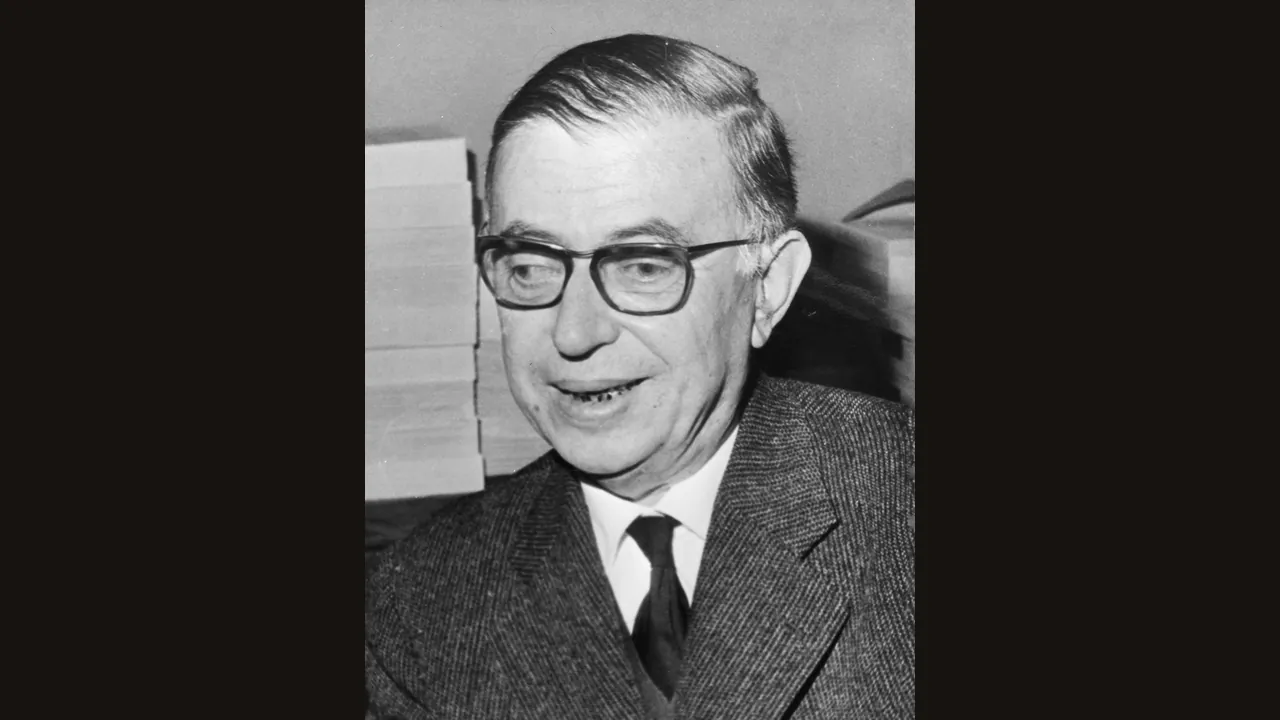
French existentialist who taught that existence precedes essence: we are condemned to be free. Being and Nothingness of 1943 built the system; his plays and novels carried it to the public. He refused the Nobel Prize in 1964 and lived 1905 to 1980.
Sartre was born in Paris in 1905 and studied philosophy at the École Normale Supérieure. He taught in lycées at Le Havre and in Paris through the 1930s. Called up in 1939, he spent nine months as a prisoner of war in 1940 and 1941. In 1945 he co-founded the journal Les Temps modernes and lived by writing from then on. He declined the Nobel Prize in Literature in 1964 and died in Paris in 1980.
Being and Nothingness (1943) divides being into the in-itself, the settled being of things, and the for-itself, human consciousness, which he describes as free and as defined by what it is not. His formula states that existence precedes essence: a person exists first and makes himself by his choices, with no human nature given beforehand. He called the condition being condemned to be free. Bad faith names the self-deception of a person who denies his freedom and hides behind a role or a fixed character. Under the Look of another, the self knows itself as an object, and shame follows. His novel Nausea (1938), the play No Exit (1944), and the lecture Existentialism Is a Humanism (1946) present the same positions in literary and popular form.
Watch
Roots and Branches of the Radical Left
Events · 2026-10-15
Socialism is presented as an economic theory. In reality, woven through every part of the theory are two things that must be adopted before socialism can "work properly": a pseudo-history of mankind, and a massive shift of worldview. Both rest on a fundamental lie about human nature: they blame man's conditions for what belongs to the man himself.
That ideology did not appear from nowhere. It grew out of long-standing ideas, taken up across a chain of events and twisted over time into a promise of a better way for human beings to live, which is why the whole runs far deeper and is far more complex than the economic label suggests. Along the way it was woven in and out of great thinkers, at different points and for different reasons. Some were used for it and some against it, and through all of it the idea kept building.
This map lays that out where it can be seen: the evolution of the ideas, the effects they had, and the chain of cause and effect that followed from thinker to thinker.
Facts
- Born
- 1905, Paris, France.
- Source: Encyclopaedia Britannica, Jean-Paul Sartre
- Died
- 1980, Paris.
- Source: Encyclopaedia Britannica, Jean-Paul Sartre
- School
- Existentialism.
- Source: Encyclopaedia Britannica, Jean-Paul Sartre
- Known for
- Bad faith, the look of the other, and the slogan that man is condemned to be free.
- Source: Encyclopaedia Britannica, Jean-Paul Sartre
Sources
- Encyclopaedia Britannica, Jean-Paul Sartre Source
Source links accessed 22 November 2026.
Images
Related
- Martin HeideggerConnected
- Simone de BeauvoirConnected
- Albert CamusConnected
- Edmund HusserlConnected
- Søren KierkegaardConnected
- Hannah ArendtSame era
What happened elsewhere
Pairings are by recorded year, not exact simultaneity.
- NorwayWhile Jean-Paul Sartre (1905)
- Hannah ArendtWhile Jean-Paul Sartre (1906)
- PanamaWhile Jean-Paul Sartre (1903)
- Karl PopperWhile Jean-Paul Sartre (1902)
- Willard Van Orman QuineWhile Jean-Paul Sartre (1908)
Meanwhile
Meanwhile, around the world — drag to spin, click a pulsing marker.
Keep reading
Test yourself
When was Jean-Paul Sartre born?
- 1905, Paris, France
- 1902, Vienna, Austria
- 1872, Trellech, Wales
- 1889, Messkirch, Germany
Answer
1905, Paris, France — Born: 1905, Paris, France.
When did Jean-Paul Sartre die?
- 1980, Paris
- 2002, Lexington, Massachusetts
- 1984, Paris, of AIDS related illness
- 1960, near Sens, France, in a car crash
Answer
1980, Paris — Died: 1980, Paris.
What is Jean-Paul Sartre known for?
- Bad faith, the look of the other, and the slogan that man is condemned to be free
- Power knowledge, the panopticon, Madness and Civilization, and the History of Sexuality
- Russell's paradox, the theory of descriptions, Principia Mathematica with Whitehead, and a century of political causes
- Falsifiability as the mark of science, and The Open Society and Its Enemies of 1945
Answer
Bad faith, the look of the other, and the slogan that man is condemned to be free — Known for: Bad faith, the look of the other, and the slogan that man is condemned to be free.
Which school of thought was Jean-Paul Sartre part of?
- Existentialism
- Political theory, in the classical tradition
- Analytic philosophy; logical atomism
- Analytic philosophy, in two acts
Answer
Existentialism — School: Existentialism.
True or false: French existentialist who taught that existence precedes essence: we are condemned to be free.
- True
- False
Answer
True — True. French existentialist who taught that existence precedes essence: we are condemned to be free.
Articles

My notes
Highlights on this page
None yet.
Spotted an error on this page? Email [email protected] and it will be checked against the sources.