

Philosopher · Age of revolutions and empire · Denmark
Søren Kierkegaard
1813–1855
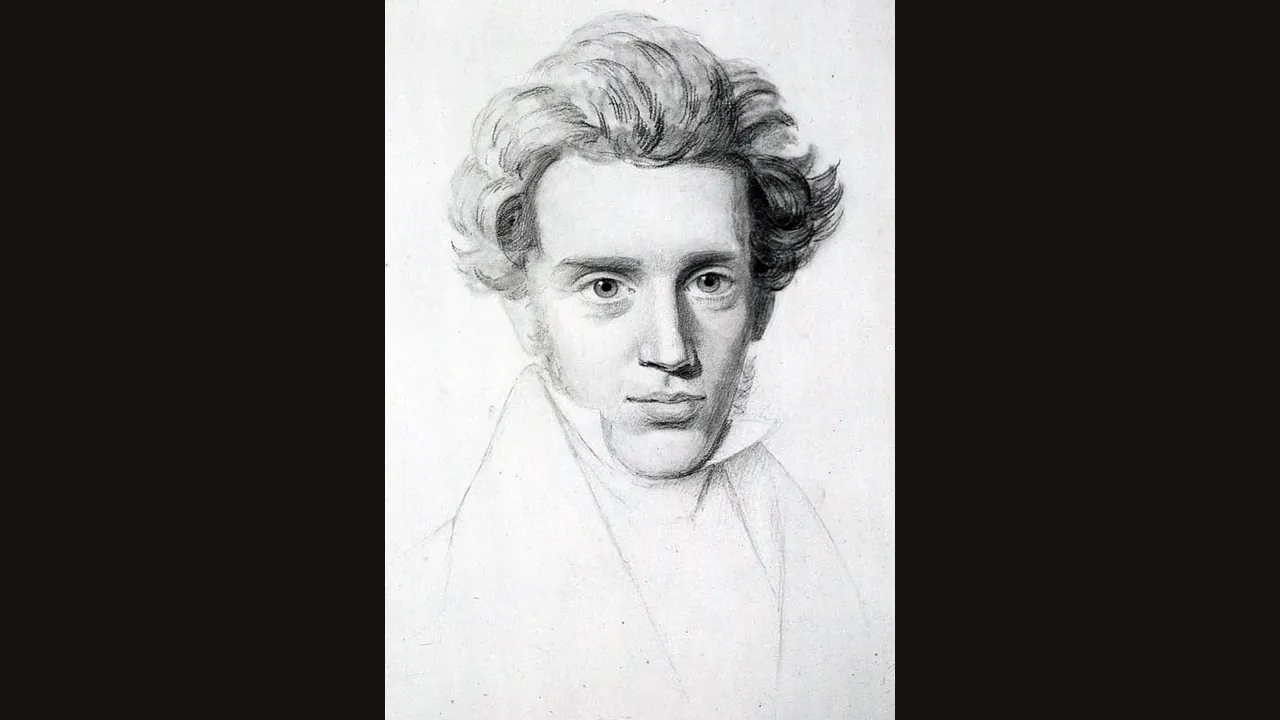
Danish thinker, the father of existentialism, who wrote under pseudonyms about the individual's leap of faith against Hegel's system. Fear and Trembling retells Abraham's trial. He lived 1813 to 1855 and died at forty two.
Søren Kierkegaard was born in 1813 at Copenhagen, the youngest child of a wealthy wool merchant. He studied theology at the University of Copenhagen and took his degree with a dissertation on irony in 1841. That year he ended his engagement to Regine Olsen, a step his journals return to throughout his life. He lived on his inheritance, wrote and published at his own expense, and held no academic post. He died at Copenhagen in 1855.
Either/Or of 1843, the first of his pseudonymous books, sets two views of life side by side: the aesthetic, which pursues pleasure and possibility, and the ethical, which binds itself by choice, duty, and marriage. Later pseudonymous works describe a third stage, the religious, in which the single individual stands in an absolute relation to God. Fear and Trembling, signed Johannes de Silentio, retells Abraham's commanded sacrifice of Isaac and presents Abraham as a knight of faith who, by virtue of the absurd, receives Isaac back. The Concept of Anxiety analyzes anxiety as the dizziness of freedom, and The Sickness unto Death defines despair as the self's misrelation to itself. Beside the pseudonymous works he published edifying discourses under his own name. In 1854 and 1855 he attacked the Danish state church in articles and pamphlets, arguing that official Christendom had abolished the Christianity of the New Testament.
Facts
- Born
- 1813, Copenhagen, Denmark.
- Source: Encyclopaedia Britannica, Søren Kierkegaard
- Died
- 1855, Copenhagen.
- Source: Encyclopaedia Britannica, Søren Kierkegaard
- School
- Existentialism, its Christian founder.
- Source: Encyclopaedia Britannica, Søren Kierkegaard
- Known for
- The leap of faith, the three stages of life, aesthetic, ethical, religious, and the attack on comfortable Christendom.
- Source: Encyclopaedia Britannica, Søren Kierkegaard
Sources
- Encyclopaedia Britannica, Søren Kierkegaard Source
Source links accessed 22 November 2026.
Images
Related
- Georg Wilhelm Friedrich HegelConnected
- Jean-Paul SartreConnected
- Otto von BismarckSame era
- Abraham LincolnSame era
- Karl MarxSame era
- VictoriaSame era
What happened elsewhere
Pairings are by recorded year, not exact simultaneity.
- Otto von BismarckWhile Søren Kierkegaard (1815)
- ParaguayWhile Søren Kierkegaard (1811)
- ArgentinaWhile Søren Kierkegaard (1816)
- Saint Pierre and MiquelonWhile Søren Kierkegaard (1816)
- Abraham LincolnWhile Søren Kierkegaard (1809)
Meanwhile
Meanwhile, around the world — drag to spin, click a pulsing marker.
Keep reading
Test yourself
When was Søren Kierkegaard born?
- 1813, Copenhagen, Denmark
- 1806, London, England
- 1762, Rammenau, Saxony, Germany
- 1788, Danzig, in what is now Poland
Answer
1813, Copenhagen, Denmark — Born: 1813, Copenhagen, Denmark.
When did Søren Kierkegaard die?
- 1855, Copenhagen
- 1854, Ragaz, Switzerland
- 1814, Berlin, of typhus
- 1938, Freiburg, Germany
Answer
1855, Copenhagen — Died: 1855, Copenhagen.
What is Søren Kierkegaard known for?
- The leap of faith, the three stages of life, aesthetic, ethical, religious, and the attack on comfortable Christendom
- The Course of Positive Philosophy, the law of three stages, and the founding of sociology as a science
- Modern predicate logic, the sense and reference distinction, and the logicist program
- The Wissenschaftslehre, the science of knowledge, and the Addresses to the German Nation of 1808
Answer
The leap of faith, the three stages of life, aesthetic, ethical, religious, and the attack on comfortable Christendom — Known for: The leap of faith, the three stages of life, aesthetic, ethical, religious, and the attack on comfortable Christendom.
Which school of thought was Søren Kierkegaard part of?
- Existentialism, its Christian founder
- German idealism
- German idealism, its completion
- Post Kantian pessimism, drawing on Indian thought
Answer
Existentialism, its Christian founder — School: Existentialism, its Christian founder.
True or false: Danish thinker, the father of existentialism, who wrote under pseudonyms about the individual's leap of faith against Hegel's system.
- True
- False
Answer
True — True. Danish thinker, the father of existentialism, who wrote under pseudonyms about the individual's leap of faith against Hegel's system.
My notes
Highlights on this page
None yet.
Spotted an error on this page? Email [email protected] and it will be checked against the sources.