
Ruler · Age of revolutions and empire · United Kingdom
Victoria
1819–1901
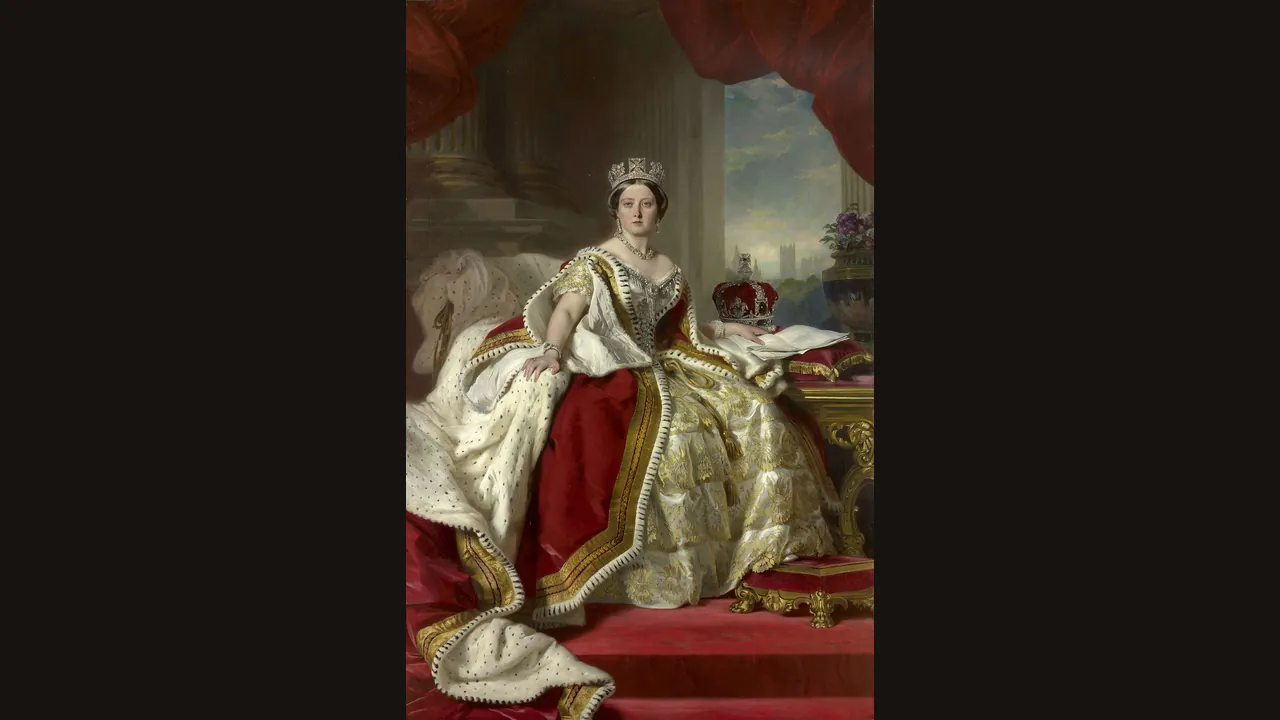
Queen of the United Kingdom from 1837 to 1901, born in 1819, whose sixty three year reign gave its name to an age. The British Empire reached its greatest extent in 1920, after her death, and she was proclaimed Empress of India in 1876. Her long mourning for Prince Albert made the monarchy a symbol of duty and empire.
Victoria was born in London in 1819 and succeeded her uncle William IV in 1837, at eighteen. She was crowned in 1838. She worked daily with her ministers, read state papers, and used the rights of a constitutional monarch to advise, to encourage, and to warn governments. Her first prime minister, Melbourne, instructed her in the working of the constitution. She married her cousin Albert in 1840, and Albert acted as her private secretary and adviser until his death in 1861.
After Albert died, Victoria withdrew from public appearances for years and drew criticism for her absence, and she returned to public duties slowly. Under the governments of her reign the British state and empire grew. After the Indian rebellion of 1857, the Crown took the government of India from the East India Company in 1858. Parliament gave her the title Empress of India in 1876. British forces occupied Egypt in 1882, and British colonies and protectorates spread across Africa and the Pacific during her reign. Britain fought the Crimean War in 1854 to 1856 and the Boer War, which began in 1899 and was still running at her death.
Victoria reigned for sixty three years and seven months, longer than any earlier British monarch. She died at Osborne House on the Isle of Wight on 22 January 1901, and her son Edward VII succeeded her.
Facts
- Born
- 1819, London.
- Source: Encyclopaedia Britannica, Victoria
- Died
- 1901, Isle of Wight.
- Source: Encyclopaedia Britannica, Victoria
- Reign
- 1837 to 1901.
- Source: Encyclopaedia Britannica, Victoria
- Realm
- The United Kingdom and the British Empire.
- Source: Encyclopaedia Britannica, Victoria
- Known for
- The Victorian era and the peak of British imperial power.
- Source: Encyclopaedia Britannica, Victoria
Sources
- Encyclopaedia Britannica, Victoria Source
Source links accessed 22 November 2026.
Images
Related
- Karl MarxSame era
- Otto von BismarckSame era
- Søren KierkegaardSame era
- Abraham LincolnSame era
- John Stuart MillSame era
- Auguste ComteSame era
What happened elsewhere
Pairings are by recorded year, not exact simultaneity.
- ColombiaWhile Victoria (1819)
- Karl MarxWhile Victoria (1818)
- ChileWhile Victoria (1818)
- Costa RicaWhile Victoria (1821)
- MexicoWhile Victoria (1821)
Meanwhile
Meanwhile, around the world — drag to spin, click a pulsing marker.
Keep reading
Test yourself
When was Victoria born?
- 1819, London
- 1809, Kentucky
- 1815, Schonhausen, Prussia
- 1783, Caracas
Answer
1819, London — Born: 1819, London.
When did Victoria die?
- 1901, Isle of Wight
- 1912, Tokyo
- 1898, Friedrichsruh
- 1830, Santa Marta, Colombia
Answer
1901, Isle of Wight — Died: 1901, Isle of Wight.
When did Victoria reign?
- 1837 to 1901
- 668 to about 627 BC
- 522 to 486 BC
- About 1279 to 1213 BC, 66 years
Answer
1837 to 1901 — Reign: 1837 to 1901.
What realm did Victoria rule?
- The United Kingdom and the British Empire
- The Neo Assyrian Empire, at its greatest extent
- The Zulu Kingdom of southeastern Africa
- New Kingdom Egypt
Answer
The United Kingdom and the British Empire — Realm: The United Kingdom and the British Empire.
True or false: Queen of the United Kingdom from 1837 to 1901, born in 1819, whose sixty three year reign gave its name to an age.
- True
- False
Answer
True — True. Queen of the United Kingdom from 1837 to 1901, born in 1819, whose sixty three year reign gave its name to an age.
My notes
Highlights on this page
None yet.
Spotted an error on this page? Email [email protected] and it will be checked against the sources.