

Philosopher · Age of revolutions and empire · France
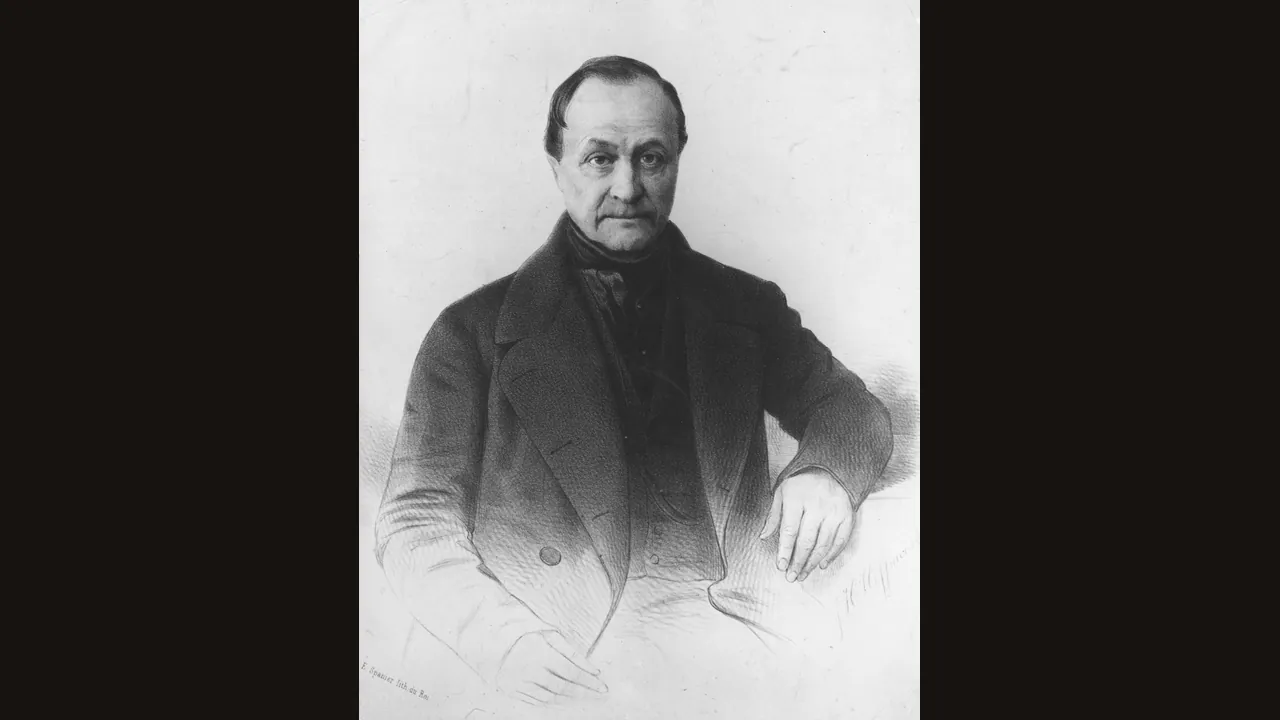
Auguste Comte
1798–1857
French thinker who founded positivism and coined the word sociology. His law of three stages said thought moves from theology through metaphysics to positive science. He lived 1798 to 1857 and ended by founding a Religion of Humanity.
Auguste Comte was born in 1798 at Montpellier, the son of a tax official. He entered the École Polytechnique at Paris at sixteen and left at its closure in 1816. From 1817 to 1824 he worked as secretary to Henri de Saint-Simon and then broke with him. He supported himself by private teaching and examining at the Polytechnique. The Course of Positive Philosophy appeared in six volumes between 1830 and 1842, and the System of Positive Polity between 1851 and 1854. He died at Paris in 1857.
Comte named his doctrine positivism. Its core is the law of three stages. In the theological stage men explain events by the wills of gods and spirits; in the metaphysical stage, by abstract entities and hidden forces; in the positive stage, they give up the search for first causes and state the laws of phenomena, the observed relations of succession and resemblance. He ranked the sciences in a hierarchy of decreasing generality: mathematics, astronomy, physics, chemistry, biology, and last the science of society, which he first called social physics and then sociology. Sociology he divided into statics, the study of the conditions of order, and dynamics, the study of progress. The System of Positive Polity drew the practical consequence: a Religion of Humanity, with Humanity as the Great Being, its own calendar of festivals, and a priesthood of positivist philosophers.
Facts
- Born
- 1798, Montpellier, France.
- Source: Encyclopaedia Britannica, Auguste Comte
- Died
- 1857, Paris.
- Source: Encyclopaedia Britannica, Auguste Comte
- School
- Positivism.
- Source: Encyclopaedia Britannica, Auguste Comte
- Known for
- The Course of Positive Philosophy, the law of three stages, and the founding of sociology as a science.
- Source: Encyclopaedia Britannica, Auguste Comte
Sources
- Encyclopaedia Britannica, Auguste Comte Source
Source links accessed 22 November 2026.
Images
Related
- John Stuart MillConnected
- French RevolutionSame era
- Arthur SchopenhauerSame era
- Abraham LincolnSame era
- ShakaSame era
- Søren KierkegaardSame era
What happened elsewhere
Pairings are by recorded year, not exact simultaneity.
- HaitiWhile Auguste Comte (1804)
- John Stuart MillWhile Auguste Comte (1806)
- LiechtensteinWhile Auguste Comte (1806)
- Pitcairn IslandsWhile Auguste Comte (1790)
- Arthur SchopenhauerWhile Auguste Comte (1788)
Meanwhile
Meanwhile, around the world — drag to spin, click a pulsing marker.
Keep reading
Test yourself
When was Auguste Comte born?
- 1798, Montpellier, France
- 1818, Trier, Germany
- 1844, Röcken, Germany
- 1770, Stuttgart, Germany
Answer
1798, Montpellier, France — Born: 1798, Montpellier, France.
When did Auguste Comte die?
- 1857, Paris
- 1814, Berlin, of typhus
- 1860, Frankfurt, Germany
- 1925, Bad Kleinen, Germany
Answer
1857, Paris — Died: 1857, Paris.
What is Auguste Comte known for?
- The Course of Positive Philosophy, the law of three stages, and the founding of sociology as a science
- God is dead, the will to power, the Übermensch, master and slave morality, and the eternal recurrence
- Intentionality, the phenomenological reduction, and the Logical Investigations of 1900
- The dialectic of the Logic and the Phenomenology, the master and slave struggle, and the claim that the real is the rational. The formula 'thesis, antithesis, synthesis' attached to his name comes from Fichte and later textbooks, not from Hegel
Answer
The Course of Positive Philosophy, the law of three stages, and the founding of sociology as a science — Known for: The Course of Positive Philosophy, the law of three stages, and the founding of sociology as a science.
Which school of thought was Auguste Comte part of?
- Positivism
- Utilitarianism and liberalism
- German idealism
- German idealism, its completion
Answer
Positivism — School: Positivism.
True or false: French thinker who founded positivism and coined the word sociology.
- True
- False
Answer
True — True. French thinker who founded positivism and coined the word sociology.
My notes
Highlights on this page
None yet.
Spotted an error on this page? Email [email protected] and it will be checked against the sources.