

Event · Age of revolutions and empire · France
French Revolution
1789–1799
From the Estates-General of 1789 through constitutional monarchy, republic, and the Terror under the Committee of Public Safety, to the Directory. Death sentences and civil war tolls are estimates with ranges.
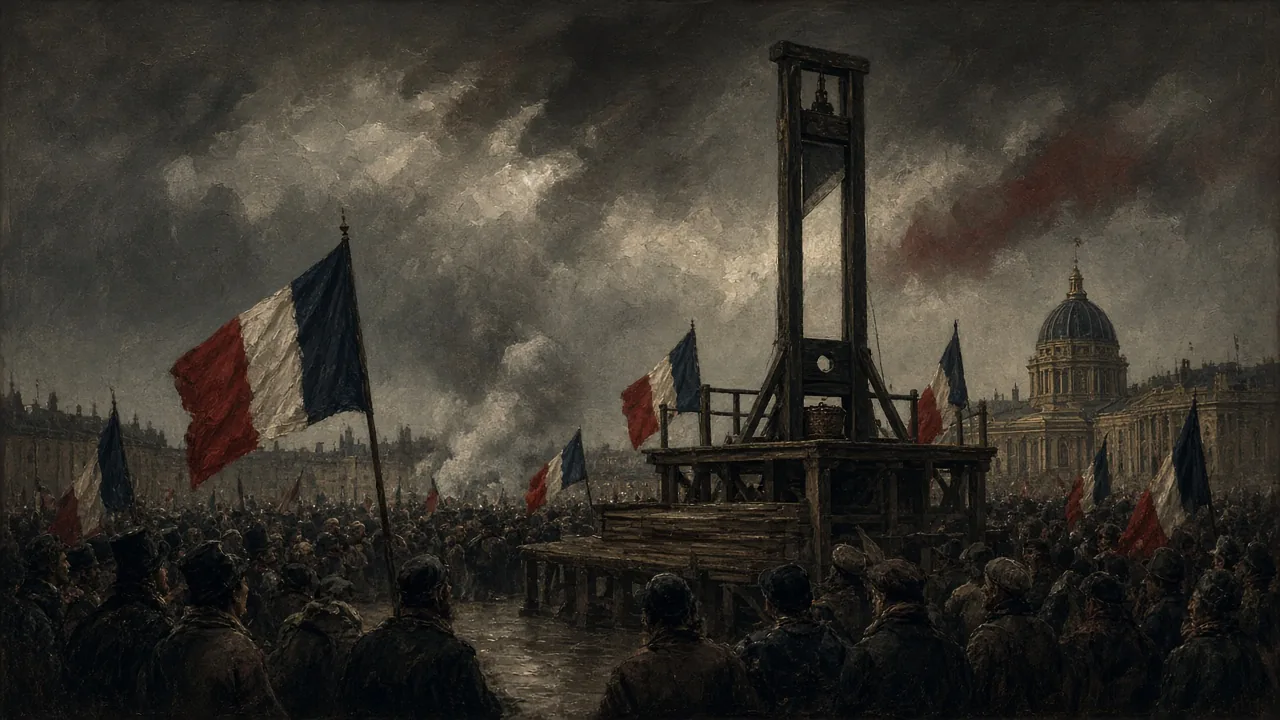
The French Revolution began with genuine grievances against an insolvent monarchy and culminated in a state-run system of political killing, run through law. When the Estates-General convened on May 5, 1789, the first such assembly in 175 years, its delegates sought to resolve a mounting financial crisis. Within months, politics in France changed completely: the Bastille fell on July 14, and the National Constituent Assembly adopted the Declaration of the Rights of Man and of the Citizen on August 26. However, the early attempt at a constitutional monarchy rapidly unraveled under the combined pressures of foreign invasion, counter-revolutionary threat, and systemic violence, exemplified by the September Massacres of 1792, in which over fifteen hundred prisoners were killed in Paris within five days. Following the execution of King Louis XVI on January 21, 1793, and the defection of General Dumouriez to the Austrians, the National Convention established the Committee of Public Safety on April 6, 1793. Serving as an executive body accountable to virtually no external oversight, the Committee directed the Reign of Terror from September 1793 through July 1794. Institutionalized through measures like the Law of Suspects (September 17, 1793) and administered by the Revolutionary Tribunal, this apparatus placed the burden of proof on the accused and made execution the sole penalty for political crimes.
Paradoxically, the primary instrument of the Terror was originally conceived as an Enlightenment instrument of humaneness and social equality. In late 1789, Dr. Joseph-Ignace Guillotin, a physician opposed to capital punishment, proposed adopting a mechanical decapitator to eliminate class distinctions in executions. Previously, aristocratic convicts enjoyed quick beheadings by sword, whereas commoners faced painful public deaths such as hanging or breaking on the wheel. Designed by physician Antoine Louis and fabricated by German harpsichord maker Tobias Schmidt, the guillotine saw its first official use on April 25, 1792, executing the highwayman Nicolas-Jacques Pelletier. Though designed to deliver swift, uniform, and painless justice, the device quickly became the symbol of mechanized state murder. Guillotin attempted to disassociate his name from the machine during the Terror, and his family later formally petitioned the French government to rename it.
Scholarly estimates place the official number of death sentences handed down nationwide at 16,594 between June 1793 and July 1794, with 2,639 occurring in Paris alone2. An additional ten to twenty thousand individuals died without formal trial or succumbed to conditions in prison while awaiting sentence. Beyond these official figures, regional civil wars claimed far higher casualties, notably in the Vendée revolt, where total deaths reached approximately two hundred thousand, as well as in suppressed uprisings at Lyon and Nantes. While popular memory often envisions the guillotine as a tool used exclusively against royals and aristocrats, historical analyses, such as those by historian Donald Greer, reveal that nobles comprised only 8.5 percent of the casualties and clergy 6.5 percent. Over 85 percent of those executed belonged to the Third Estate, ordinary workers, peasants, and shopkeepers, and women accounted for roughly 9 percent of the total.
Where the guillotine provided mechanized efficiency in Paris, regional repressions used mass killings that discarded all judicial pretense. At Nantes, Jean-Baptiste Carrier, acting as the Convention's representative on mission, crushed local counter-revolutionary uprisings through systematically organized mass drownings (noyades) in the Loire River. Beginning on the night of December 6–7, 1793, prisoners were bound, loaded onto custom-built barges fitted with trap doors, and submerged. Soldiers positioned in nearby boats executed any victims who managed to loosen their bindings and reach the surface. Estimates of those drowned range from eighteen hundred to nearly five thousand, encompassing non-juring priests, captured rebels, women, and young children. Official records submitted to the Convention in October 1794 documented individual drownings such as one in Bourgneuf Bay involving forty-one people, including a blind elderly man, twelve women, and fifteen children. Once the political climate shifted, Carrier himself was tried and guillotined on December 16, 1794, serving as a scapegoat for the regime's excessive atrocities.
At the intellectual center of the Terror stood Maximilien Robespierre, who articulated a philosophical justification linking political morality with state violence. In his address to the National Convention on February 5, 1794, Robespierre argued that democratic government in wartime required both moral virtue and coercive fear:
"If the spring of popular government in time of peace is virtue, the springs of popular government in revolution are at once virtue and terror1: virtue, without which terror is fatal; terror, without which virtue is powerless. Terror is nothing else than justice, prompt, severe, inflexible; it is therefore an emanation of virtue."
Robespierre sought to institutionalize this vision through civic religion, orchestrating the Festival of the Supreme Being on June 8, 1794. Choreographed by painter Jacques-Louis David on the Champ de Mars, the pageant featured an artificial mountain and a ceremonial burning of an effigy representing atheism, led by Robespierre. However, two days later, the passing of the Law of 22 Prairial (June 10, 1794) inaugurated the "Great Terror". The law stripped defendants of legal counsel, barred witnesses, and drastically reduced acquittals. In the forty-seven days between its enactment and the end of July, 1,376 individuals were guillotined in Paris, averaging nearly thirty executions per day.
The escalation of fear ultimately united political factions against Robespierre, bringing the regime down in the Coup of 9 Thermidor (July 27, 1794). Shouted down in the Convention, Robespierre and his allies retreated to the Hôtel de Ville, where troops loyal to the Convention stormed the building that night. Robespierre suffered a shattered jaw from a gunshot,whether self-inflicted or fired by gendarme Charles-André Médat remains debated. The following day, July 28, 1794, Robespierre was taken to the Place de la Révolution to be executed alongside twenty-one associates. Executioner Charles-Henri Sanson removed the bandages supporting his fractured jaw, and Robespierre was guillotined before a cheering crowd.
The men who ran the Terror began with humanitarian ideals, emergency powers, and moral absolutism, and turned them into state violence. Conceived to deliver egalitarian justice, the guillotine became an instrument of indiscriminate repression when coupled with an ideology that treated political dissent as a moral contagion. The institutions built in France between 1793 and 1794 gave later revolutionary regimes a model to copy, regimes that justified mass violence in pursuit of theoretical political ideals.
Sources
Primary sources
- Robespierre's February 5, 1794 speech on virtue and terror Maximilien Robespierre, Address to the National Convention (1794).
Secondary sources
- 16,594 death sentences June 1793-July 1794; 2,639 in Paris Donald Greer, The Incidence of the Terror during the French Revolution (1935).
Watch
Roots and Branches of the Radical Left
Events · 2026-10-15
Socialism is presented as an economic theory. In reality, woven through every part of the theory are two things that must be adopted before socialism can "work properly": a pseudo-history of mankind, and a massive shift of worldview. Both rest on a fundamental lie about human nature: they blame man's conditions for what belongs to the man himself.
That ideology did not appear from nowhere. It grew out of long-standing ideas, taken up across a chain of events and twisted over time into a promise of a better way for human beings to live, which is why the whole runs far deeper and is far more complex than the economic label suggests. Along the way it was woven in and out of great thinkers, at different points and for different reasons. Some were used for it and some against it, and through all of it the idea kept building.
This map lays that out where it can be seen: the evolution of the ideas, the effects they had, and the chain of cause and effect that followed from thinker to thinker.
Facts
- Start marker used here
- Estates-General convened 5 May 1789; Bastille 14 July 1789.
- Source: Encyclopaedia Britannica, French Revolution
- Terror
- Committee of Public Safety from April 1793; Reign of Terror roughly September 1793–July 1794.
- Source: Encyclopaedia Britannica, French Revolution
- Official death sentences
- About 16,594 nationwide June 1793–July 1794 (Donald Greer). Additional prison and civil-war deaths are higher and disputed.
- Source: Donald Greer, The Incidence of the Terror
Sources
- Donald Greer, The Incidence of the Terror
- Encyclopaedia Britannica, French Revolution Source
Source links accessed 22 November 2026.
Images
Related
- Napoleon BonaparteConnected
- FranceConnected
- Arthur SchopenhauerSame era
- ShakaSame era
- Simon BolivarSame era
- Auguste ComteSame era
What happened elsewhere
Pairings are by recorded year, not exact simultaneity.
- Arthur SchopenhauerWhile French Revolution (1788)
- Norfolk IslandWhile French Revolution (1788)
- Pitcairn IslandsWhile French Revolution (1790)
- ShakaWhile French Revolution (around 1787)
- Simon BolivarWhile French Revolution (1783)
Meanwhile
Meanwhile, around the world — drag to spin, click a pulsing marker.
Keep reading
Articles
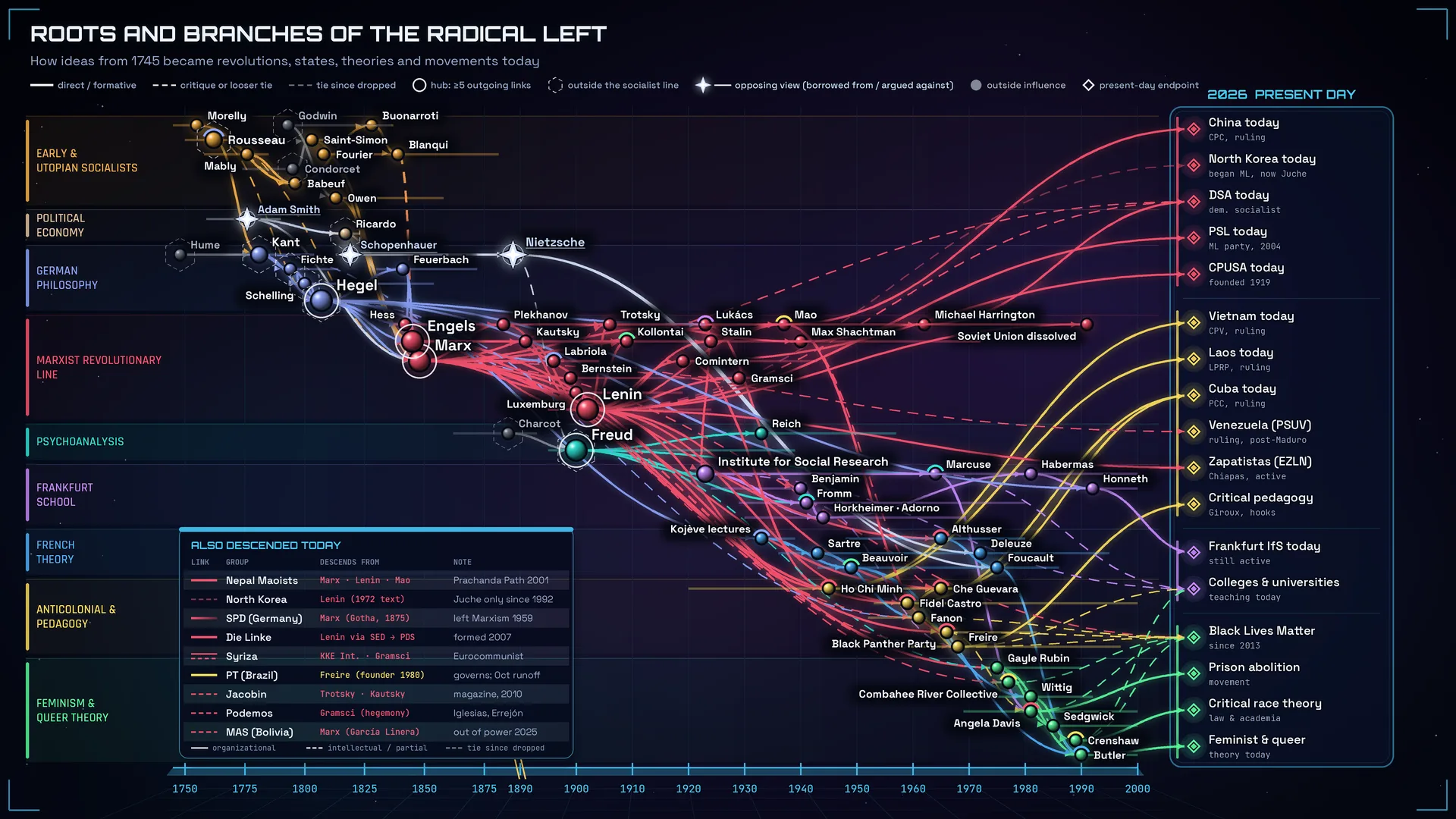 Roots and Branches of the Radical LeftHow ideas from 1745 became revolutions, states, theories and movements todayRead
 Before You Curse AmericaLiberty produces unequal outcomes because men are unequal in talent, judgment, appetite, luck, family, and will. Unequal outcomes produce comparison. Comparison can turn into envy.Read
My notes
Highlights on this page
None yet.
Spotted an error on this page? Email [email protected] and it will be checked against the sources.