

Philosopher · Age of revolutions and empire · Germany
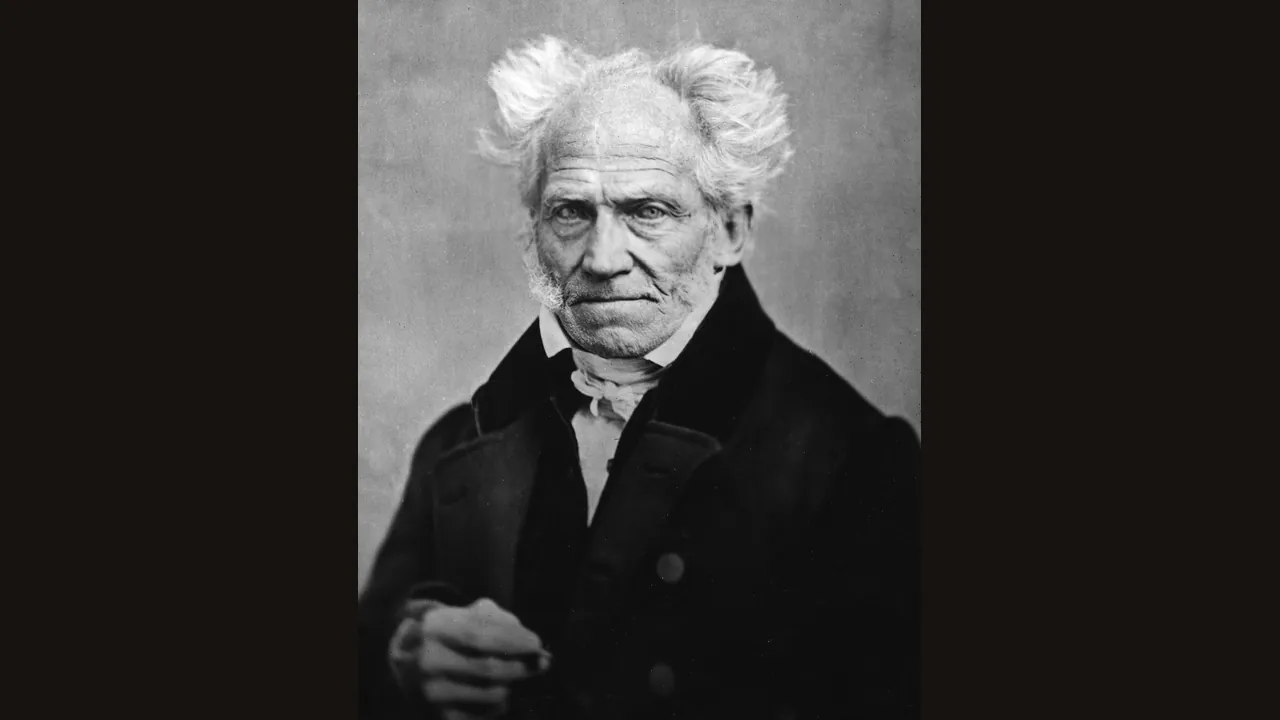
Arthur Schopenhauer
1788–1860
German pessimist whose World as Will and Representation of 1818 taught that a blind striving will drives all things and that release comes through art and denial. Ignored for decades, he became famous late. He lived 1788 to 1860.
Arthur Schopenhauer was born in 1788 at Danzig, the son of a merchant. His father trained him for trade and took him on long journeys through France and England. After his father's death in 1805 he left the counting house, studied at Göttingen and Berlin, and took his doctorate at Jena in 1813 with a dissertation on the principle of sufficient reason. In 1833 he settled at Frankfurt and lived there on his inheritance for the rest of his life. He died at Frankfurt in 1860.
His chief work, The World as Will and Representation, appeared in 1818, with a second volume in 1844. Following Kant, he divided the world as it appears, representation, ordered by space, time, and causality, from the thing in itself. He identified the thing in itself as will, a blind striving without final goal, known directly in one's own body. The will expresses itself in grades, from the forces of nature through plant and animal life to man, and the intellect serves it as an instrument. Striving means suffering: a desire met gives brief satisfaction and then new desire or boredom, and pain outweighs pleasure in every life. Release comes for a time in art, above all in music, where perception rests from service to the will, and permanently in the denial of the will to live, reached through compassion and ascetic resignation.
Watch
Roots and Branches of the Radical Left
Events · 2026-10-15
Socialism is presented as an economic theory. In reality, woven through every part of the theory are two things that must be adopted before socialism can "work properly": a pseudo-history of mankind, and a massive shift of worldview. Both rest on a fundamental lie about human nature: they blame man's conditions for what belongs to the man himself.
That ideology did not appear from nowhere. It grew out of long-standing ideas, taken up across a chain of events and twisted over time into a promise of a better way for human beings to live, which is why the whole runs far deeper and is far more complex than the economic label suggests. Along the way it was woven in and out of great thinkers, at different points and for different reasons. Some were used for it and some against it, and through all of it the idea kept building.
This map lays that out where it can be seen: the evolution of the ideas, the effects they had, and the chain of cause and effect that followed from thinker to thinker.
Facts
- Born
- 1788, Danzig, in what is now Poland.
- Source: Encyclopaedia Britannica, Arthur Schopenhauer
- Died
- 1860, Frankfurt, Germany.
- Source: Encyclopaedia Britannica, Arthur Schopenhauer
- School
- Post Kantian pessimism, drawing on Indian thought.
- Source: Encyclopaedia Britannica, Arthur Schopenhauer
- Known for
- The world as will and representation, and the ethics of compassion and ascetic denial.
- Source: Encyclopaedia Britannica, Arthur Schopenhauer
Sources
- Encyclopaedia Britannica, Arthur Schopenhauer Source
Source links accessed 22 November 2026.
Images
Related
- Immanuel KantConnected
- Friedrich NietzscheConnected
- French RevolutionSame era
- ShakaSame era
- Simon BolivarSame era
- Auguste ComteSame era
What happened elsewhere
Pairings are by recorded year, not exact simultaneity.
- Norfolk IslandWhile Arthur Schopenhauer (1788)
- French RevolutionWhile Arthur Schopenhauer (1789)
- ShakaWhile Arthur Schopenhauer (around 1787)
- Pitcairn IslandsWhile Arthur Schopenhauer (1790)
- Simon BolivarWhile Arthur Schopenhauer (1783)
Meanwhile
Meanwhile, around the world — drag to spin, click a pulsing marker.
Keep reading
Test yourself
When was Arthur Schopenhauer born?
- 1788, Danzig, in what is now Poland
- 1775, Leonberg, Germany
- 1859, Prossnitz, Moravia, in what is now Czechia
- 1813, Copenhagen, Denmark
Answer
1788, Danzig, in what is now Poland — Born: 1788, Danzig, in what is now Poland.
When did Arthur Schopenhauer die?
- 1860, Frankfurt, Germany
- 1925, Bad Kleinen, Germany
- 1900, Weimar, Germany, after eleven years of mental collapse
- 1857, Paris
Answer
1860, Frankfurt, Germany — Died: 1860, Frankfurt, Germany.
What is Arthur Schopenhauer known for?
- The world as will and representation, and the ethics of compassion and ascetic denial
- The Wissenschaftslehre, the science of knowledge, and the Addresses to the German Nation of 1808
- The leap of faith, the three stages of life, aesthetic, ethical, religious, and the attack on comfortable Christendom
- The Communist Manifesto, written with Engels, and Capital, on surplus value and the laws of capitalist crisis
Answer
The world as will and representation, and the ethics of compassion and ascetic denial — Known for: The world as will and representation, and the ethics of compassion and ascetic denial.
Which school of thought was Arthur Schopenhauer part of?
- Post Kantian pessimism, drawing on Indian thought
- Analytic philosophy, its founder; logicism
- Phenomenology, its founder
- German idealism
Answer
Post Kantian pessimism, drawing on Indian thought — School: Post Kantian pessimism, drawing on Indian thought.
True or false: German pessimist whose World as Will and Representation of 1818 taught that a blind striving will drives all things and that release comes through art and denial.
- True
- False
Answer
True — True. German pessimist whose World as Will and Representation of 1818 taught that a blind striving will drives all things and that release comes through art and denial.
Articles

My notes
Highlights on this page
None yet.
Spotted an error on this page? Email [email protected] and it will be checked against the sources.