

Philosopher · Age of revolutions and empire · England
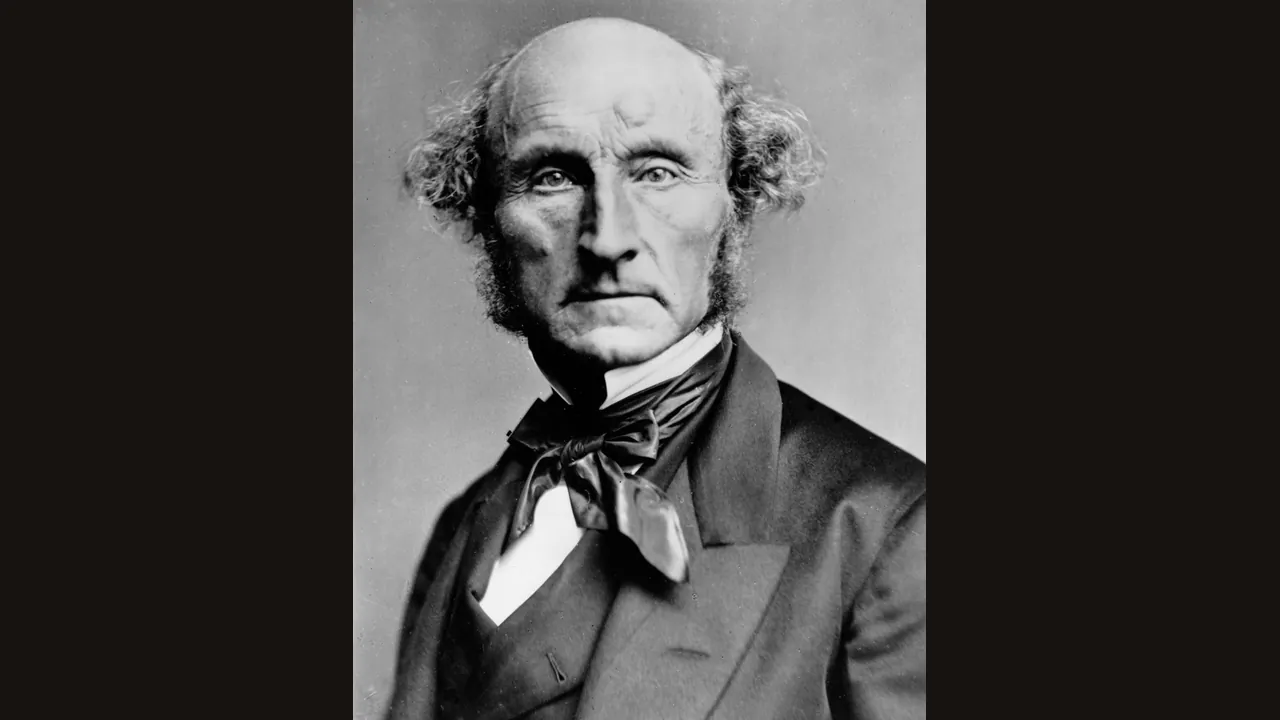
John Stuart Mill
1806–1873
English thinker raised by his father as a reasoning machine who became liberalism's great defender. On Liberty of 1859 made free speech and individuality the test of civilization. He lived 1806 to 1873.
John Stuart Mill was born in 1806 at London, the eldest son of James Mill, the philosopher and historian. His father educated him at home: Greek at three, Latin and arithmetic, then logic and political economy in his teens, and no schooling with other boys. At seventeen he became a clerk in the East India Company, rose to head its examiner's office, and remained until the company was dissolved in 1858. He sat in Parliament for Westminster from 1865 to 1868. He died at Avignon in 1873.
A System of Logic of 1843 treated reasoning as resting on induction from experience. Utilitarianism of 1863 defended Bentham's principle that actions are right in proportion as they tend to promote happiness, and it separated higher pleasures from lower by the settled preference of those who know both. On Liberty of 1859 defended freedom of thought and discussion, and it stated the harm principle: the sole end for which mankind are warranted in interfering with the liberty of action of any of their number is to prevent harm to others. His Autobiography records a mental crisis at twenty, when the aims of his education lost their hold on his feelings. The Subjection of Women of 1869 argued that the subordination of women rested on force and custom rather than nature, and demanded equality in education, employment, and the vote.
Facts
- Born
- 1806, London, England.
- Source: Encyclopaedia Britannica, John Stuart Mill
- Died
- 1873, Avignon, France.
- Source: Encyclopaedia Britannica, John Stuart Mill
- School
- Utilitarianism and liberalism.
- Source: Encyclopaedia Britannica, John Stuart Mill
- Known for
- On Liberty, Utilitarianism, and The Subjection of Women, an early argument for women's equality.
- Source: Encyclopaedia Britannica, John Stuart Mill
Sources
- Encyclopaedia Britannica, John Stuart Mill Source
Source links accessed 22 November 2026.
Images
Related
- Jeremy BenthamConnected
- Auguste ComteConnected
- John RawlsConnected
- Abraham LincolnSame era
- Søren KierkegaardSame era
- Otto von BismarckSame era
What happened elsewhere
Pairings are by recorded year, not exact simultaneity.
- LiechtensteinWhile John Stuart Mill (1806)
- HaitiWhile John Stuart Mill (1804)
- Abraham LincolnWhile John Stuart Mill (1809)
- ParaguayWhile John Stuart Mill (1811)
- Søren KierkegaardWhile John Stuart Mill (1813)
Meanwhile
Meanwhile, around the world — drag to spin, click a pulsing marker.
Keep reading
Test yourself
When was John Stuart Mill born?
- 1806, London, England
- 1762, Rammenau, Saxony, Germany
- 1848, Wismar, Germany
- 1798, Montpellier, France
Answer
1806, London, England — Born: 1806, London, England.
When did John Stuart Mill die?
- 1873, Avignon, France
- 1860, Frankfurt, Germany
- 1925, Bad Kleinen, Germany
- 1857, Paris
Answer
1873, Avignon, France — Died: 1873, Avignon, France.
What is John Stuart Mill known for?
- On Liberty, Utilitarianism, and The Subjection of Women, an early argument for women's equality
- God is dead, the will to power, the Übermensch, master and slave morality, and the eternal recurrence
- The Wissenschaftslehre, the science of knowledge, and the Addresses to the German Nation of 1808
- The leap of faith, the three stages of life, aesthetic, ethical, religious, and the attack on comfortable Christendom
Answer
On Liberty, Utilitarianism, and The Subjection of Women, an early argument for women's equality — Known for: On Liberty, Utilitarianism, and The Subjection of Women, an early argument for women's equality.
Which school of thought was John Stuart Mill part of?
- Utilitarianism and liberalism
- None; the critic of all schools
- German idealism
- German idealism, its completion
Answer
Utilitarianism and liberalism — School: Utilitarianism and liberalism.
True or false: English thinker raised by his father as a reasoning machine who became liberalism's great defender.
- True
- False
Answer
True — True. English thinker raised by his father as a reasoning machine who became liberalism's great defender.
My notes
Highlights on this page
None yet.
Spotted an error on this page? Email [email protected] and it will be checked against the sources.