

Philosopher · Early modern period · England
Jeremy Bentham
1748–1832
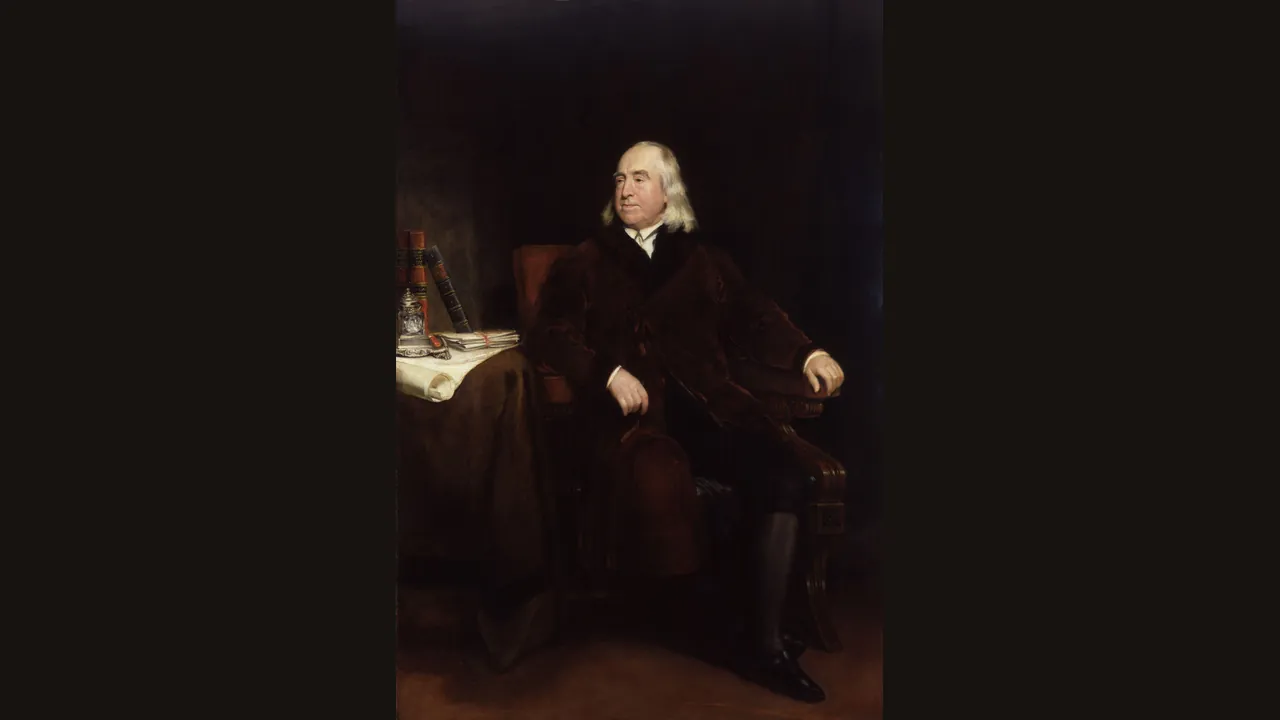
English reformer who founded utilitarianism on the greatest happiness principle: the right act is the one that makes the most happiness. He campaigned for legal reform, animal welfare, and the secret ballot. He lived 1748 to 1832.
Jeremy Bentham was born in London in 1748, trained for the law, and was called to the bar, but he turned from practice to the criticism of law itself. His first book, A Fragment on Government of 1776, attacked the commentaries of Blackstone. He wrote every day for more than sixty years and left a mountain of manuscripts, much of it published by editors after his death in 1832. Parliament never adopted his schemes in his lifetime, and he measured his career in rejected proposals.
The Introduction to the Principles of Morals and Legislation, printed in 1780 and published in 1789, stated his principle of utility: nature has placed mankind under the governance of two sovereign masters, pain and pleasure, and an action is right in proportion as it tends to produce the greatest happiness of the greatest number. To compare pleasures and pains he proposed a felicific calculus weighing intensity, duration, certainty, nearness, and further effects. His Panopticon letters of 1791 designed a prison of cells arranged around a single unseen watchman, so that prisoners, never knowing whether they were observed, would police themselves. Bentham demanded codified law in place of judge made common law, and he defended the interests of animals on one ground: the question is not whether they can reason or talk, but whether they can suffer.
Facts
- Born
- 1748, London, England.
- Source: Encyclopaedia Britannica, Jeremy Bentham
- Died
- 1832, London. His preserved body sits at University College London.
- Source: Encyclopaedia Britannica, Jeremy Bentham
- School
- Utilitarianism, its founder.
- Source: Encyclopaedia Britannica, Jeremy Bentham
- Known for
- The greatest happiness principle, the Panopticon prison design, and the felicific calculus for weighing pleasures and pains.
- Source: Encyclopaedia Britannica, Jeremy Bentham
Sources
- Encyclopaedia Britannica, Jeremy Bentham Source
Source links accessed 22 November 2026.
Images
Related
- David HumeConnected
- John Stuart MillConnected
- Adam SmithConnected
- Catherine the GreatSame era
- Immanuel KantSame era
- Jean-Jacques RousseauSame era
What happened elsewhere
Pairings are by recorded year, not exact simultaneity.
- AfghanistanWhile Jeremy Bentham (1747)
- OmanWhile Jeremy Bentham (1744)
Meanwhile
Meanwhile, around the world — drag to spin, click a pulsing marker.
Keep reading
Test yourself
When was Jeremy Bentham born?
- 1748, London, England
- 1685, near Kilkenny, Ireland
- 1646, Leipzig, Germany
- 1723, Kirkcaldy, Scotland
Answer
1748, London, England — Born: 1748, London, England.
When did Jeremy Bentham die?
- 1832, London. His preserved body sits at University College London
- 1704, Essex, England
- 1778, Paris, cheered by crowds on his return from exile
- 1753, Oxford, England
Answer
1832, London. His preserved body sits at University College London — Died: 1832, London. His preserved body sits at University College London.
What is Jeremy Bentham known for?
- The greatest happiness principle, the Panopticon prison design, and the felicific calculus for weighing pleasures and pains
- The unity of knowledge and action: to know the good and not do it is not to know it. And innate knowing, the mind's original sense of right
- The Essays, three books of self examination published from 1580, and the motto Que sais je, what do I know
- The Wealth of Nations, the invisible hand, and the pin factory example of the division of labor
Answer
The greatest happiness principle, the Panopticon prison design, and the felicific calculus for weighing pleasures and pains — Known for: The greatest happiness principle, the Panopticon prison design, and the felicific calculus for weighing pleasures and pains.
Which school of thought was Jeremy Bentham part of?
- Utilitarianism, its founder
- Rationalism
- Renaissance skepticism
- Enlightenment political theory
Answer
Utilitarianism, its founder — School: Utilitarianism, its founder.
True or false: English reformer who founded utilitarianism on the greatest happiness principle: the right act is the one that makes the most happiness.
- True
- False
Answer
True — True. English reformer who founded utilitarianism on the greatest happiness principle: the right act is the one that makes the most happiness.
My notes
Highlights on this page
None yet.
Spotted an error on this page? Email [email protected] and it will be checked against the sources.