

Philosopher · Early modern period · Scotland
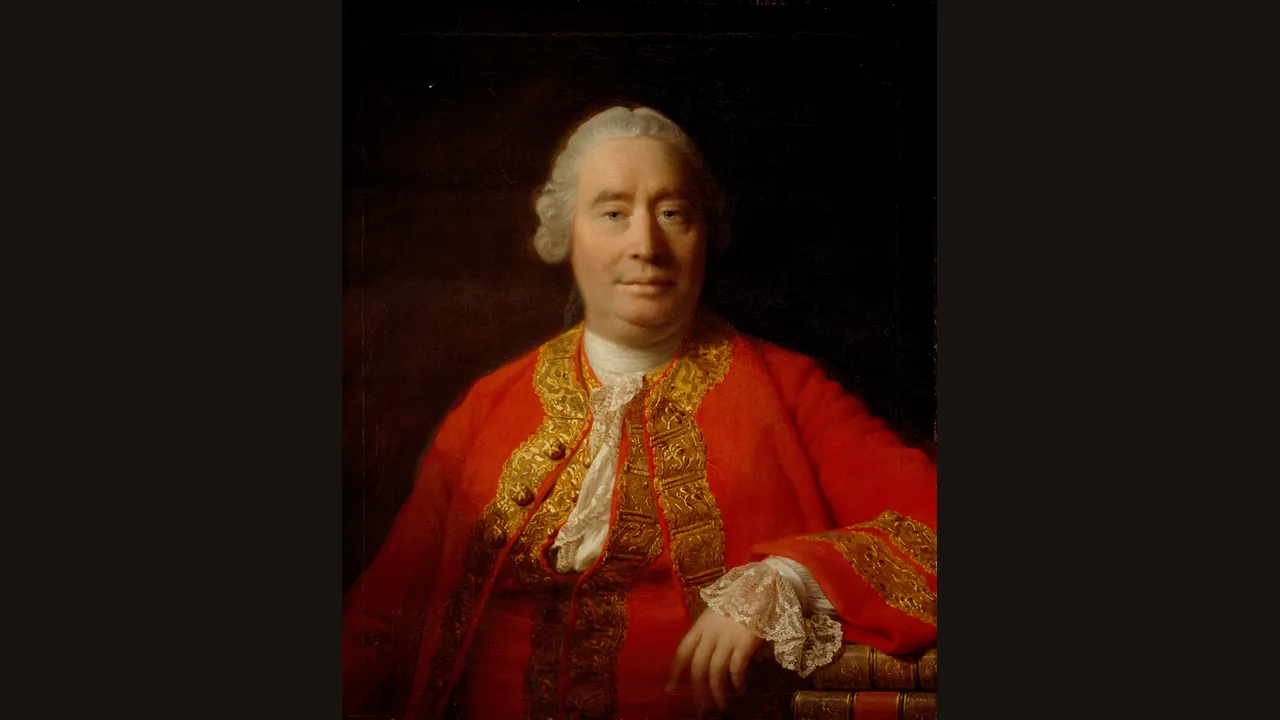
David Hume
1711–1776
Scottish thinker who pushed empiricism to skepticism: causation is habit, the self is a bundle of perceptions, and reason is the slave of the passions. His Treatise fell dead born from the press; the Enquiries made him famous. He lived 1711 to 1776.
David Hume was born in Edinburgh in 1711. He wrote his Treatise of Human Nature in France and published it in 1739 and 1740 to a poor reception. He recast its material in shorter books that found readers: the Enquiry Concerning Human Understanding of 1748 and the Enquiry Concerning the Principles of Morals of 1751. Opposition on religious grounds kept him from chairs at Edinburgh and Glasgow. He worked as a librarian, a military secretary, and a diplomat in Paris. His History of England brought him income and reputation. He died in Edinburgh in 1776.
Hume divided the contents of the mind into impressions, lively perceptions of sensation and feeling, and ideas, their fainter copies. Belief in cause and effect, he argued, rests on no reasoning about nature itself. Men observe one event following another repeatedly, and habit carries the mind from the first to the expectation of the second. Past regularities, on this account, supply custom rather than demonstration. The self he described as a bundle of perceptions in flux, without a single underlying subject. On morals he held that reason is, and ought only to be, the slave of the passions, and that moral distinctions come from sentiment. His essay on miracles weighed testimony for a miracle against the uniform experience behind a law of nature. The Dialogues Concerning Natural Religion appeared in 1779, after his death.
Watch
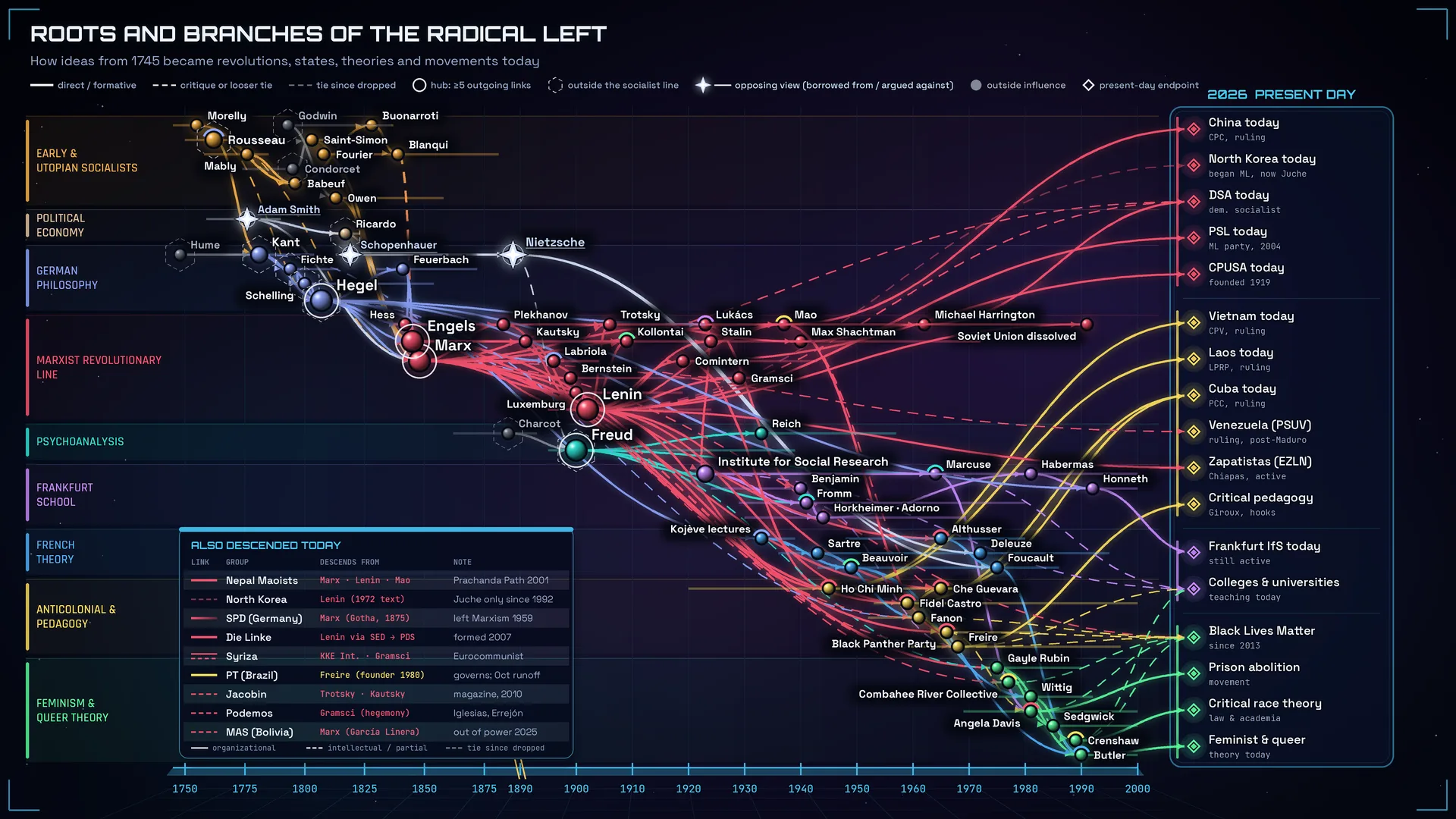
Roots and Branches of the Radical Left
Events · 2026-10-15
Socialism is presented as an economic theory. In reality, woven through every part of the theory are two things that must be adopted before socialism can "work properly": a pseudo-history of mankind, and a massive shift of worldview. Both rest on a fundamental lie about human nature: they blame man's conditions for what belongs to the man himself.
That ideology did not appear from nowhere. It grew out of long-standing ideas, taken up across a chain of events and twisted over time into a promise of a better way for human beings to live, which is why the whole runs far deeper and is far more complex than the economic label suggests. Along the way it was woven in and out of great thinkers, at different points and for different reasons. Some were used for it and some against it, and through all of it the idea kept building.
This map lays that out where it can be seen: the evolution of the ideas, the effects they had, and the chain of cause and effect that followed from thinker to thinker.
Facts
- Born
- 1711, Edinburgh, Scotland.
- Source: Encyclopaedia Britannica, David Hume
- Died
- 1776, Edinburgh.
- Source: Encyclopaedia Britannica, David Hume
- School
- Empiricism and skepticism.
- Source: Encyclopaedia Britannica, David Hume
- Known for
- The problem of induction, the attack on miracles, and the Dialogues Concerning Natural Religion, published after his death.
- Source: Encyclopaedia Britannica, David Hume
Sources
- Encyclopaedia Britannica, David Hume Source
Source links accessed 22 November 2026.
Images
Related
- John LockeConnected
- George BerkeleyConnected
- Sextus EmpiricusConnected
- Adam SmithConnected
- Immanuel KantConnected
- Jeremy BenthamConnected
What happened elsewhere
Pairings are by recorded year, not exact simultaneity.
- Qianlong EmperorWhile David Hume (1711)
- Jean-Jacques RousseauWhile David Hume (1712)
- Frederick the GreatWhile David Hume (1712)
- United KingdomWhile David Hume (1707)
- GreenlandWhile David Hume (1721)
Meanwhile
Meanwhile, around the world — drag to spin, click a pulsing marker.
Keep reading
Test yourself
When was David Hume born?
- 1711, Edinburgh, Scotland
- 1632, Wrington, Somerset, England
- 1561, London, England
- 1694, Paris, France, as François Marie Arouet
Answer
1711, Edinburgh, Scotland — Born: 1711, Edinburgh, Scotland.
When did David Hume die?
- 1776, Edinburgh
- 1529, on campaign in the south
- 1778, Paris, cheered by crowds on his return from exile
- 1592, at his estate near Bordeaux
Answer
1776, Edinburgh — Died: 1776, Edinburgh.
What is David Hume known for?
- The problem of induction, the attack on miracles, and the Dialogues Concerning Natural Religion, published after his death
- Cogito ergo sum, mind body dualism, and analytic geometry, the coordinate system that carries his name
- The unity of knowledge and action: to know the good and not do it is not to know it. And innate knowing, the mind's original sense of right
- Esse est percipi, to be is to be perceived. The tree in the quad stands because God perceives it
Answer
The problem of induction, the attack on miracles, and the Dialogues Concerning Natural Religion, published after his death — Known for: The problem of induction, the attack on miracles, and the Dialogues Concerning Natural Religion, published after his death.
Which school of thought was David Hume part of?
- Empiricism and skepticism
- Rationalism, its founder
- Rationalism, in its most uncompromising form
- Renaissance skepticism
Answer
Empiricism and skepticism — School: Empiricism and skepticism.
True or false: Scottish thinker who pushed empiricism to skepticism: causation is habit, the self is a bundle of perceptions, and reason is the slave of the passions.
- True
- False
Answer
True — True. Scottish thinker who pushed empiricism to skepticism: causation is habit, the self is a bundle of perceptions, and reason is the slave of the passions.
Articles
My notes
Highlights on this page
None yet.
Spotted an error on this page? Email [email protected] and it will be checked against the sources.