

Philosopher · Early modern period · Ireland
George Berkeley
1685–1753
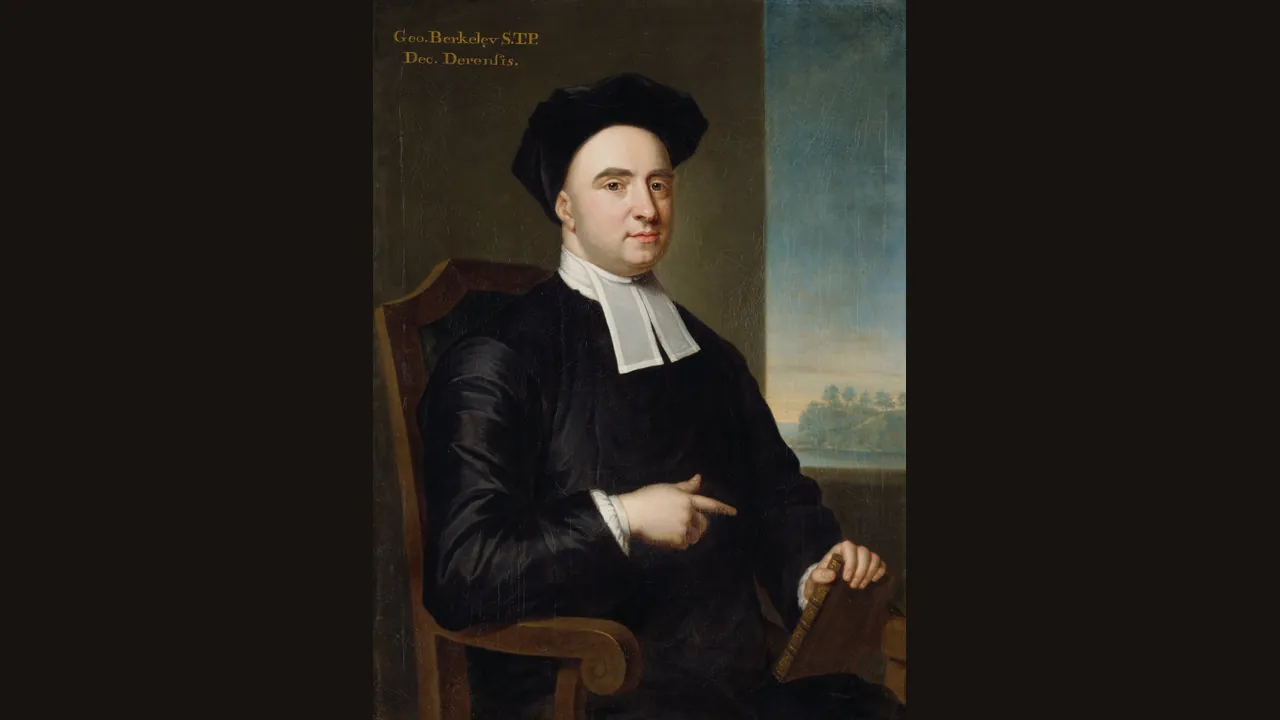
Irish thinker and Anglican Bishop of Cloyne who argued that to be is to be perceived: matter does not exist apart from minds. His immaterialism was meant to defend religion against skepticism. He lived 1685 to 1753.
George Berkeley was born near Kilkenny in Ireland in 1685 and studied at Trinity College Dublin, where he later held a fellowship. He published his main works young: the Essay Towards a New Theory of Vision in 1709, the Treatise Concerning the Principles of Human Knowledge in 1710, and the Three Dialogues Between Hylas and Philonous in 1713. He spent years promoting a college in Bermuda for training clergy and teachers for America, sailed to Rhode Island in 1728, and returned in 1731 when the promised funds failed. He became Bishop of Cloyne in 1734 and died at Oxford in 1753.
Berkeley attacked the notion of abstract ideas and the distinction between primary and secondary qualities that Locke had drawn. Men perceive ideas only, he argued, and a material substance standing behind ideas, never perceived itself, explains nothing and means nothing. His formula was esse est percipi, to be is to be perceived. The world does not lapse when no human mind attends to it, because God perceives all things at all times. What men call physical objects are ordered collections of ideas, and the laws of nature are the regular patterns in that order. In the Siris of 1744 he recommended tar water as a medicine and built a chain of reasoning from it up to God.
Facts
- Born
- 1685, near Kilkenny, Ireland.
- Source: Encyclopaedia Britannica, George Berkeley
- Died
- 1753, Oxford, England.
- Source: Encyclopaedia Britannica, George Berkeley
- School
- Empiricism, turned into immaterialism.
- Source: Encyclopaedia Britannica, George Berkeley
- Known for
- Esse est percipi, to be is to be perceived. The tree in the quad stands because God perceives it.
- Source: Encyclopaedia Britannica, George Berkeley
Sources
- Encyclopaedia Britannica, George Berkeley Source
Source links accessed 22 November 2026.
Images
Related
- John LockeConnected
- David HumeConnected
- MontesquieuSame era
- VoltaireSame era
- Peter the GreatSame era
- Qianlong EmperorSame era
What happened elsewhere
Pairings are by recorded year, not exact simultaneity.
- MontesquieuWhile George Berkeley (1689)
- Turks and Caicos IslandsWhile George Berkeley (1678)
- VoltaireWhile George Berkeley (1694)
Meanwhile
Meanwhile, around the world — drag to spin, click a pulsing marker.
Keep reading
Test yourself
When was George Berkeley born?
- 1685, near Kilkenny, Ireland
- 1711, Edinburgh, Scotland
- 1723, Kirkcaldy, Scotland
- 1712, Geneva, in what is now Switzerland
Answer
1685, near Kilkenny, Ireland — Born: 1685, near Kilkenny, Ireland.
When did George Berkeley die?
- 1753, Oxford, England
- 1778, Paris, cheered by crowds on his return from exile
- 1704, Essex, England
- 1677, The Hague, of lung disease, at forty four
Answer
1753, Oxford, England — Died: 1753, Oxford, England.
What is George Berkeley known for?
- Esse est percipi, to be is to be perceived. The tree in the quad stands because God perceives it
- The Essays, three books of self examination published from 1580, and the motto Que sais je, what do I know
- Monads, the pre established harmony, the principle of sufficient reason, and the calculus priority dispute with Newton
- The Wealth of Nations, the invisible hand, and the pin factory example of the division of labor
Answer
Esse est percipi, to be is to be perceived. The tree in the quad stands because God perceives it — Known for: Esse est percipi, to be is to be perceived. The tree in the quad stands because God perceives it.
Which school of thought was George Berkeley part of?
- Empiricism, turned into immaterialism
- Neo Confucianism, the school of mind
- Materialism and contract theory
- Enlightenment, against its grain
Answer
Empiricism, turned into immaterialism — School: Empiricism, turned into immaterialism.
True or false: Irish thinker and Anglican Bishop of Cloyne who argued that to be is to be perceived: matter does not exist apart from minds.
- True
- False
Answer
True — True. Irish thinker and Anglican Bishop of Cloyne who argued that to be is to be perceived: matter does not exist apart from minds.
My notes
Highlights on this page
None yet.
Spotted an error on this page? Email [email protected] and it will be checked against the sources.