
Ruler · Early modern period · Russia
Peter the Great
1672–1725
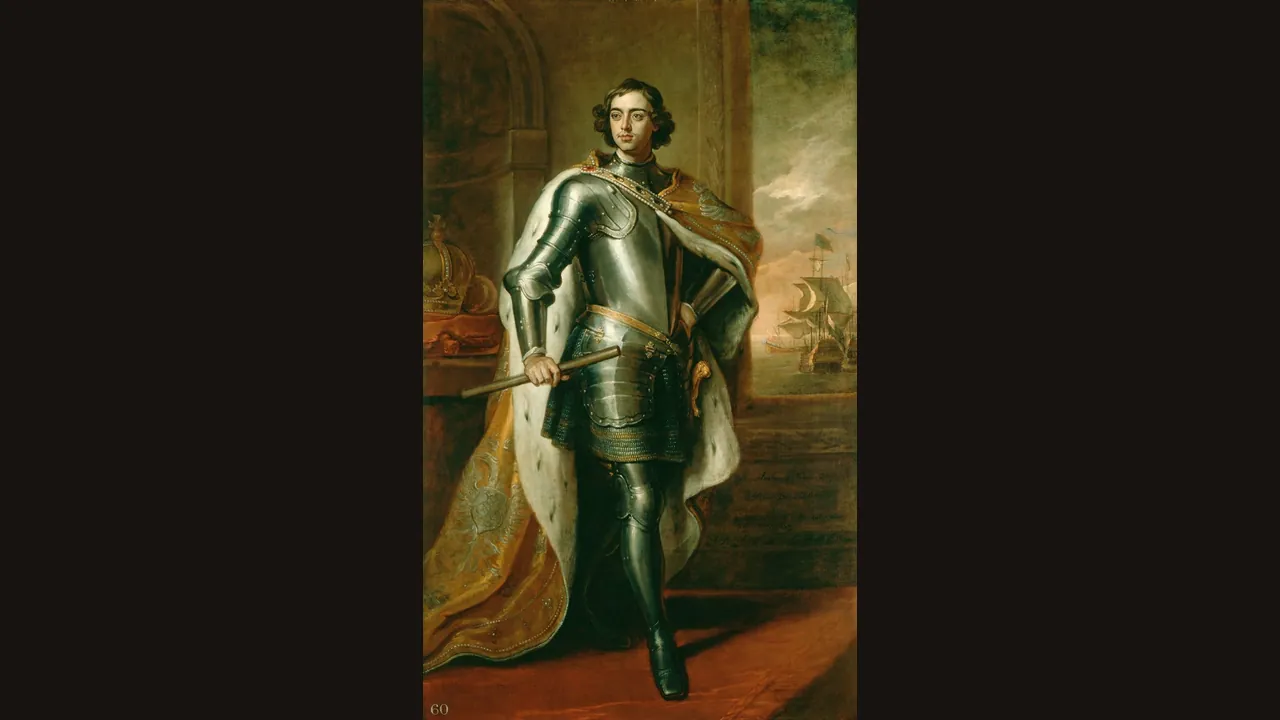
Tsar of Russia from 1682 to 1725, born in 1672, who dragged Russia toward the west by force. He built a navy, reorganized the army, and founded Saint Petersburg as a new capital on the Baltic. His victory over Sweden at Poltava in 1709 made Russia a great power.
Peter became tsar in 1682 at the age of ten, sharing the throne with his half brother Ivan the Fifth while their sister Sophia ruled as regent. He spent much of his youth in the foreign quarter of Moscow, learning from Dutch and German officers and craftsmen, and on the water at a lake estate where he taught himself sailing and gunnery. In 1689 he pushed Sophia into a convent and took power in fact, though he left government to his mother and her kin until Ivan died in 1696.
His first war aimed at the Black Sea. The campaigns of 1695 and 1696 took the fortress of Azov from the Ottoman Turks, and Peter built a fleet at Voronezh to hold it. Then he went to see the west for himself. The Grand Embassy of 1697 and 1698 carried him through Holland and England, where he worked with his hands in shipyards, visited factories and mints, and hired hundreds of engineers, officers, and craftsmen for Russian service. News that the Streltsy musketeers had risen in revolt cut the journey short. He came home, shaved the beards of his courtiers with his own hand, and oversaw the torture and execution of more than a thousand Streltsy.
The long war of his reign was the Great Northern War against Sweden, fought from 1700 to 1721. It opened with disaster at Narva, where the young Charles the Twelfth smashed a larger Russian army in a snowstorm. Peter rebuilt the army from nothing, drafting peasants for life service and casting church bells into cannon. On marshy ground that Sweden held at the mouth of the Neva, he founded Saint Petersburg in 1703 and set armies of conscript laborers to build it. In 1709 at Poltava he destroyed the Swedish field army, and Charles fled into Ottoman exile. Russian sea power grew until the fleet beat the Swedes at Gangut in 1714. The Treaty of Nystad in 1721 gave Russia Estonia, Livonia, Ingria, and part of Karelia. Peter took the title of emperor, and Russia stood as a great power on the Baltic.
The reforms remade the state that paid for the war. He replaced the old council with a governing Senate in 1711 and the old offices with colleges run on Swedish lines. The Table of Ranks of 1722 set fourteen grades for army, navy, and civil service, and tied a man's standing to his service rather than to his birth alone. The church lost its patriarch and came under a state office, the Holy Synod, in 1721. Peter taxed beards, set rules for dress, moved the new year to January, simplified the alphabet, and started the first Russian newspaper. Navigation schools and engineering schools trained the servants the new state needed, and the Academy of Sciences he ordered in 1724 opened a year after his death.
Russians paid for all of it. Taxes roughly tripled across the reign, capped by a poll tax on every male soul, and serfs were bound tighter to the land and sent by the thousand to factories, mines, and building sites. Saint Petersburg rose on piles driven into marsh, and the death toll among its laborers was large. Estimates run into the tens of thousands, but no complete register survives and historians cannot fix the number. Revolts in Astrakhan and on the Don under Bulavin were put down with executions. The deepest wound was inside his family. His son Alexei opposed the reforms, fled abroad in 1716, returned under a promise of pardon, and died in prison in 1718 after torture and a sentence of death. Whether Peter meant the death sentence to be carried out, and how far the torture itself killed the prince, remain disputed.
Peter died in Saint Petersburg in early 1725 at the age of fifty two, after an illness his doctors tied to the bladder and kidneys. A popular story says he caught his death rescuing sailors from icy water the autumn before. The story cannot be proved, and his medical history offers causes enough without it. He left no succession rule that worked, and a string of palace coups followed him. What he left standing was the thing itself. Russia held a Baltic coastline, a navy, a capital facing Europe, and an army no western power could ignore. The price was a state that took more from its people than any before it and that taught its rulers force could remake the country by decree.
Facts
- Born
- 1672, Moscow.
- Source: Encyclopaedia Britannica, Peter the Great
- Died
- 1725, Saint Petersburg.
- Source: Encyclopaedia Britannica, Peter the Great
- Reign
- 1682 to 1725; emperor from 1721.
- Source: Encyclopaedia Britannica, Peter the Great
- Realm
- Russia.
- Source: Encyclopaedia Britannica, Peter the Great
- Known for
- Poltava (1709), the founding of Saint Petersburg (1703), and westernizing reform.
- Source: Encyclopaedia Britannica, Peter the Great
Sources
- Encyclopaedia Britannica, Peter the Great Source
Source links accessed 22 November 2026.
Images
Related
- RussiaConnected
- George BerkeleySame era
- MontesquieuSame era
- Kangxi EmperorSame era
- VoltaireSame era
- Gottfried Wilhelm LeibnizSame era
What happened elsewhere
Pairings are by recorded year, not exact simultaneity.
- British Virgin IslandsWhile Peter the Great (1672)
- Cayman IslandsWhile Peter the Great (1670)
- Turks and Caicos IslandsWhile Peter the Great (1678)
Meanwhile
Meanwhile, around the world — drag to spin, click a pulsing marker.
Keep reading
Test yourself
When was Peter the Great born?
- 1672, Moscow
- 1533, Greenwich
- 1527, Valladolid
- 1491, Greenwich
Answer
1672, Moscow — Born: 1672, Moscow.
When did Peter the Great die?
- 1725, Saint Petersburg
- 1603, Richmond
- 1715, Versailles
- 1547, Whitehall
Answer
1725, Saint Petersburg — Died: 1725, Saint Petersburg.
When did Peter the Great reign?
- 1682 to 1725; emperor from 1721
- Shogun 1603 to 1605; effective ruler to 1616
- 1661 to 1722
- 1611 to 1632
Answer
1682 to 1725; emperor from 1721 — Reign: 1682 to 1725; emperor from 1721.
What realm did Peter the Great rule?
- Russia
- Japan under the Tokugawa shogunate
- Sweden and its Baltic empire
- Prussia
Answer
Russia — Realm: Russia.
True or false: Tsar of Russia from 1682 to 1725, born in 1672, who dragged Russia toward the west by force.
- True
- False
Answer
True — True. Tsar of Russia from 1682 to 1725, born in 1672, who dragged Russia toward the west by force.
My notes
Highlights on this page
None yet.
Spotted an error on this page? Email [email protected] and it will be checked against the sources.