

Philosopher · Early modern period · France
Voltaire
1694–1778
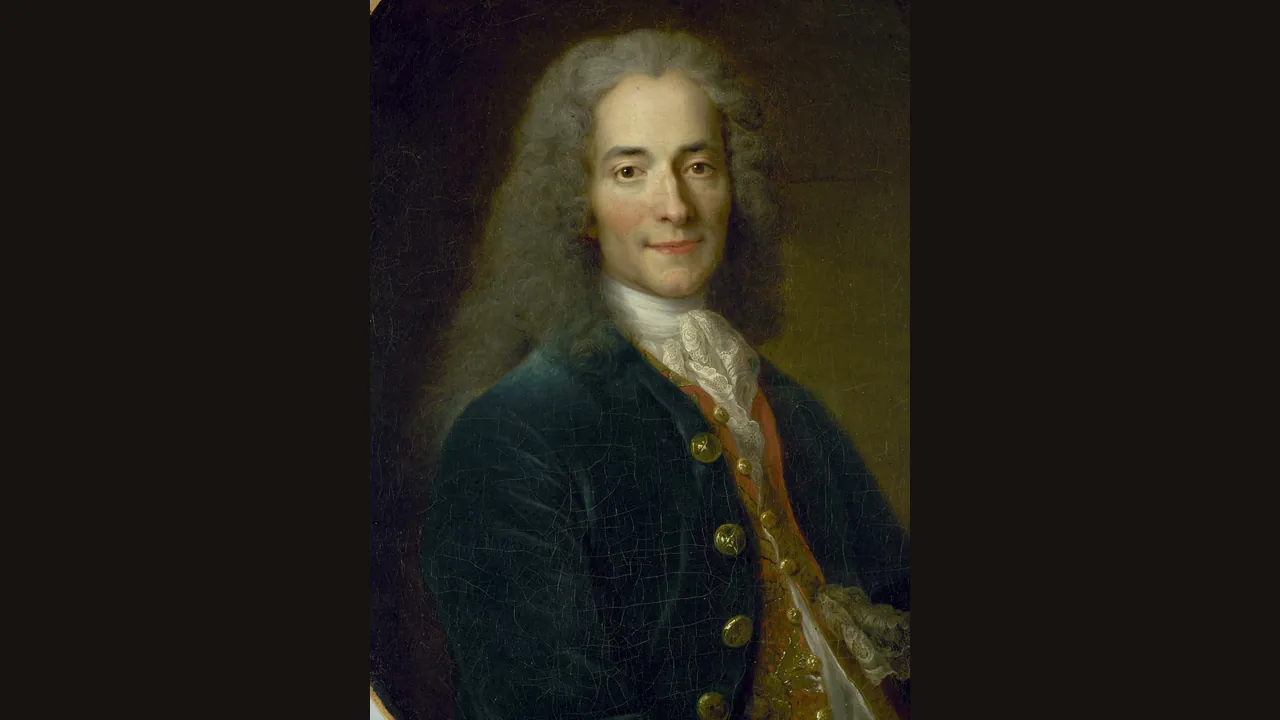
French writer, wit, and campaigner against religious persecution, the most famous voice of the Enlightenment. Exiled, imprisoned in the Bastille, and celebrated across Europe, he made toleration a cause. He lived 1694 to 1778.
Voltaire was born François Marie Arouet in Paris in 1694. Satirical verses against the Regent put him in the Bastille in 1717, and a quarrel with a nobleman sent him there again briefly in 1726, after which he was exiled to England. Two years among the English changed his subjects: he praised their commerce, their religious variety, and their science in the Philosophical Letters of 1734, a book condemned and burned in France. He wrote plays, verse, and histories, lived for a time at the court of Frederick of Prussia, and settled at Ferney near Geneva. He died in Paris in 1778, on a return visit, amid public celebration.
Candide, published in 1759, followed a young man schooled in the doctrine that all is for the best in the best of all possible worlds through war, earthquake, shipwreck, and the Inquisition. The Philosophical Dictionary of 1764 collected his attacks on persecution and superstition in short articles. In his last decades Voltaire took up particular cases of religious injustice. He campaigned for Jean Calas, a Protestant broken on the wheel in 1762 on a charge of murdering his son, and the courts reversed the verdict in 1765. He worked for the Sirven family and for the chevalier de La Barre on similar grounds. His repeated motto was écrasez l'infâme, crush the infamous thing.
Facts
- Born
- 1694, Paris, France, as François Marie Arouet.
- Source: Encyclopaedia Britannica, Voltaire
- Died
- 1778, Paris, cheered by crowds on his return from exile.
- Source: Encyclopaedia Britannica, Voltaire
- School
- Enlightenment, its sharpest pen.
- Source: Encyclopaedia Britannica, Voltaire
- Known for
- Candide, the Philosophical Letters, and the campaigns for Calas and other victims of religious courts. Ecrasez linfame: crush the infamous thing.
- Source: Encyclopaedia Britannica, Voltaire
Sources
- Encyclopaedia Britannica, Voltaire Source
Source links accessed 22 November 2026.
Images
Related
- John LockeConnected
- FranceConnected
- Jean-Jacques RousseauConnected
- MontesquieuSame era
- George BerkeleySame era
- David HumeSame era
What happened elsewhere
Pairings are by recorded year, not exact simultaneity.
- George BerkeleyWhile Voltaire (1685)
Meanwhile
Meanwhile, around the world — drag to spin, click a pulsing marker.
Keep reading
Test yourself
When was Voltaire born?
- 1694, Paris, France, as François Marie Arouet
- 1685, near Kilkenny, Ireland
- 1588, Malmesbury, England
- 1723, Kirkcaldy, Scotland
Answer
1694, Paris, France, as François Marie Arouet — Born: 1694, Paris, France, as François Marie Arouet.
When did Voltaire die?
- 1778, Paris, cheered by crowds on his return from exile
- 1529, on campaign in the south
- 1753, Oxford, England
- 1790, Edinburgh
Answer
1778, Paris, cheered by crowds on his return from exile — Died: 1778, Paris, cheered by crowds on his return from exile.
Which school of thought was Voltaire part of?
- Enlightenment, its sharpest pen
- Empiricism and skepticism
- Rationalism
- Rationalism, in its most uncompromising form
Answer
Enlightenment, its sharpest pen — School: Enlightenment, its sharpest pen.
True or false: French writer, wit, and campaigner against religious persecution, the most famous voice of the Enlightenment.
- True
- False
Answer
True — True. French writer, wit, and campaigner against religious persecution, the most famous voice of the Enlightenment.
My notes
Highlights on this page
None yet.
Spotted an error on this page? Email [email protected] and it will be checked against the sources.