

Philosopher · Early modern period · Switzerland
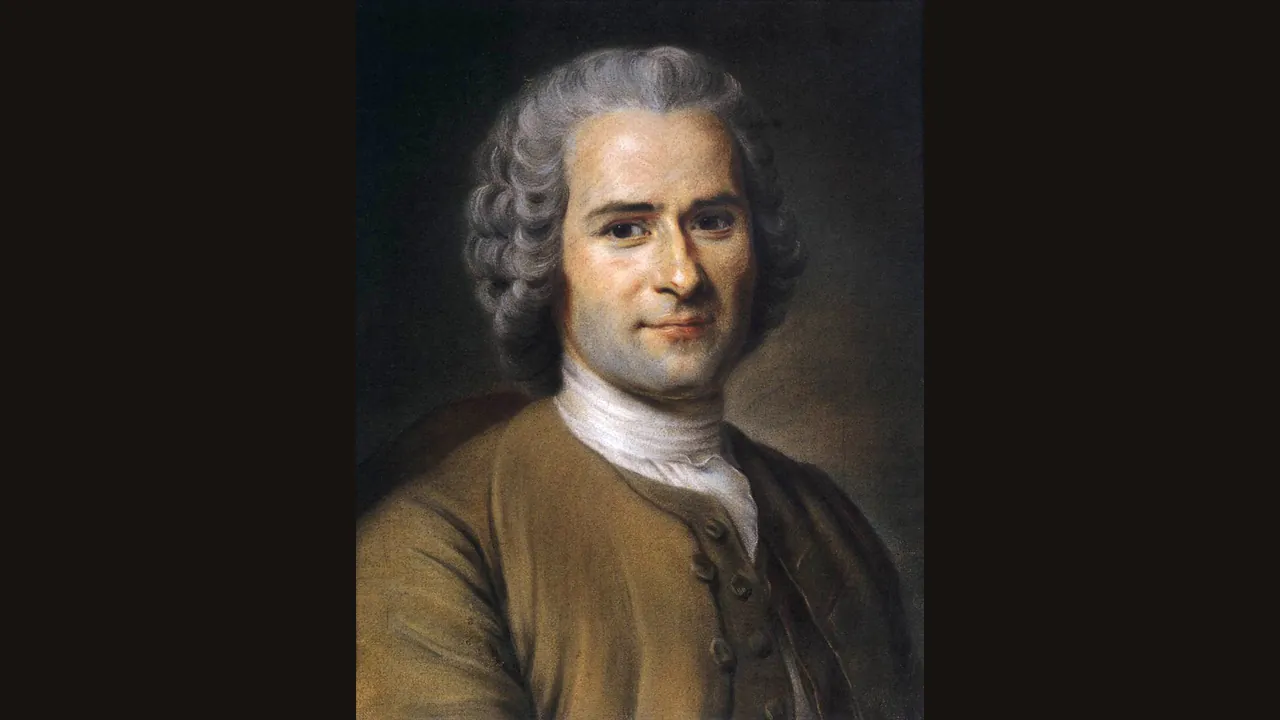
Jean-Jacques Rousseau
1712–1778
Genevan born thinker who lived in France and argued that civilization corrupts natural man. His Social Contract of 1762 made the general will the source of legitimate rule. He lived 1712 to 1778, quarreling with nearly every friend he had.
Jean Jacques Rousseau was born in Geneva in 1712. His mother died days after his birth, and his father, a watchmaker, fled the city after a quarrel when Rousseau was ten. Apprenticed to an engraver, he ran away at fifteen and was taken up in Savoy by Madame de Warens, his patron and later his lover. He converted to Catholicism, drifted through employments as tutor, music teacher, and secretary, and arrived in Paris in 1742. In Paris he joined the circle of the philosophes, wrote music articles for Diderot's Encyclopedia, and lived the rest of his life, unmarried, with Thérèse Levasseur. Their five children were all delivered to a foundling hospital, a fact he confessed, with visible anguish, in his Confessions.
In 1750 the Academy of Dijon awarded its prize to his Discourse on the Arts and Sciences, which argued that learning and refinement had corrupted morals and made men polite slaves. The Discourse on the Origin of Inequality of 1755 went deeper. His natural man, in a condition Rousseau admitted may never have existed, is solitary and healthy, moved by self preservation and by pity, a reluctance to see any creature suffer. Corruption arrives with comparison, as men gather, judge one another, and come to live in the opinion of others; the healthy instinct, amour de soi, curdles into amour propre, the hunger for rank in other men's eyes. Property begins when the first man encloses a plot of ground and finds people simple enough to believe him when he says it is his. Agriculture and metalworking fix dependence and inequality, the rich invent government to guard what they hold, and the process ends in despotism, where all are equal in having nothing. The rich man's fraud, offered as law, is for Rousseau the origin of political society.
The Social Contract of 1762 attempts the remedy. Its opening sentence declares that man is born free and everywhere is in chains. Legitimate rule cannot rest on force or on nature, so it must rest on convention. Each citizen gives himself wholly to the community and thereby to no private master, and from this act arises the general will, aimed at the common good. Rousseau distinguishes the general will from the will of all, which is only the sum of private desires. Sovereignty, which is the exercise of the general will, cannot be transferred or divided, and law must speak generally, naming no man and favoring no class. The book's most contested sentence says that a man who refuses the general will shall be forced to be free, since obedience to self prescribed law is liberty. The same book subordinates religion to the state through a civil profession of faith, and assigns lawgiving to extraordinary founders such as Moses and Lycurgus.
Emile, published the same year, rebuilt education on the same foundation. The tutor is to practice negative education, arranging the child's experience and shielding him from books and premature moralizing, so that he learns from things and from necessity rather than from commands, growing strong, self reliant, and free of amour propre until reason ripens. The fourth book contains the profession of faith of a Savoyard vicar, rejecting revealed religion for a religion of the heart. Paris condemned both Emile and the Social Contract, and Emile was publicly burned; Geneva condemned them as well. Rousseau fled a warrant, lived at Môtiers until his house was stoned, took refuge in England in 1766, and then quarreled with Hume, accusing his benefactor of conspiring against him. His fear of plots was partly delusion and partly grounded in real persecution, and the two are hard to separate in his last decade.
He spent his final years in France under assumed names, writing the Confessions, an autobiography claiming to show a man exactly as he was, and the unfinished Reveries of the Solitary Walker. He died at Ermenonville in 1778, and the Revolution transferred his remains to the Panthéon in 1794. Kant testified that Rousseau set him right and taught him to honor common humanity. The French revolutionaries treated the Social Contract as scripture; Robespierre venerated its author, and the Cult of the Supreme Being drew on its chapter on civil religion. His influence ran onward into Romantic literature, educational practice, and every later politics that grounds legitimacy in the people's will. J. L. Talmon named Rousseau a father of totalitarian democracy, and Isaiah Berlin argued that freedom redefined as obedience to the general will can be claimed by any faction that seizes the name. Defenders answer that Rousseau required small republics, laws general in form, direct legislation by assembled citizens, and a people formed by shared customs, conditions no Jacobin committee met. Whether the Revolution applied Rousseau or betrayed him remains disputed.
Watch
Roots and Branches of the Radical Left
Events · 2026-10-15
Socialism is presented as an economic theory. In reality, woven through every part of the theory are two things that must be adopted before socialism can "work properly": a pseudo-history of mankind, and a massive shift of worldview. Both rest on a fundamental lie about human nature: they blame man's conditions for what belongs to the man himself.
That ideology did not appear from nowhere. It grew out of long-standing ideas, taken up across a chain of events and twisted over time into a promise of a better way for human beings to live, which is why the whole runs far deeper and is far more complex than the economic label suggests. Along the way it was woven in and out of great thinkers, at different points and for different reasons. Some were used for it and some against it, and through all of it the idea kept building.
This map lays that out where it can be seen: the evolution of the ideas, the effects they had, and the chain of cause and effect that followed from thinker to thinker.
Facts
- Born
- 1712, Geneva, in what is now Switzerland.
- Source: Encyclopaedia Britannica, Jean-Jacques Rousseau
- Died
- 1778, Ermenonville, France.
- Source: Encyclopaedia Britannica, Jean-Jacques Rousseau
- School
- Enlightenment, against its grain.
- Source: Encyclopaedia Britannica, Jean-Jacques Rousseau
- Known for
- The Social Contract and the general will, Emile on education, and the Confessions, the first modern autobiography.
- Source: Encyclopaedia Britannica, Jean-Jacques Rousseau
Sources
- Encyclopaedia Britannica, Jean-Jacques Rousseau Source
Source links accessed 22 November 2026.
Images
Related
- John LockeConnected
- MontesquieuConnected
- FranceConnected
- Thomas HobbesConnected
- VoltaireConnected
- Frederick the GreatSame era
What happened elsewhere
Pairings are by recorded year, not exact simultaneity.
- Frederick the GreatWhile Jean-Jacques Rousseau (1712)
- David HumeWhile Jean-Jacques Rousseau (1711)
- Qianlong EmperorWhile Jean-Jacques Rousseau (1711)
- United KingdomWhile Jean-Jacques Rousseau (1707)
- GreenlandWhile Jean-Jacques Rousseau (1721)
Meanwhile
Meanwhile, around the world — drag to spin, click a pulsing marker.
Keep reading
Test yourself
When was Jean-Jacques Rousseau born?
- 1712, Geneva, in what is now Switzerland
- 1588, Malmesbury, England
- 1596, La Haye, France
- 1632, Wrington, Somerset, England
Answer
1712, Geneva, in what is now Switzerland — Born: 1712, Geneva, in what is now Switzerland.
When did Jean-Jacques Rousseau die?
- 1778, Ermenonville, France
- 1753, Oxford, England
- 1529, on campaign in the south
- 1704, Essex, England
Answer
1778, Ermenonville, France — Died: 1778, Ermenonville, France.
What is Jean-Jacques Rousseau known for?
- The Social Contract and the general will, Emile on education, and the Confessions, the first modern autobiography
- Candide, the Philosophical Letters, and the campaigns for Calas and other victims of religious courts. Ecrasez linfame: crush the infamous thing
- The unity of knowledge and action: to know the good and not do it is not to know it. And innate knowing, the mind's original sense of right
- Cogito ergo sum, mind body dualism, and analytic geometry, the coordinate system that carries his name
Answer
The Social Contract and the general will, Emile on education, and the Confessions, the first modern autobiography — Known for: The Social Contract and the general will, Emile on education, and the Confessions, the first modern autobiography.
Which school of thought was Jean-Jacques Rousseau part of?
- Enlightenment, against its grain
- Empiricism, at its programmatic beginning
- Materialism and contract theory
- Empiricism, turned into immaterialism
Answer
Enlightenment, against its grain — School: Enlightenment, against its grain.
True or false: Genevan born thinker who lived in France and argued that civilization corrupts natural man.
- True
- False
Answer
True — True. Genevan born thinker who lived in France and argued that civilization corrupts natural man.
Articles

My notes
Highlights on this page
None yet.
Spotted an error on this page? Email [email protected] and it will be checked against the sources.