

Philosopher · Early modern period · England
Thomas Hobbes
1588–1679
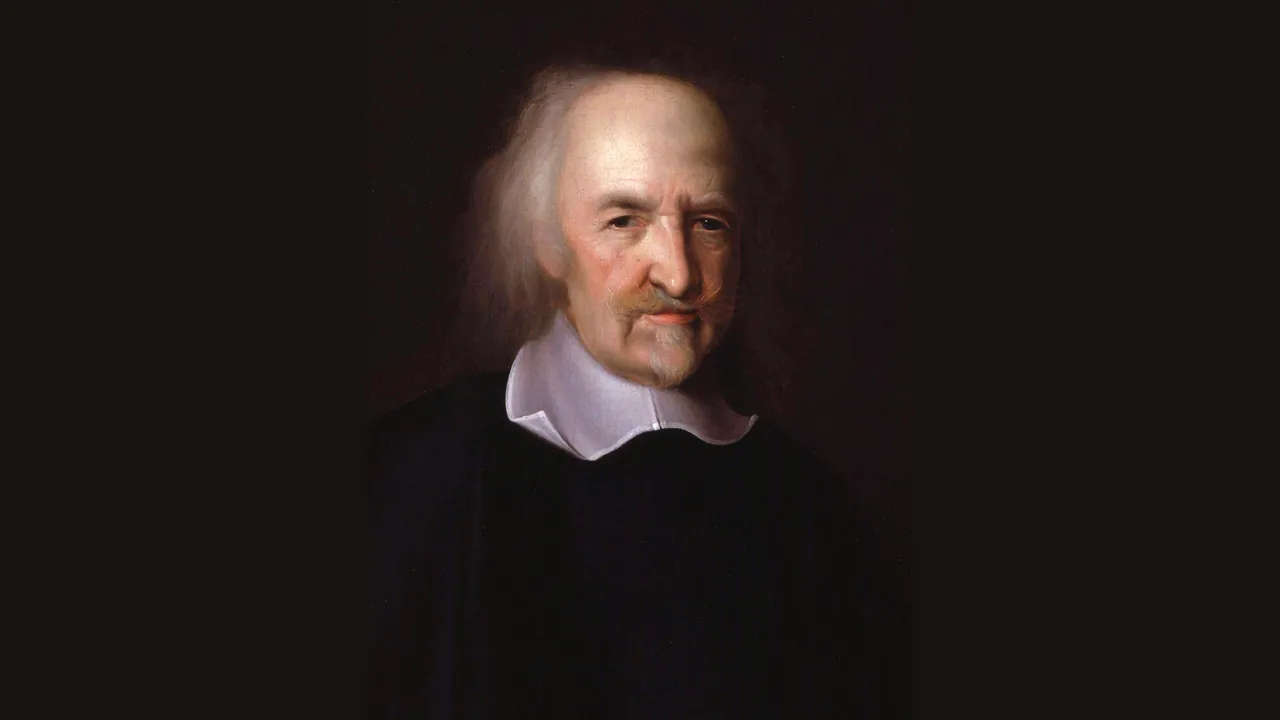
English thinker whose Leviathan of 1651 founded modern political philosophy on the social contract. Men in the state of nature live in war of all against all, so they surrender power to a sovereign. He lived 1588 to 1679.
Thomas Hobbes was born in Malmesbury, Wiltshire, in 1588, the son of a clergyman. He later joked that his mother, frightened by news of the Spanish Armada, gave birth to twins, himself and fear. He studied at Oxford, became a tutor in the Cavendish family, and kept that connection for the rest of his life. His travels in Europe brought him into the circle of the new science. He met Galileo in Florence in 1636 and corresponded with Descartes through the friar Marin Mersenne, though the two philosophers disliked each other's conclusions. In 1640, as quarrels between king and Parliament moved toward war, Hobbes fled to Paris. He was among the first of the royalist exiles, and he remained in France for eleven years, for a time teaching mathematics to the exiled Prince of Wales, the future Charles II.
Leviathan, published in 1651, rests on a materialist account of nature. Hobbes held that the universe is bodies in motion and nothing more, and that thought itself is motion within the brain. Human beings are machines of appetite and aversion, each seeking what he calls his good and fleeing what he calls his evil. Reason, on this account, does not set the ends of life. Reason finds the means to ends the passions have already chosen. A science of politics must therefore begin with men as they are, moved by desire and by fear, and not as preachers wish them to be.
The famous argument follows. Imagine men with no common power over them, in what Hobbes calls the state of nature. They are equal in the way that matters: the weakest can kill the strongest, by stealth or by alliance. From equality comes competition for goods, distrust that drives each man to strike first for safety, and the love of glory that makes men fight over reputation. The result is a war of every man against every man, in which there is no industry, no agriculture, no navigation, no arts, no letters, and no society, because the outcome of every undertaking is uncertain. Life in that condition is, in his celebrated words, solitary, poor, nasty, brutish, and short. In the state of nature there is no law, and so no justice and no injustice, and no property, because nothing can be called a man's own where another may take it by force.
Reason itself, Hobbes argues, teaches laws of nature that point out of the war. The first law is to seek peace where peace can be had. The second is to lay down, together with others, the natural right to all things. The third is to keep covenants once made, for without covenant keeping there is no exit from the war. Men escape by conferring their power on one man or one assembly, each promising every other to obey a common sovereign. The sovereign is not a party to this covenant and so cannot break it, and subjects cannot lawfully resist or change the form of government once set. The sovereign makes law, judges disputes, controls property, and decides which doctrines may be publicly taught, since disputed doctrine was, in Hobbes's judgment, a chief cause of the civil war he had lived through. Sovereignty divided is sovereignty destroyed, because rival powers return men to the state of nature. Hobbes preferred monarchy as the form most likely to keep the peace, but he allowed that an assembly could hold the same authority. A subject keeps one right only, the right to defend his own body when the sovereign moves directly against his life, because no man can be understood to have given that away.
Leviathan made Hobbes the founder of modern contract theory, and every later contract thinker wrote in his shadow or against him. Locke built his politics as an answer to Hobbes, limiting the sovereign Hobbes had made absolute, and Rousseau took up the contract while rejecting Hobbes's account of natural man. In his own century Hobbes was attacked as an atheist by churchmen such as Bishop Bramhall and the Earl of Clarendon, and his name became a byword for selfish philosophy. Scholars still dispute his private religion. A. P. Martinich has argued that Hobbes was a sincere if unusual theist, while readers in the line of Leo Strauss have treated his theology as protective covering for unbelief. The criticism that has lasted longest is simpler: critics from Locke onward have answered that an absolute sovereign can produce the very insecurity the contract was meant to end, and students of stateless societies note that such societies in the record are governed by custom and kinship and are not the constant war Hobbes described. He died at Hardwick Hall in 1679, at the age of ninety one, still arguing.
Facts
- Born
- 1588, Malmesbury, England.
- Source: Encyclopaedia Britannica, Thomas Hobbes
- Died
- 1679, Hardwick Hall, England, at ninety one.
- Source: Encyclopaedia Britannica, Thomas Hobbes
- School
- Materialism and contract theory.
- Source: Encyclopaedia Britannica, Thomas Hobbes
- Known for
- Leviathan: the state of nature as solitary, poor, nasty, brutish, and short, and the absolute sovereign as the escape from it.
- Source: Encyclopaedia Britannica, Thomas Hobbes
Sources
- Encyclopaedia Britannica, Thomas Hobbes Source
Source links accessed 22 November 2026.
Images
Related
- John LockeConnected
- Jean-Jacques RousseauConnected
- Gustavus AdolphusSame era
- René DescartesSame era
- Abbas ISame era
- Francis BaconSame era
What happened elsewhere
Pairings are by recorded year, not exact simultaneity.
- Gustavus AdolphusWhile Thomas Hobbes (1594)
- NetherlandsWhile Thomas Hobbes (1581)
- René DescartesWhile Thomas Hobbes (1596)
Meanwhile
Meanwhile, around the world — drag to spin, click a pulsing marker.
Keep reading
Test yourself
When was Thomas Hobbes born?
- 1588, Malmesbury, England
- 1748, London, England
- 1561, London, England
- 1533, near Bordeaux, France
Answer
1588, Malmesbury, England — Born: 1588, Malmesbury, England.
When did Thomas Hobbes die?
- 1679, Hardwick Hall, England, at ninety one
- 1677, The Hague, of lung disease, at forty four
- 1778, Paris, cheered by crowds on his return from exile
- 1778, Ermenonville, France
Answer
1679, Hardwick Hall, England, at ninety one — Died: 1679, Hardwick Hall, England, at ninety one.
What is Thomas Hobbes known for?
- Leviathan: the state of nature as solitary, poor, nasty, brutish, and short, and the absolute sovereign as the escape from it
- The Spirit of the Laws: liberty requires the separation of legislative, executive, and judicial power; laws fit climates and customs
- The Essays, three books of self examination published from 1580, and the motto Que sais je, what do I know
- The greatest happiness principle, the Panopticon prison design, and the felicific calculus for weighing pleasures and pains
Answer
Leviathan: the state of nature as solitary, poor, nasty, brutish, and short, and the absolute sovereign as the escape from it — Known for: Leviathan: the state of nature as solitary, poor, nasty, brutish, and short, and the absolute sovereign as the escape from it.
Which school of thought was Thomas Hobbes part of?
- Materialism and contract theory
- Empiricism, turned into immaterialism
- Scottish Enlightenment; classical economics
- Enlightenment, against its grain
Answer
Materialism and contract theory — School: Materialism and contract theory.
True or false: English thinker whose Leviathan of 1651 founded modern political philosophy on the social contract.
- True
- False
Answer
True — True. English thinker whose Leviathan of 1651 founded modern political philosophy on the social contract.
My notes
Highlights on this page
None yet.
Spotted an error on this page? Email [email protected] and it will be checked against the sources.