

Philosopher · Early modern period · France
René Descartes
1596–1650
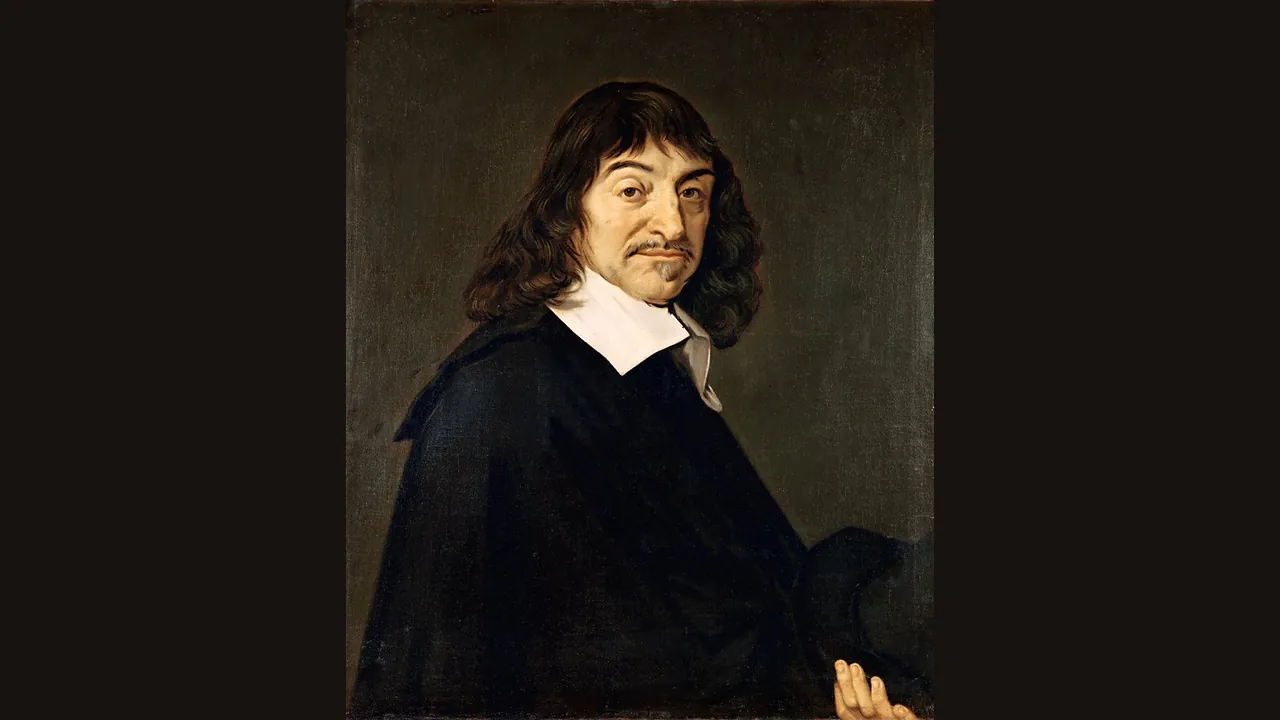
French thinker, mathematician, and soldier who founded modern rationalism. Starting from I think, therefore I am, he rebuilt knowledge on reason in the Meditations of 1641. He lived 1596 to 1650 and died at Stockholm.
René Descartes was born at La Haye in France in 1596 and educated by the Jesuits at La Flèche. He took a law degree at Poitiers, then served as a volunteer soldier in Dutch and Bavarian armies. In 1619, during a winter spent in quarters in Germany, he resolved to rebuild his knowledge on a foundation he could not doubt. He settled in the Netherlands in 1628 and lived there for twenty years. In 1649 he accepted an invitation to tutor Queen Christina of Sweden and died of pneumonia at Stockholm in 1650.
The Discourse on Method of 1637 set out his rules of inquiry and included his Geometry, which joined algebra to geometry in the coordinate system that bears his name. The Meditations of 1641 carried out his method of doubt: he set aside the testimony of the senses and supposed a deceiving demon, and he found one certainty remaining, that he was thinking, and therefore existed. From this he argued to the existence of God, and from God's truthfulness to the reliability of clear and distinct ideas. Descartes divided reality into thinking substance and extended substance, mind and body, and he treated animals and the human body as machines. His Principles of Philosophy of 1644 presented the whole system.
Facts
- Born
- 1596, La Haye, France.
- Source: Encyclopaedia Britannica, René Descartes
- Died
- 1650, Stockholm, Sweden, of pneumonia, while tutoring Queen Christina.
- Source: Encyclopaedia Britannica, René Descartes
- School
- Rationalism, its founder.
- Source: Encyclopaedia Britannica, René Descartes
- Known for
- Cogito ergo sum, mind body dualism, and analytic geometry, the coordinate system that carries his name.
- Source: Encyclopaedia Britannica, René Descartes
Sources
- Encyclopaedia Britannica, René Descartes Source
Source links accessed 22 November 2026.
Images
Related
- Augustine of HippoConnected
- Sextus EmpiricusConnected
- FranceConnected
- Baruch SpinozaConnected
- Gottfried Wilhelm LeibnizConnected
- John LockeConnected
What happened elsewhere
Pairings are by recorded year, not exact simultaneity.
- Gustavus AdolphusWhile René Descartes (1594)
- Thomas HobbesWhile René Descartes (1588)
Meanwhile
Meanwhile, around the world — drag to spin, click a pulsing marker.
Keep reading
Test yourself
When was René Descartes born?
- 1596, La Haye, France
- 1646, Leipzig, Germany
- 1561, London, England
- 1712, Geneva, in what is now Switzerland
Answer
1596, La Haye, France — Born: 1596, La Haye, France.
When did René Descartes die?
- 1650, Stockholm, Sweden, of pneumonia, while tutoring Queen Christina
- 1753, Oxford, England
- 1778, Paris, cheered by crowds on his return from exile
- 1755, Paris
Answer
1650, Stockholm, Sweden, of pneumonia, while tutoring Queen Christina — Died: 1650, Stockholm, Sweden, of pneumonia, while tutoring Queen Christina.
What is René Descartes known for?
- Cogito ergo sum, mind body dualism, and analytic geometry, the coordinate system that carries his name
- The greatest happiness principle, the Panopticon prison design, and the felicific calculus for weighing pleasures and pains
- The unity of knowledge and action: to know the good and not do it is not to know it. And innate knowing, the mind's original sense of right
- The Essays, three books of self examination published from 1580, and the motto Que sais je, what do I know
Answer
Cogito ergo sum, mind body dualism, and analytic geometry, the coordinate system that carries his name — Known for: Cogito ergo sum, mind body dualism, and analytic geometry, the coordinate system that carries his name.
Which school of thought was René Descartes part of?
- Rationalism, its founder
- Neo Confucianism, the school of mind
- Materialism and contract theory
- Enlightenment, its sharpest pen
Answer
Rationalism, its founder — School: Rationalism, its founder.
True or false: French thinker, mathematician, and soldier who founded modern rationalism.
- True
- False
Answer
True — True. French thinker, mathematician, and soldier who founded modern rationalism.
My notes
Highlights on this page
None yet.
Spotted an error on this page? Email [email protected] and it will be checked against the sources.