

Philosopher · Early modern period · Germany
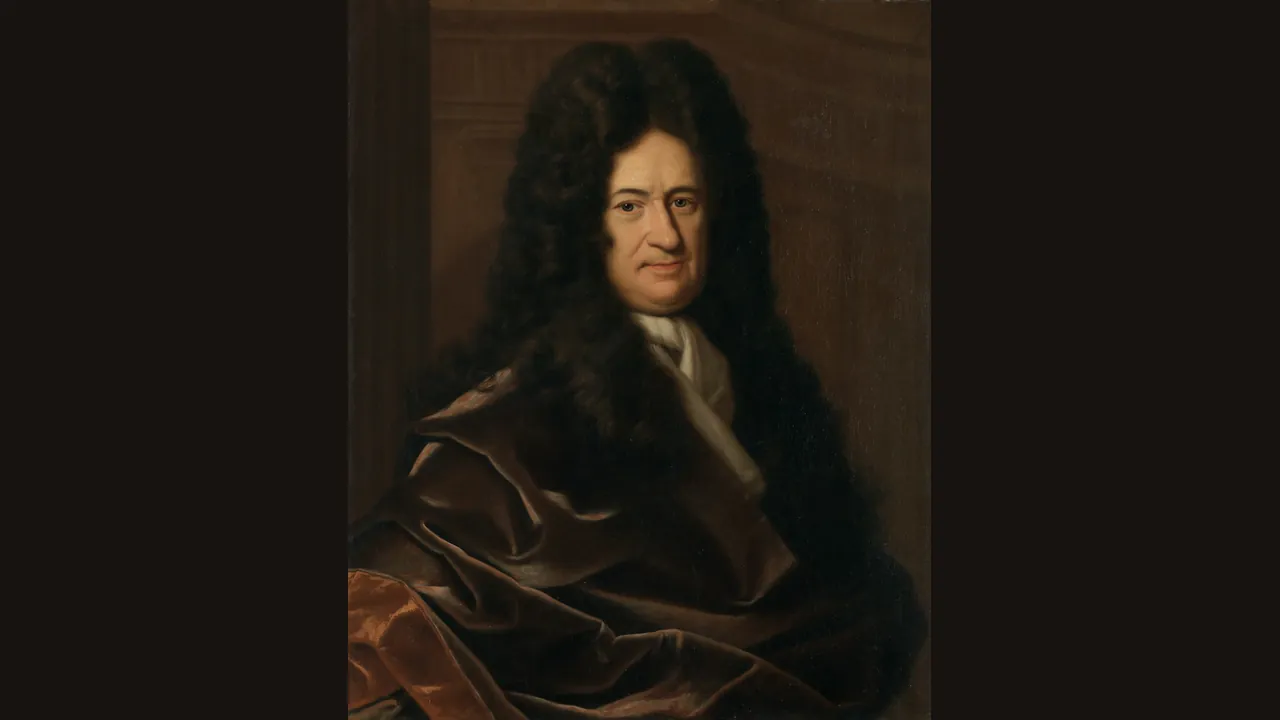
Gottfried Wilhelm Leibniz
1646–1716
German polymath, diplomat, and librarian who invented the calculus independently of Newton and built a metaphysics of monads, windowless souls mirroring the universe. He lived 1646 to 1716 and wrote mostly in French and Latin.
Gottfried Wilhelm Leibniz was born at Leipzig in 1646 and took a doctorate in law at Altdorf at twenty. He entered the service of the Elector of Mainz, then passed in 1676 to the court of Hanover, where he worked as counsellor and librarian for forty years. His duties ranged from diplomacy and genealogy to mining projects in the Harz mountains. He published his first paper on the calculus in 1684, having developed the method independently of Newton, and the two camps disputed priority for decades. His notation is the notation still used. Leibniz died at Hanover in 1716.
Leibniz published one philosophical book in his lifetime, the Theodicy of 1710, and stated his mature system most compactly in the Monadology of 1714. Reality, he held, consists of monads, simple substances without parts. Monads have no windows: nothing enters or leaves them, and each mirrors the whole universe from its own point of view. Their agreement comes from a harmony God established at creation. He defended two principles, contradiction for truths of reason and sufficient reason for truths of fact: nothing happens without a reason why it is so rather than otherwise. His Theodicy argued that God, choosing among possible worlds, chose the best. Leibniz also built a stepped reckoning machine and wrote out the binary number system.
Facts
- Born
- 1646, Leipzig, Germany.
- Source: Encyclopaedia Britannica, Gottfried Wilhelm Leibniz
- Died
- 1716, Hanover, Germany.
- Source: Encyclopaedia Britannica, Gottfried Wilhelm Leibniz
- School
- Rationalism.
- Source: Encyclopaedia Britannica, Gottfried Wilhelm Leibniz
- Known for
- Monads, the pre established harmony, the principle of sufficient reason, and the calculus priority dispute with Newton.
- Source: Encyclopaedia Britannica, Gottfried Wilhelm Leibniz
Sources
- Encyclopaedia Britannica, Gottfried Wilhelm Leibniz Source
Source links accessed 22 November 2026.
Images
Related
- René DescartesConnected
- Baruch SpinozaConnected
- GermanyConnected
- Immanuel KantConnected
- Kangxi EmperorSame era
- Louis XIVSame era
What happened elsewhere
Pairings are by recorded year, not exact simultaneity.
- Saint BarthélemyWhile Gottfried Wilhelm Leibniz (1648)
- Saint MartinWhile Gottfried Wilhelm Leibniz (1648)
- Sint MaartenWhile Gottfried Wilhelm Leibniz (1648)
- AnguillaWhile Gottfried Wilhelm Leibniz (1650)
- Kangxi EmperorWhile Gottfried Wilhelm Leibniz (1654)
Meanwhile
Meanwhile, around the world — drag to spin, click a pulsing marker.
Keep reading
Test yourself
When was Gottfried Wilhelm Leibniz born?
- 1646, Leipzig, Germany
- 1533, near Bordeaux, France
- 1723, Kirkcaldy, Scotland
- 1561, London, England
Answer
1646, Leipzig, Germany — Born: 1646, Leipzig, Germany.
When did Gottfried Wilhelm Leibniz die?
- 1716, Hanover, Germany
- 1529, on campaign in the south
- 1755, Paris
- 1704, Essex, England
Answer
1716, Hanover, Germany — Died: 1716, Hanover, Germany.
What is Gottfried Wilhelm Leibniz known for?
- Monads, the pre established harmony, the principle of sufficient reason, and the calculus priority dispute with Newton
- Cogito ergo sum, mind body dualism, and analytic geometry, the coordinate system that carries his name
- The unity of knowledge and action: to know the good and not do it is not to know it. And innate knowing, the mind's original sense of right
- The greatest happiness principle, the Panopticon prison design, and the felicific calculus for weighing pleasures and pains
Answer
Monads, the pre established harmony, the principle of sufficient reason, and the calculus priority dispute with Newton — Known for: Monads, the pre established harmony, the principle of sufficient reason, and the calculus priority dispute with Newton.
Which school of thought was Gottfried Wilhelm Leibniz part of?
- Rationalism
- Neo Confucianism, the school of mind
- Enlightenment political theory
- Renaissance skepticism
Answer
Rationalism — School: Rationalism.
True or false: German polymath, diplomat, and librarian who invented the calculus independently of Newton and built a metaphysics of monads, windowless souls mirroring the universe.
- True
- False
Answer
True — True. German polymath, diplomat, and librarian who invented the calculus independently of Newton and built a metaphysics of monads, windowless souls mirroring the universe.
My notes
Highlights on this page
None yet.
Spotted an error on this page? Email [email protected] and it will be checked against the sources.