

Philosopher · Early modern period · Netherlands
Baruch Spinoza
1632–1677
Dutch Jewish thinker, excommunicated by the Amsterdam synagogue in 1656, who ground lenses for a living and wrote the Ethics, identifying God with Nature. He lived 1632 to 1677 and published almost nothing under his name in his lifetime.
Baruch Spinoza was born in Amsterdam in 1632, in the city's Portuguese Jewish community. In 1656 the congregation issued a writ of excommunication against him, and he thereafter lived outside the community, earning his bread by grinding lenses. He refused offers of support that carried conditions and declined a professorship at Heidelberg in 1673. He published one book under his own name in his lifetime, on Descartes. He died at The Hague in 1677 of a lung disease, aged forty four.
His Ethics appeared after his death in 1677, arranged in the manner of a geometry book, with definitions, axioms, and propositions. Spinoza held that there is one substance, which he named God or Nature, and that everything else exists as a mode of that substance. Substance has infinite attributes, and human beings know two of them, thought and extension. Mind and body are therefore one thing viewed in two ways. Every thing strives to persist in its being, a striving he called conatus, and human emotion he analyzed as passages between greater and lesser power. Freedom, for Spinoza, is not escape from necessity but understanding of it. His Theological Political Treatise of 1670, published anonymously, examined Scripture as a historical text and defended freedom of thought.
Facts
- Born
- 1632, Amsterdam, Netherlands, to Portuguese Jewish parents.
- Source: Encyclopaedia Britannica, Baruch Spinoza
- Died
- 1677, The Hague, of lung disease, at forty four.
- Source: Encyclopaedia Britannica, Baruch Spinoza
- School
- Rationalism, in its most uncompromising form.
- Source: Encyclopaedia Britannica, Baruch Spinoza
- Known for
- The Ethics: one substance, God or Nature, of which minds and bodies are modes; freedom as understanding necessity.
- Source: Encyclopaedia Britannica, Baruch Spinoza
Sources
- Encyclopaedia Britannica, Baruch Spinoza Source
Source links accessed 22 November 2026.
Images
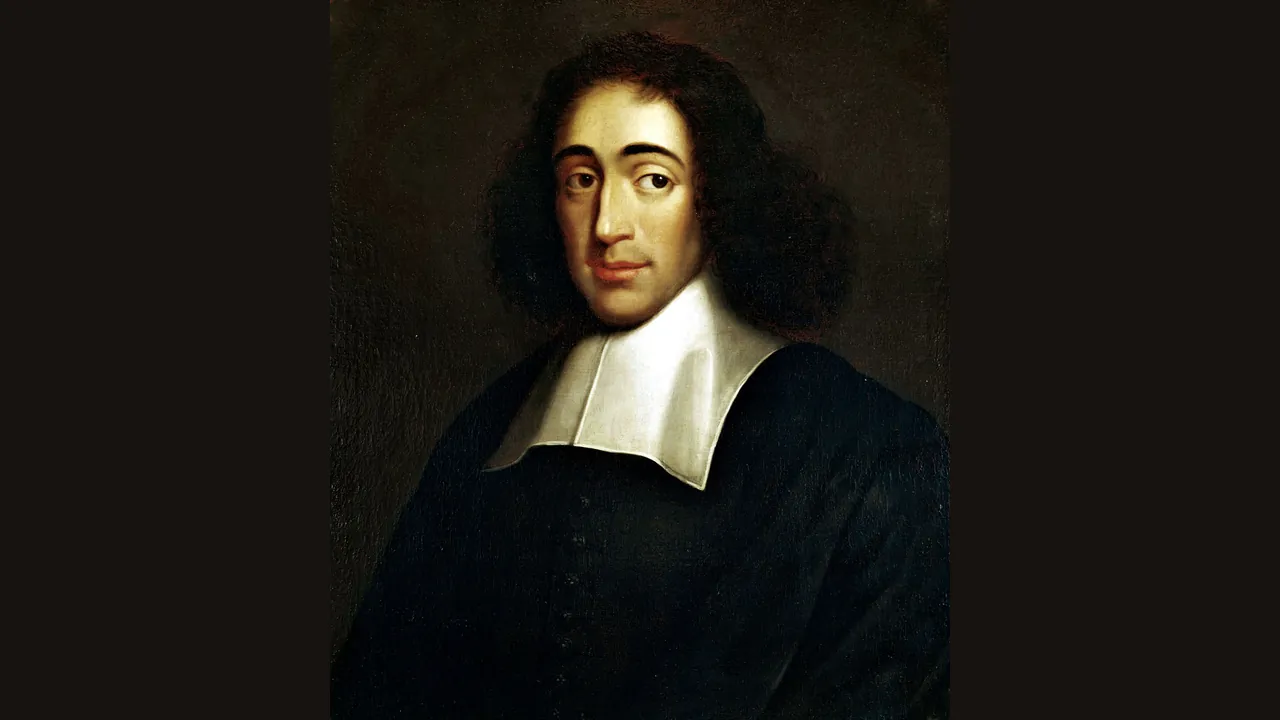
Related
- René DescartesConnected
- Gottfried Wilhelm LeibnizConnected
- John LockeSame era
- Louis XIVSame era
- Kangxi EmperorSame era
- Gustavus AdolphusSame era
What happened elsewhere
Pairings are by recorded year, not exact simultaneity.
- John LockeWhile Baruch Spinoza (1632)
- MontserratWhile Baruch Spinoza (1632)
- Louis XIVWhile Baruch Spinoza (1638)
Meanwhile
Meanwhile, around the world — drag to spin, click a pulsing marker.
Keep reading
Test yourself
When was Baruch Spinoza born?
- 1632, Amsterdam, Netherlands, to Portuguese Jewish parents
- 1694, Paris, France, as François Marie Arouet
- 1712, Geneva, in what is now Switzerland
- 1533, near Bordeaux, France
Answer
1632, Amsterdam, Netherlands, to Portuguese Jewish parents — Born: 1632, Amsterdam, Netherlands, to Portuguese Jewish parents.
When did Baruch Spinoza die?
- 1677, The Hague, of lung disease, at forty four
- 1529, on campaign in the south
- 1679, Hardwick Hall, England, at ninety one
- 1776, Edinburgh
Answer
1677, The Hague, of lung disease, at forty four — Died: 1677, The Hague, of lung disease, at forty four.
What is Baruch Spinoza known for?
- The Ethics: one substance, God or Nature, of which minds and bodies are modes; freedom as understanding necessity
- The greatest happiness principle, the Panopticon prison design, and the felicific calculus for weighing pleasures and pains
- The unity of knowledge and action: to know the good and not do it is not to know it. And innate knowing, the mind's original sense of right
- The Essays, three books of self examination published from 1580, and the motto Que sais je, what do I know
Answer
The Ethics: one substance, God or Nature, of which minds and bodies are modes; freedom as understanding necessity — Known for: The Ethics: one substance, God or Nature, of which minds and bodies are modes; freedom as understanding necessity.
Which school of thought was Baruch Spinoza part of?
- Rationalism, in its most uncompromising form
- Renaissance skepticism
- Utilitarianism, its founder
- Empiricism and skepticism
Answer
Rationalism, in its most uncompromising form — School: Rationalism, in its most uncompromising form.
True or false: Dutch Jewish thinker, excommunicated by the Amsterdam synagogue in 1656, who ground lenses for a living and wrote the Ethics, identifying God with Nature.
- True
- False
Answer
True — True. Dutch Jewish thinker, excommunicated by the Amsterdam synagogue in 1656, who ground lenses for a living and wrote the Ethics, identifying God with Nature.
My notes
Highlights on this page
None yet.
Spotted an error on this page? Email [email protected] and it will be checked against the sources.