

Philosopher · Early modern period · England
John Locke
1632–1704
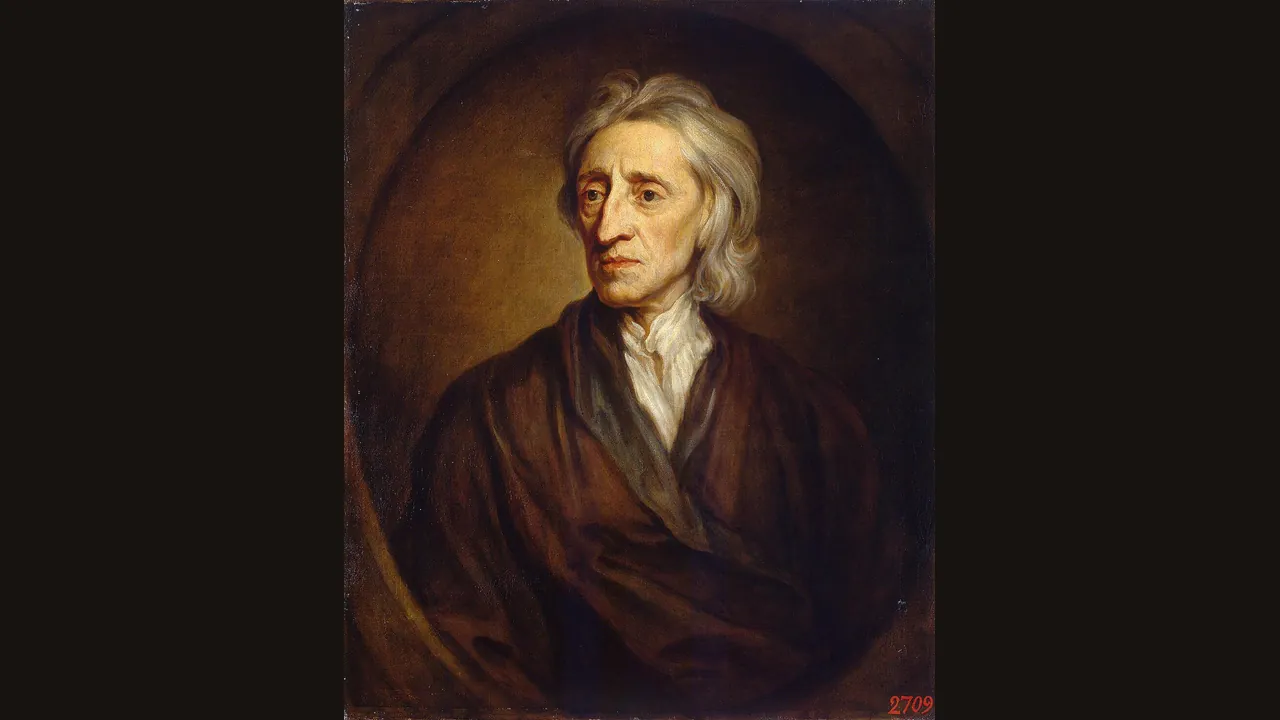
English thinker whose Essay Concerning Human Understanding made him the founder of British empiricism, and whose Two Treatises justified the Glorious Revolution of 1688. He taught that the mind begins as a blank slate. He lived 1632 to 1704.
John Locke was born in Wrington, Somerset, in 1632. His father, a country lawyer, fought for Parliament in the civil war, and Locke grew up in a Puritan household of the parliamentary party. He was educated at Westminster School and at Christ Church, Oxford, where the scholastic curriculum bored him and he turned to medicine and experimental philosophy. He worked with the chemist Robert Boyle and the physician Thomas Sydenham, and medicine trained him to trust observation. In 1667 he entered the household of Anthony Ashley Cooper, later Earl of Shaftesbury, as physician and secretary, a connection that placed him near the center of English politics and shaped everything he wrote.
When Shaftesbury fell from power, Locke's position became dangerous. He left England for the Netherlands in 1683, the year of the Rye House Plot against Charles II, and the English government sought his extradition as a suspected traitor. He lived five years in Holland, in the circle of William of Orange. He returned in February 1689 on the ship that carried Mary to England after the Glorious Revolution, and in that year he published the three works that made his reputation: the Essay Concerning Human Understanding, the Letter Concerning Toleration, and, anonymously, the Two Treatises of Government.
The Essay attacks the doctrine of innate ideas, the claim that certain truths are stamped on the mind before birth. Locke pointed to children and whole peoples who show no knowledge of the supposed universal principles, and concluded that the mind at birth is like white paper, empty of ideas. All the materials of knowledge arrive through experience, in two forms. Sensation brings ideas of the world outside us, and reflection brings ideas of the mind's own operations, perceiving, doubting, willing. From these simple ideas the mind builds everything it knows. He also separated qualities belonging to bodies themselves, such as shape, size, and motion, from qualities such as color and taste, which bodies have only as powers to produce sensations in us. His account of personal identity placed sameness of person in continuity of consciousness and memory rather than in any substance, and critics answered quickly. Joseph Butler and Thomas Reid argued that consciousness of identity already assumes the identity it is supposed to explain, so the account argues in a circle.
The Two Treatises did the political work. The First Treatise refutes Sir Robert Filmer, whose Patriarcha grounded kingship in Adam's fatherhood and the divine right inherited from him. The Second Treatise builds Locke's own account. The state of nature is a condition of freedom and equality under the law of nature, which is reason, teaching that no one ought to harm another in his life, health, liberty, or possessions. A man gains property by mixing his labor with what nature provides, provided he leaves enough and as good for others and lets nothing spoil in his hands; the invention of money lets holdings grow beyond the spoilage limit. Government arises by consent, and legislative power, though supreme, is held in trust for the people's good. When rulers break that trust, invade the rights they exist to protect, and leave no appeal on earth, government dissolves and power returns to the people, who may erect a new one. Peter Laslett's scholarship dates the Treatises to the Exclusion Crisis of 1679 to 1681 rather than to 1689, so the book was no after the fact defense of a finished revolution, but a revolutionary argument written while resistance was still dangerous.
The Letter Concerning Toleration argues that the magistrate has no business with the care of souls, that a church is a voluntary society, and that force cannot produce inward belief. Yet Locke drew limits that his modern admirers must record honestly. He denied toleration to atheists, holding that oaths can have no hold on a man who believes in no God, and to Catholics, whom he treated as owing allegiance to a foreign prince. His toleration, the widest offered in his century, still fell short of toleration as now understood.
The record also holds his involvement in institutions his principles condemn. He held shares in the Royal African Company, which traded in enslaved Africans, and as secretary to the Lords Proprietors of Carolina he helped draft the Fundamental Constitutions, which gave every freeman absolute power over his enslaved laborers. His theory permitted enslavement only as continued war against an aggressor who had forfeited his life, which describes nothing in the Atlantic slave trade; the contradiction stands. The American founders read the Second Treatise closely, and Jefferson's Declaration carries its structure: natural rights held before government, government by consent, and a long train of abuses dissolving the trust. Through Berkeley and Hume his empiricism governed British philosophy for a century. He died in Essex in 1704.
Facts
- Born
- 1632, Wrington, Somerset, England.
- Source: Encyclopaedia Britannica, John Locke
- Died
- 1704, Essex, England.
- Source: Encyclopaedia Britannica, John Locke
- School
- Empiricism.
- Source: Encyclopaedia Britannica, John Locke
- Known for
- Tabula rasa, the mind as blank at birth; natural rights to life, liberty, and property; and the right of revolution.
- Source: Encyclopaedia Britannica, John Locke
Sources
- Encyclopaedia Britannica, John Locke Source
Source links accessed 22 November 2026.
Images
Related
- René DescartesConnected
- David HumeConnected
- George BerkeleyConnected
- Jean-Jacques RousseauConnected
- Thomas HobbesConnected
- MontesquieuConnected
What happened elsewhere
Pairings are by recorded year, not exact simultaneity.
- Baruch SpinozaWhile John Locke (1632)
- MontserratWhile John Locke (1632)
- Louis XIVWhile John Locke (1638)
Meanwhile
Meanwhile, around the world — drag to spin, click a pulsing marker.
Keep reading
Test yourself
When was John Locke born?
- 1632, Wrington, Somerset, England
- 1596, La Haye, France
- 1711, Edinburgh, Scotland
- 1646, Leipzig, Germany
Answer
1632, Wrington, Somerset, England — Born: 1632, Wrington, Somerset, England.
When did John Locke die?
- 1704, Essex, England
- 1529, on campaign in the south
- 1778, Ermenonville, France
- 1677, The Hague, of lung disease, at forty four
Answer
1704, Essex, England — Died: 1704, Essex, England.
What is John Locke known for?
- Tabula rasa, the mind as blank at birth; natural rights to life, liberty, and property; and the right of revolution
- The greatest happiness principle, the Panopticon prison design, and the felicific calculus for weighing pleasures and pains
- The Social Contract and the general will, Emile on education, and the Confessions, the first modern autobiography
- Esse est percipi, to be is to be perceived. The tree in the quad stands because God perceives it
Answer
Tabula rasa, the mind as blank at birth; natural rights to life, liberty, and property; and the right of revolution — Known for: Tabula rasa, the mind as blank at birth; natural rights to life, liberty, and property; and the right of revolution.
Which school of thought was John Locke part of?
- Empiricism
- Rationalism
- Neo Confucianism, the school of mind
- Empiricism and skepticism
Answer
Empiricism — School: Empiricism.
True or false: English thinker whose Essay Concerning Human Understanding made him the founder of British empiricism, and whose Two Treatises justified the Glorious Revolution of 1688.
- True
- False
Answer
True — True. English thinker whose Essay Concerning Human Understanding made him the founder of British empiricism, and whose Two Treatises justified the Glorious Revolution of 1688.
My notes
Highlights on this page
None yet.
Spotted an error on this page? Email [email protected] and it will be checked against the sources.