

Philosopher · Early modern period · England
Francis Bacon
1561–1626
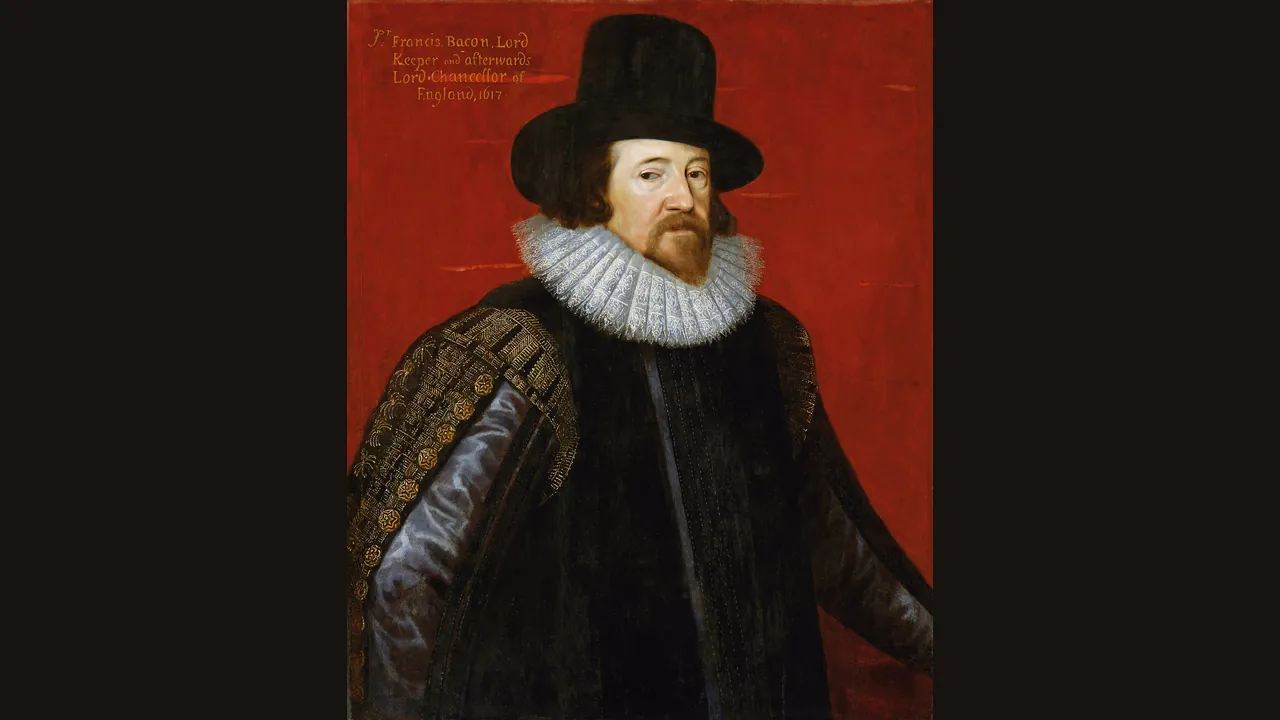
English statesman and writer who rose to Lord Chancellor under James I, then fell on a bribery charge. His Novum Organum called for a new logic of experiment to replace Aristotle's. He lived 1561 to 1626.
Francis Bacon was born in London in 1561 and studied at Cambridge and Gray's Inn. He sat in Parliament, rose through legal office under James I, and became Lord Chancellor in 1618. In 1621 Parliament charged him with taking bribes from parties with cases before him. Bacon confessed to accepting gifts, denied that gifts had swayed his judgments, and was fined and barred from office. He spent his remaining years writing. He died in 1626 after catching a chill at Highgate while testing snow as a preservative for a chicken.
Bacon planned a total renewal of learning, the Great Instauration, and published the Novum Organum in 1620 as its second part. The book attacked the syllogism as a tool of discovery and set out a method of induction instead. The investigator builds tables of cases where a quality is present, cases where it is absent, and cases where it varies, and excludes explanations case by case. Bacon named four classes of error, the idols of the tribe, the cave, the marketplace, and the theatre, standing for faults of human nature, of individual temperament, of language, and of received systems. His other books include The Advancement of Learning, the Essays, and the unfinished New Atlantis.
Facts
- Born
- 1561, London, England.
- Source: Encyclopaedia Britannica, Francis Bacon
- Died
- 1626, London, of a chill caught stuffing a chicken with snow in an experiment.
- Source: Encyclopaedia Britannica, Francis Bacon
- School
- Empiricism, at its programmatic beginning.
- Source: Encyclopaedia Britannica, Francis Bacon
- Known for
- The idols of the mind, the biases that corrupt thinking, and the method of induction from experiment.
- Source: Encyclopaedia Britannica, Francis Bacon
Sources
- Encyclopaedia Britannica, Francis Bacon Source
Source links accessed 22 November 2026.
Images
Related
- AristotleConnected
- Abbas ISame era
- Tokugawa IeyasuSame era
- AkbarSame era
- Thomas HobbesSame era
- Michel de MontaigneSame era
What happened elsewhere
Pairings are by recorded year, not exact simultaneity.
Meanwhile
Meanwhile, around the world — drag to spin, click a pulsing marker.
Keep reading
Test yourself
When was Francis Bacon born?
- 1561, London, England
- 1472, Yuyao, Zhejiang, China
- 1533, near Bordeaux, France
- 1596, La Haye, France
Answer
1561, London, England — Born: 1561, London, England.
When did Francis Bacon die?
- 1626, London, of a chill caught stuffing a chicken with snow in an experiment
- 1592, at his estate near Bordeaux
- 1790, Edinburgh
- 1778, Ermenonville, France
Answer
1626, London, of a chill caught stuffing a chicken with snow in an experiment — Died: 1626, London, of a chill caught stuffing a chicken with snow in an experiment.
What is Francis Bacon known for?
- The idols of the mind, the biases that corrupt thinking, and the method of induction from experiment
- The problem of induction, the attack on miracles, and the Dialogues Concerning Natural Religion, published after his death
- Monads, the pre established harmony, the principle of sufficient reason, and the calculus priority dispute with Newton
- The Spirit of the Laws: liberty requires the separation of legislative, executive, and judicial power; laws fit climates and customs
Answer
The idols of the mind, the biases that corrupt thinking, and the method of induction from experiment — Known for: The idols of the mind, the biases that corrupt thinking, and the method of induction from experiment.
Which school of thought was Francis Bacon part of?
- Empiricism, at its programmatic beginning
- Scottish Enlightenment; classical economics
- Empiricism and skepticism
- Enlightenment, its sharpest pen
Answer
Empiricism, at its programmatic beginning — School: Empiricism, at its programmatic beginning.
True or false: English statesman and writer who rose to Lord Chancellor under James I, then fell on a bribery charge.
- True
- False
Answer
True — True. English statesman and writer who rose to Lord Chancellor under James I, then fell on a bribery charge.
My notes
Highlights on this page
None yet.
Spotted an error on this page? Email [email protected] and it will be checked against the sources.