

Philosopher · Early modern period · France
Michel de Montaigne
1533–1592
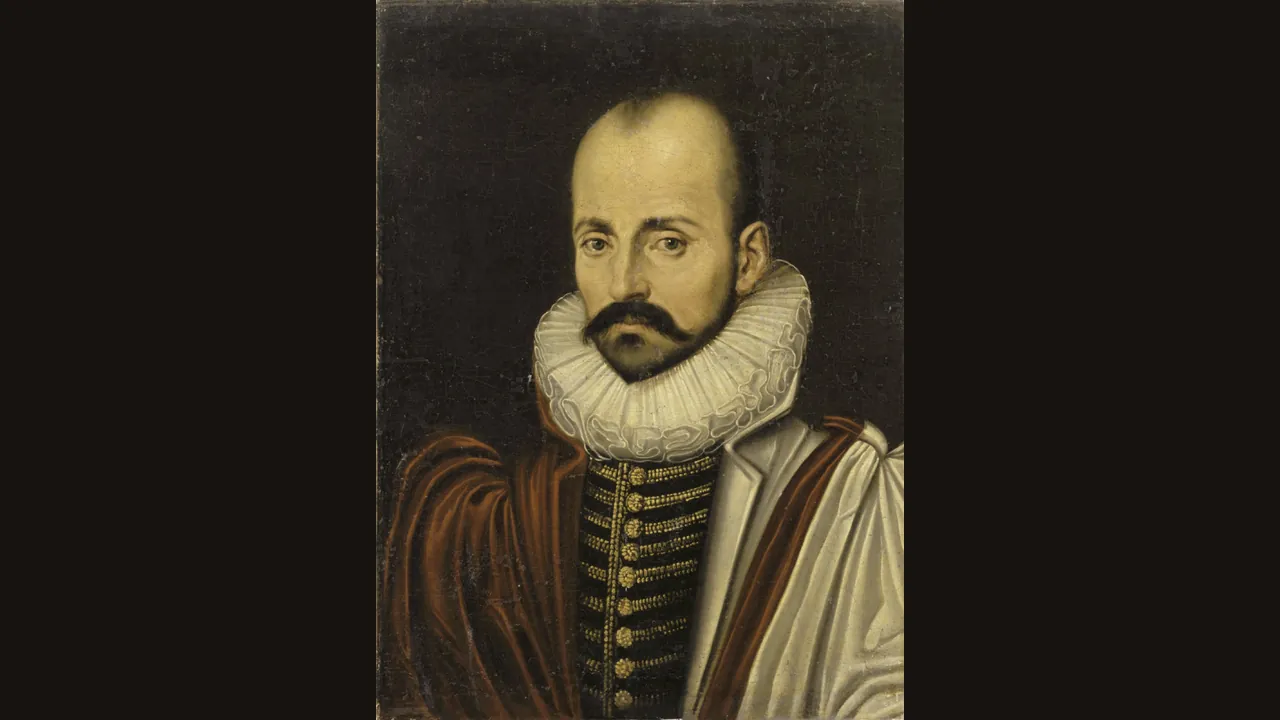
French nobleman who retired to his tower to write the Essays, inventing the essay as a form and asking on his seal, what do I know. His skepticism, learned from Sextus Empiricus, shaped Descartes. He lived 1533 to 1592.
Michel de Montaigne was born in 1533 at the family estate near Bordeaux. His father had him taught Latin as a small child by a tutor who spoke nothing else to him, and Latin became his first language. Montaigne studied law, sat as a counsellor in the Parlement of Bordeaux from 1557, and retired from public office in 1571 to a tower on his estate. He served two terms as mayor of Bordeaux between 1581 and 1585 and travelled in Italy. He died at his estate in 1592.
Montaigne published the first two books of his Essays in 1580 and a third book in 1588, and he kept revising the text for the rest of his life. He took the self as his subject and announced that he himself was the matter of his book. His motto, Que sais je, what do I know, stated his skepticism, drawn from the Pyrrhonist arguments of Sextus Empiricus. Custom, he argued, governs most belief: each people calls barbarism whatever is not its own practice, a point he pressed in his essay on the cannibals of Brazil. The Essays treat friendship, education, experience, solitude, and death, and they return constantly to the weakness and inconsistency of human judgment.
Facts
- Born
- 1533, near Bordeaux, France.
- Source: Encyclopaedia Britannica, Montaigne
- Died
- 1592, at his estate near Bordeaux.
- Source: Encyclopaedia Britannica, Montaigne
- School
- Renaissance skepticism.
- Source: Encyclopaedia Britannica, Montaigne
- Known for
- The Essays, three books of self examination published from 1580, and the motto Que sais je, what do I know.
- Source: Encyclopaedia Britannica, Montaigne
Sources
- Encyclopaedia Britannica, Montaigne Source
Source links accessed 22 November 2026.
Images
Related
- Sextus EmpiricusConnected
- René DescartesConnected
- FranceConnected
- Elizabeth ISame era
- Philip IISame era
- Mughal EmpireSame era
What happened elsewhere
Pairings are by recorded year, not exact simultaneity.
- Elizabeth IWhile Michel de Montaigne (1533)
- Philip IIWhile Michel de Montaigne (1527)
- Mughal EmpireWhile Michel de Montaigne (1526)
- AkbarWhile Michel de Montaigne (1542)
- Tokugawa IeyasuWhile Michel de Montaigne (1543)
Meanwhile
Meanwhile, around the world — drag to spin, click a pulsing marker.
Keep reading
Test yourself
When was Michel de Montaigne born?
- 1533, near Bordeaux, France
- 1596, La Haye, France
- 1748, London, England
- 1472, Yuyao, Zhejiang, China
Answer
1533, near Bordeaux, France — Born: 1533, near Bordeaux, France.
When did Michel de Montaigne die?
- 1592, at his estate near Bordeaux
- 1716, Hanover, Germany
- 1755, Paris
- 1704, Essex, England
Answer
1592, at his estate near Bordeaux — Died: 1592, at his estate near Bordeaux.
What is Michel de Montaigne known for?
- The Essays, three books of self examination published from 1580, and the motto Que sais je, what do I know
- The problem of induction, the attack on miracles, and the Dialogues Concerning Natural Religion, published after his death
- The Ethics: one substance, God or Nature, of which minds and bodies are modes; freedom as understanding necessity
- The Wealth of Nations, the invisible hand, and the pin factory example of the division of labor
Answer
The Essays, three books of self examination published from 1580, and the motto Que sais je, what do I know — Known for: The Essays, three books of self examination published from 1580, and the motto Que sais je, what do I know.
Which school of thought was Michel de Montaigne part of?
- Renaissance skepticism
- Enlightenment, against its grain
- Neo Confucianism, the school of mind
- Rationalism
Answer
Renaissance skepticism — School: Renaissance skepticism.
True or false: French nobleman who retired to his tower to write the Essays, inventing the essay as a form and asking on his seal, what do I know.
- True
- False
Answer
True — True. French nobleman who retired to his tower to write the Essays, inventing the essay as a form and asking on his seal, what do I know.
My notes
Highlights on this page
None yet.
Spotted an error on this page? Email [email protected] and it will be checked against the sources.