

Ruler · Early modern period · England
Elizabeth I
1533–1603
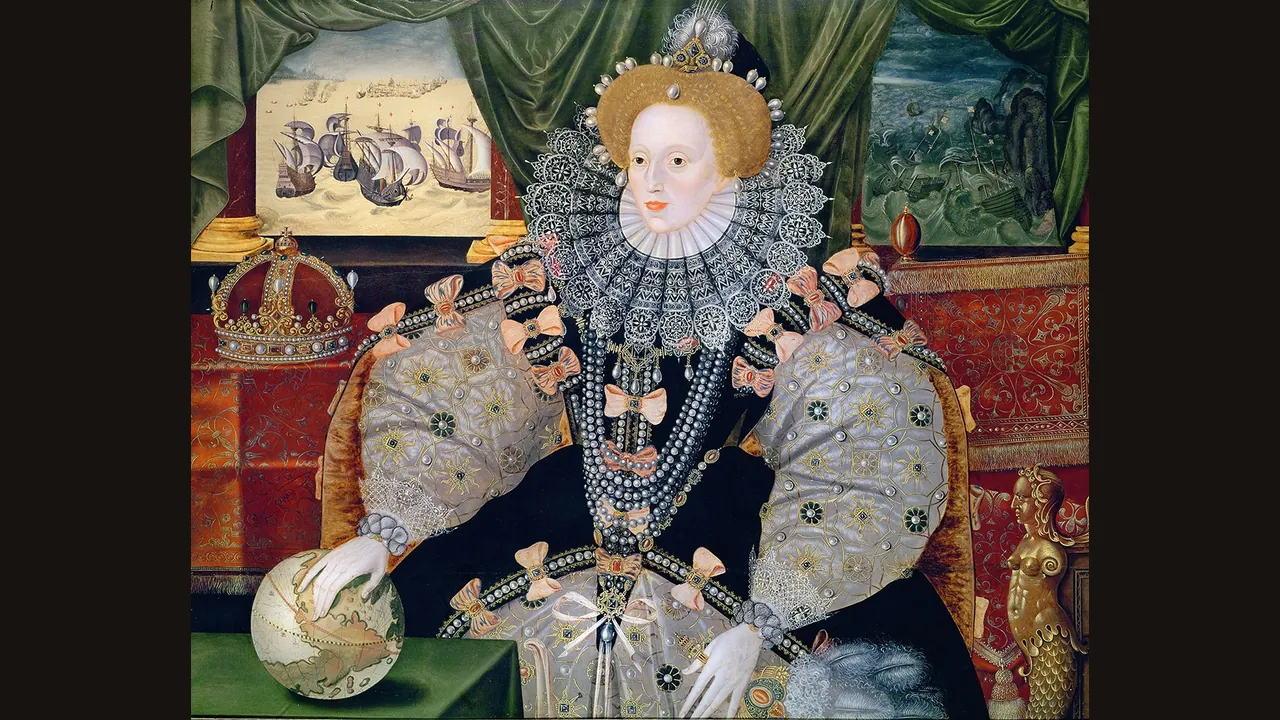
Queen of England from 1558 to 1603, born in 1533, daughter of Henry VIII and Anne Boleyn. Her forty four year reign saw the defeat of the Spanish Armada in 1588, the flowering of English drama with Shakespeare, and England's first steps toward overseas empire. She never married and named no heir.
Elizabeth became queen in 1558 on the death of her half sister Mary I. The settlement of 1559, in the Acts of Supremacy and Uniformity, made the Church of England Protestant in doctrine, with Elizabeth as supreme governor. In 1570 Pope Pius V excommunicated her and released her Catholic subjects from obedience. Laws against recusancy, refusal to attend the established church, grew harsher, and Catholic priests sent on mission were treated as traitors. About 130 priests, and laypeople who sheltered them, were executed.
Mary, Queen of Scots, fled to England in 1568 and was held prisoner for nineteen years while plots formed around her. After the Babington plot of 1586 she was tried and executed in February 1587. War with Spain opened in 1585, when Elizabeth sent troops to the Netherlands. In 1588 Philip II sent the Armada to carry an invasion army across the Channel. English ships harried it up the Channel, fireships scattered it at Gravelines, and storms wrecked much of the fleet on the way home.
In the 1590s rebellion in Ireland under Hugh O'Neill drew in men and money until it was starved into submission in 1603. Elizabeth chartered the East India Company in 1600, and the Poor Law of 1601 fixed parish responsibility for the poor. She died on March 24, 1603, never having named an heir. James VI of Scotland succeeded her.
Facts
- Born
- 1533, Greenwich.
- Source: Encyclopaedia Britannica, Elizabeth I
- Died
- 1603, Richmond.
- Source: Encyclopaedia Britannica, Elizabeth I
- Reign
- 1558 to 1603.
- Source: Encyclopaedia Britannica, Elizabeth I
- Realm
- England.
- Source: Encyclopaedia Britannica, Elizabeth I
- Known for
- The Spanish Armada (1588) and the Elizabethan religious settlement.
- Source: Encyclopaedia Britannica, Elizabeth I
Sources
- Encyclopaedia Britannica, Elizabeth I Source
Source links accessed 22 November 2026.
Images
Related
- Michel de MontaigneSame era
- Philip IISame era
- Mughal EmpireSame era
- AkbarSame era
- Tokugawa IeyasuSame era
- Francis BaconSame era
What happened elsewhere
Pairings are by recorded year, not exact simultaneity.
- Michel de MontaigneWhile Elizabeth I (1533)
- Philip IIWhile Elizabeth I (1527)
- Mughal EmpireWhile Elizabeth I (1526)
- AkbarWhile Elizabeth I (1542)
- Tokugawa IeyasuWhile Elizabeth I (1543)
Meanwhile
Meanwhile, around the world — drag to spin, click a pulsing marker.
Keep reading
Test yourself
When was Elizabeth I born?
- 1533, Greenwich
- 1491, Greenwich
- 1638, Saint Germain en Laye
- 1527, Valladolid
Answer
1533, Greenwich — Born: 1533, Greenwich.
When did Elizabeth I die?
- 1603, Richmond
- 1786, Potsdam
- 1520, Tenochtitlan
- 1715, Versailles
Answer
1603, Richmond — Died: 1603, Richmond.
When did Elizabeth I reign?
- 1558 to 1603
- 1502 to 1520
- 1661 to 1722
- King of Spain 1516 to 1556; emperor 1519 to 1556
Answer
1558 to 1603 — Reign: 1558 to 1603.
What realm did Elizabeth I rule?
- England
- Prussia
- Russia
- The Mughal Empire across northern and central India
Answer
England — Realm: England.
True or false: Queen of England from 1558 to 1603, born in 1533, daughter of Henry VIII and Anne Boleyn.
- True
- False
Answer
True — True. Queen of England from 1558 to 1603, born in 1533, daughter of Henry VIII and Anne Boleyn.
My notes
Highlights on this page
None yet.
Myth vs. evidence
The myth
Elizabeth's speech at Tilbury survives in her exact words, heart and stomach of a king and all.
The evidence
Elizabeth did address the troops at Tilbury in 1588 as the Armada approached. The celebrated wording survives in a letter written by Leonel Sharp decades after the event, and other reports of the speech give different words. The speech is real; the famous text is a later reconstruction.
Sources: Leonel Sharp, letter on the Tilbury speech; Susan Frye, The Myth of Elizabeth at Tilbury
Spotted an error on this page? Email [email protected] and it will be checked against the sources.