

Philosopher · Early modern period · Scotland
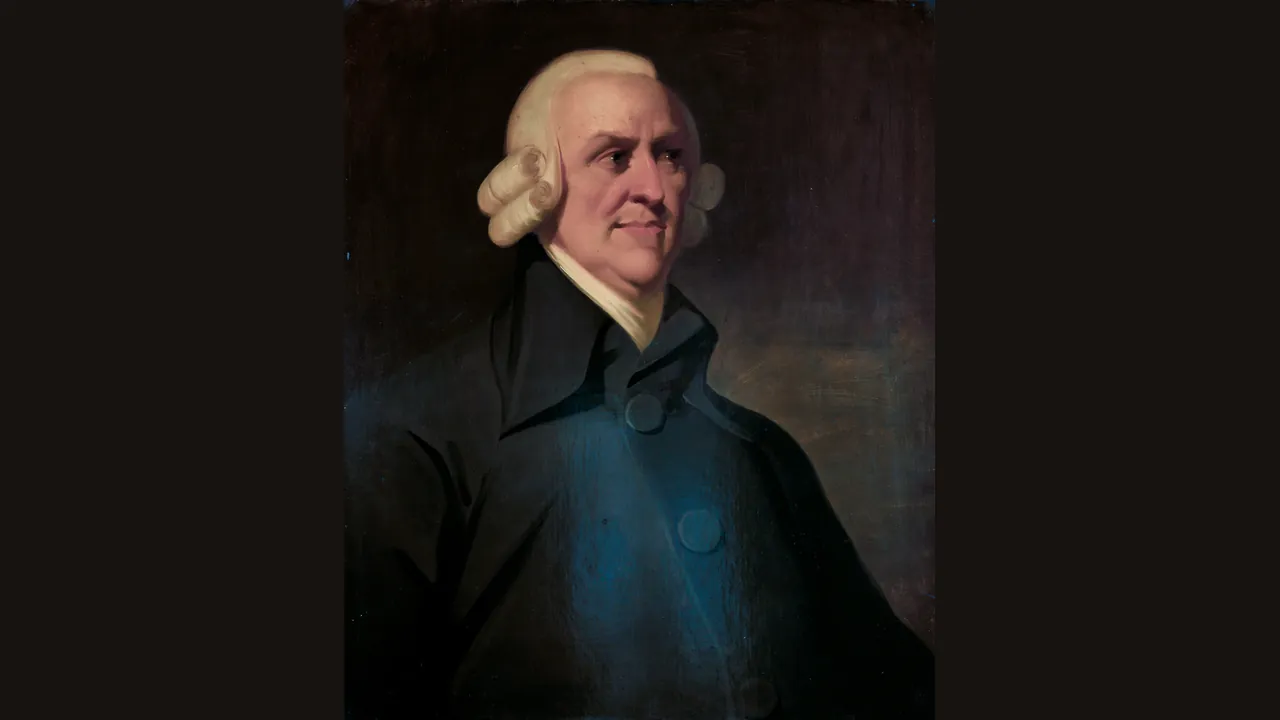
Adam Smith
1723–1790
Scottish moral philosopher whose Theory of Moral Sentiments grounded ethics in sympathy, and whose Wealth of Nations of 1776 founded modern economics on the division of labor and free markets. He lived 1723 to 1790 and taught at Glasgow.
Adam Smith was born at Kirkcaldy in Scotland in 1723 and studied at Glasgow and Balliol College, Oxford. He became professor at Glasgow in 1751, first of logic and then of moral philosophy. From 1764 to 1766 he travelled in France as tutor to the young Duke of Buccleuch, and the pension from that post supported his writing afterward. He spent ten years on his economics book and later served as a commissioner of customs in Edinburgh. He died there in 1790 and ordered his manuscripts burned.
The Theory of Moral Sentiments of 1759 grounded morality in sympathy, the human capacity to imagine oneself in another person's situation. A man judges his own conduct, Smith held, by imagining how an impartial spectator would judge it, and conscience is that spectator carried within. The Wealth of Nations of 1776 opened with the division of labor, illustrated by a pin factory, where splitting the work among separate tasks multiplied the output many times over. He argued that men serve the public in markets by pursuing their own interest, as with the butcher, the brewer, and the baker, from whom we expect dinner not from benevolence but from regard to their own interest. The book attacked the mercantile system of monopolies, bounties, and trade restrictions, and it used the phrase invisible hand for the unintended public result of private dealings.
Watch
Roots and Branches of the Radical Left
Events · 2026-10-15
Socialism is presented as an economic theory. In reality, woven through every part of the theory are two things that must be adopted before socialism can "work properly": a pseudo-history of mankind, and a massive shift of worldview. Both rest on a fundamental lie about human nature: they blame man's conditions for what belongs to the man himself.
That ideology did not appear from nowhere. It grew out of long-standing ideas, taken up across a chain of events and twisted over time into a promise of a better way for human beings to live, which is why the whole runs far deeper and is far more complex than the economic label suggests. Along the way it was woven in and out of great thinkers, at different points and for different reasons. Some were used for it and some against it, and through all of it the idea kept building.
This map lays that out where it can be seen: the evolution of the ideas, the effects they had, and the chain of cause and effect that followed from thinker to thinker.
Facts
- Born
- 1723, Kirkcaldy, Scotland.
- Source: Encyclopaedia Britannica, Adam Smith
- Died
- 1790, Edinburgh.
- Source: Encyclopaedia Britannica, Adam Smith
- School
- Scottish Enlightenment; classical economics.
- Source: Encyclopaedia Britannica, Adam Smith
- Known for
- The Wealth of Nations, the invisible hand, and the pin factory example of the division of labor.
- Source: Encyclopaedia Britannica, Adam Smith
Sources
- Encyclopaedia Britannica, Adam Smith Source
Source links accessed 22 November 2026.
Images
Related
- David HumeConnected
- Friedrich August von HayekConnected
- Jeremy BenthamConnected
- Immanuel KantSame era
- Catherine the GreatSame era
- Jean-Jacques RousseauSame era
What happened elsewhere
Pairings are by recorded year, not exact simultaneity.
- Immanuel KantWhile Adam Smith (1724)
- GreenlandWhile Adam Smith (1721)
- Catherine the GreatWhile Adam Smith (1729)
Meanwhile
Meanwhile, around the world — drag to spin, click a pulsing marker.
Keep reading
Test yourself
When was Adam Smith born?
- 1723, Kirkcaldy, Scotland
- 1694, Paris, France, as François Marie Arouet
- 1712, Geneva, in what is now Switzerland
- 1632, Wrington, Somerset, England
Answer
1723, Kirkcaldy, Scotland — Born: 1723, Kirkcaldy, Scotland.
When did Adam Smith die?
- 1790, Edinburgh
- 1776, Edinburgh
- 1753, Oxford, England
- 1755, Paris
Answer
1790, Edinburgh — Died: 1790, Edinburgh.
What is Adam Smith known for?
- The Wealth of Nations, the invisible hand, and the pin factory example of the division of labor
- Tabula rasa, the mind as blank at birth; natural rights to life, liberty, and property; and the right of revolution
- The idols of the mind, the biases that corrupt thinking, and the method of induction from experiment
- The Spirit of the Laws: liberty requires the separation of legislative, executive, and judicial power; laws fit climates and customs
Answer
The Wealth of Nations, the invisible hand, and the pin factory example of the division of labor — Known for: The Wealth of Nations, the invisible hand, and the pin factory example of the division of labor.
Which school of thought was Adam Smith part of?
- Scottish Enlightenment; classical economics
- Materialism and contract theory
- Empiricism, turned into immaterialism
- Enlightenment, against its grain
Answer
Scottish Enlightenment; classical economics — School: Scottish Enlightenment; classical economics.
True or false: Scottish moral philosopher whose Theory of Moral Sentiments grounded ethics in sympathy, and whose Wealth of Nations of 1776 founded modern economics on the division of labor and free markets.
- True
- False
Answer
True — True. Scottish moral philosopher whose Theory of Moral Sentiments grounded ethics in sympathy, and whose Wealth of Nations of 1776 founded modern economics on the division of labor and free markets.
Articles

My notes
Highlights on this page
None yet.
Spotted an error on this page? Email [email protected] and it will be checked against the sources.