
Ruler · Early modern period · Russia
Catherine the Great
1729–1796
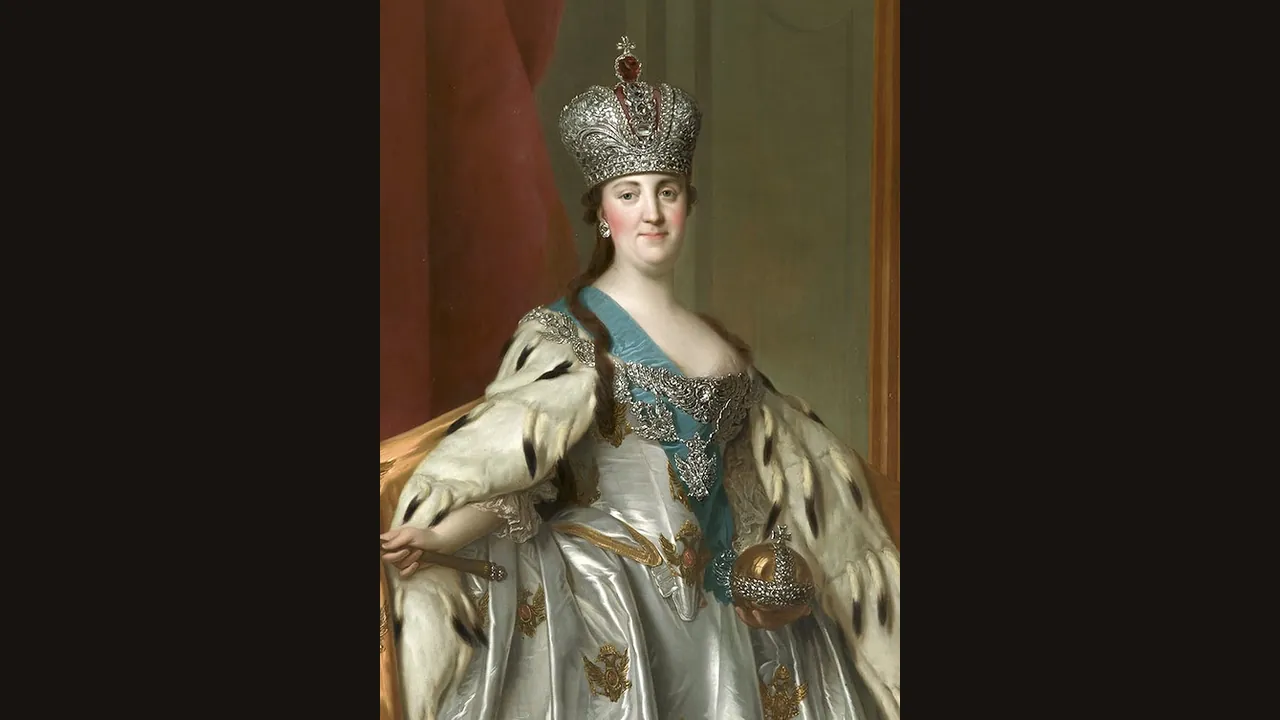
Empress of Russia from 1762 to 1796, born Sophie of Anhalt Zerbst in 1729, a German princess who seized the Russian throne from her husband. She extended Russia to the Black Sea, annexed Crimea in 1783, and joined the partitions of Poland. A correspondent of Voltaire, she patronized the arts while ruling as an autocrat.
Catherine, born Sophie of Anhalt Zerbst, a German princess, came to Russia to marry the heir to the throne and did so in 1745. Her husband became emperor as Peter III in January 1762. In June that year officers of the Guards, led by the Orlov brothers, deposed him, and Catherine was proclaimed empress. Peter died in custody days after his abdication, in circumstances the court did not explain.
Her Legislative Commission of 1767, summoned to write a new code under her Instruction, produced no code and was dissolved. War with the Ottoman Empire from 1768 to 1774 won Russia the northern Black Sea coast, and a second war, ending in 1792, pushed the frontier to the Dniester. She annexed the Crimea in 1783. The Pugachev revolt, a rising of Cossacks and serfs that swept the Volga and Ural regions from 1773 to 1775, was put down by the army, and Pugachev was executed in Moscow. The Charter to the Nobility of 1785 secured noble property and privilege, and in 1783 she bound the peasants of Ukraine to the soil.
With Prussia and Austria she carried out the three partitions of Poland, in 1772, 1793, and 1795, which erased Poland from the map. Catherine bought paintings for the Hermitage and corresponded with Voltaire and Diderot. She died in November 1796 after a stroke, and her son Paul succeeded her.
Facts
- Born
- 1729, Stettin.
- Source: Encyclopaedia Britannica, Catherine the Great
- Died
- 1796, Saint Petersburg.
- Source: Encyclopaedia Britannica, Catherine the Great
- Reign
- 1762 to 1796.
- Source: Encyclopaedia Britannica, Catherine the Great
- Realm
- The Russian Empire.
- Source: Encyclopaedia Britannica, Catherine the Great
- Known for
- The annexation of Crimea (1783), the partitions of Poland, and Enlightenment patronage.
- Source: Encyclopaedia Britannica, Catherine the Great
Sources
- Encyclopaedia Britannica, Catherine the Great Source
Source links accessed 22 November 2026.
Images
Related
- RussiaConnected
- Immanuel KantSame era
- Adam SmithSame era
- Jean-Jacques RousseauSame era
- Frederick the GreatSame era
- David HumeSame era
What happened elsewhere
Pairings are by recorded year, not exact simultaneity.
- Immanuel KantWhile Catherine the Great (1724)
- Adam SmithWhile Catherine the Great (1723)
- GreenlandWhile Catherine the Great (1721)
Meanwhile
Meanwhile, around the world — drag to spin, click a pulsing marker.
Keep reading
Test yourself
When was Catherine the Great born?
- 1729, Stettin
- 1712, Berlin
- 1543, Okazaki
- 1672, Moscow
Answer
1729, Stettin — Born: 1729, Stettin.
When did Catherine the Great die?
- 1796, Saint Petersburg
- 1603, Richmond
- 1558, Yuste, Spain
- 1520, Tenochtitlan
Answer
1796, Saint Petersburg — Died: 1796, Saint Petersburg.
When did Catherine the Great reign?
- 1762 to 1796
- Shogun 1603 to 1605; effective ruler to 1616
- 1740 to 1786
- 1611 to 1632
Answer
1762 to 1796 — Reign: 1762 to 1796.
What realm did Catherine the Great rule?
- The Russian Empire
- The Aztec Empire of central Mexico
- Prussia
- The Mughal Empire across northern and central India
Answer
The Russian Empire — Realm: The Russian Empire.
True or false: Empress of Russia from 1762 to 1796, born Sophie of Anhalt Zerbst in 1729, a German princess who seized the Russian throne from her husband.
- True
- False
Answer
True — True. Empress of Russia from 1762 to 1796, born Sophie of Anhalt Zerbst in 1729, a German princess who seized the Russian throne from her husband.
My notes
Highlights on this page
None yet.
Spotted an error on this page? Email [email protected] and it will be checked against the sources.